








Introduction:Colombia is a globally renowned Arabica coffee origin, and its rigorous grading system and diverse regional terroirs contribute to a rich array of coffee flavors. This article delves into the screen size grading standards for Colombian green beans, including the differences among export grades such as UGQ, EP, Supremo, and Excelso, while also focusing on the geographic conditions and washed processing characteristics of the Huila region. Through practical pour over parameters and flavor profiles, it guides you through the brewing essentials and taste features of this classic Central and South American bean.
Thanks to the terrain of the Andes Mountains and its varied climate, Colombia has become an important global producer of high-quality Arabica coffee. The country has extensive coffee-growing areas with significant elevation changes, creating diverse microclimates that provide an ideal environment for coffee trees. Among the many factors influencing coffee quality, the grading system is a key criterion for assessing green bean grade and quality, as well as a crucial standard in the export market.
The success of Colombia’s coffee industry is inseparable from the efforts of the Federación Nacional de Cafeteros (National Federation of Coffee Growers of Colombia), abbreviated as FNC. Since its establishment in 1927, the FNC has been committed to promoting varietal improvement, cultivation techniques, harvesting standards, and green bean quality control, ensuring that every stage of coffee—from origin to international market—meets high standards. In addition, the FNC has established a comprehensive green bean traceability system, allowing each batch of coffee to be traced back to its specific region and farmer.

The grading of Colombian green beans is primarily based on bean size, screened using fixed sieves. The higher the sieve number, the larger the coffee beans that pass through. Common grades include UGQ, EP, and Supremo. It is worth noting that regardless of screen size grade, all Colombian green beans intended for export are uniformly classified as Excelso, which is currently the standard classification for Colombian green bean exports.
Looking in detail, Excelso UGQ 12*60 (1.5%) refers to beans that pass through a 12-mesh sieve but are no larger than 14 mesh, with over 50% of the beans exceeding 15 mesh, and only 1.5% of beans allowed between 12 and 14 mesh. Excelso EP 12*60 (10%) requires beans to be at least 15 mesh, allowing up to 10% of beans smaller than 15 mesh but not less than 14 mesh. Excelso Supremo 12*60 (5%) requires most beans to exceed 17 mesh, with only 5% allowed below this standard, but not less than 14 mesh. Additionally, the market also sees higher-specifications such as Extra (above 16 mesh), Premium (above 18 mesh), and even Minama (with nearly uniform particle size) for premium markets or specific buyer needs.
Colombia’s coffee-growing regions are mainly concentrated along the Andes Mountains, which consist of three major mountain ranges and feature fertile, organic-rich soils. Coffee trees are generally planted at elevations between 800 and 2300 meters, enjoying ample sunlight as well as moderate shading from cloud cover. The elevation-induced diurnal temperature variation helps coffee cherries ripen slowly, accumulating richer flavor compounds. Due to the diverse geography, Colombia has almost year-round coffee harvest periods, with maturity times of different regions and varieties staggered, enabling a continuous production cycle.
In terms of varieties, in addition to traditional high-quality cultivars such as Caturra, Bourbon, and Typica, Colombia also cultivates disease-resistant national varieties such as Castillo, Tabi, and “Colombia.” Some advanced farms have also introduced internationally renowned varieties such as Geisha, further enhancing the region’s flavor potential and market competitiveness.
Washed processing is the mainstream method in Colombia, thanks to the area’s abundant water resources. Many small farms use homemade green bean processing equipment, such as Ecomill or Eco-Pulper, which can remove the pulp while using minimal water to eliminate most of the mucilage. Afterward, the parchment beans undergo about one night of fermentation to soften residual mucilage, followed by thorough rinsing with clean water. Finally, the beans are evenly spread under the sun to dry until they reach the desired moisture content. This process not only effectively reduces defect rates but also preserves the coffee’s clean flavor and high cup clarity.
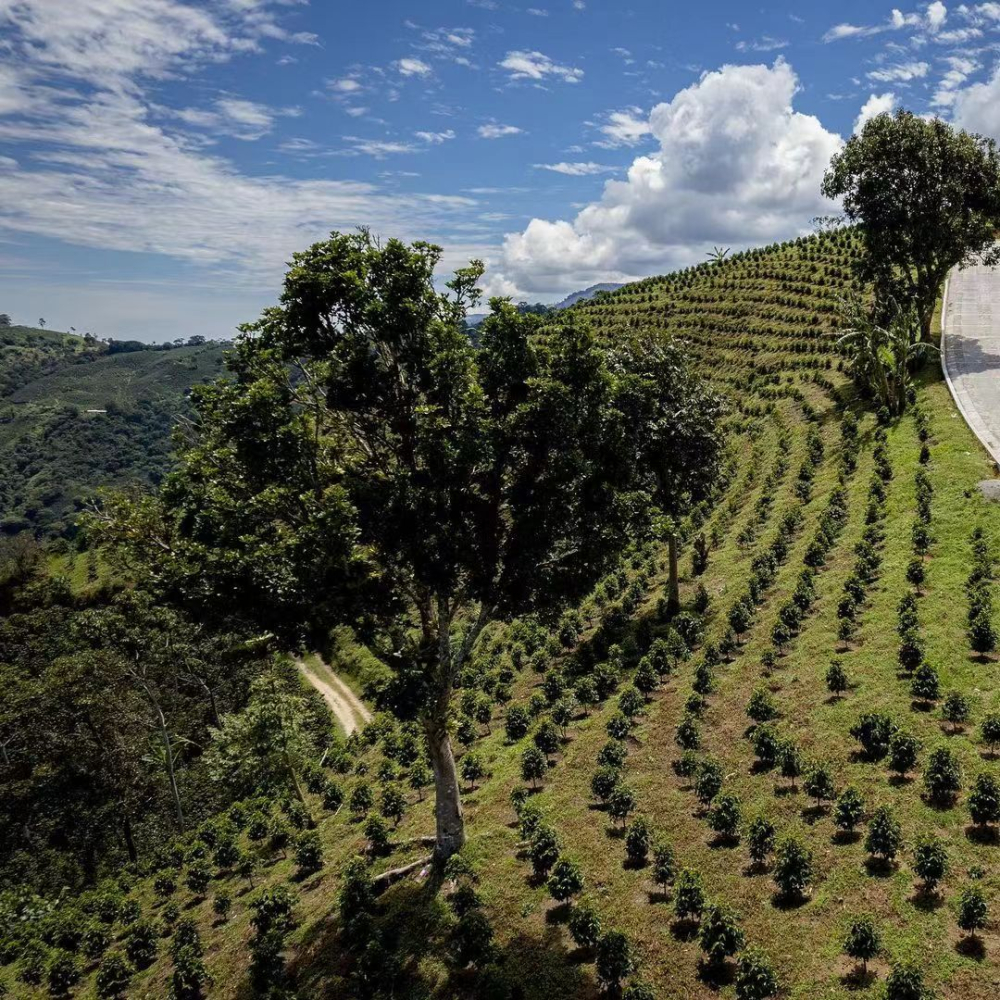
Huila is a prominent specialty coffee region in southern Colombia, accounting for approximately 12% of the country’s total production. The terrain here is mostly hilly, with elevations generally above 1500 meters, and the climate and water conditions are highly suitable for coffee cultivation. Compared to the often bold flavors found in other parts of Colombia, the Huila region is known for its diverse microclimates and unique processing methods. Many coffees come from micro-lots produced by smallholder farmers, resulting in distinctive and unique flavor profiles.
The washed Huila coffee introduced in this article is grown at high altitudes of 1500–1800 meters, using the Caturra variety and washed processing, presenting a classic medium-to-dark roast flavor profile. Its flavor highlights include notes of nuts, dark chocolate, and caramel, with a soft acidity and an overall full-bodied yet layered mouthfeel, making it suitable for coffee enthusiasts who enjoy Central and South American styles.
For brewing recommendations, since this Huila everyday coffee is a medium-to-dark roast with flavor notes leaning toward rich nuts and chocolate, it is recommended to use a medium-coarse grind (e.g., 75% passing rate through a standard 20-mesh sieve), with a water temperature of 90°C. Brew using a KONO filter in a three-stage pour over method, with a suggested powder-to-water ratio of 1:15, using about 15 grams of coffee. The specific steps are as follows: first, perform a 30-second bloom with a small amount of hot water (about twice the weight of the coffee grounds). Then, pour water steadily in small streams in a circular motion from the inside out until reaching 125 grams for the first pour. Once the coffee bed descends to the middle of the filter, continue pouring to 225 grams to complete the extraction, with a total brew time of about 2 minutes. These parameters help balance intense flavors with a clean taste and avoid bitterness caused by over-extraction.
The brewed Huila coffee delivers an immediate impression of distinct chocolate and nut aromas, accompanied by a soft caramel sweetness. The overall mouthfeel is smooth and clean. As the temperature slightly cools, gentle layers of fruit acidity gradually emerge, adding a lively finish to the overall flavor profile.
The above content is compiled by CoffeeHunters, a coffee news website.


