








Introduction:In recent years, Ethiopia has introduced several coffee varieties named with numerical codes, such as 74158, 74110, etc. These varieties have garnered widespread attention in the market due to their excellent disease resistance, high yield, and captivating flavors. This article will explore the origins and breeding background of these numbered varieties, and take an in-depth look at two popular 74158 beans — ALO and Hamashu — highlighting their regional characteristics and flavor profiles, and uncovering their unique charm in cupping.
On the global stage of specialty coffee in recent years, several Ethiopian coffee varieties identified by numerical codes—such as 74158, 74110, and 74112—have gradually become hot topics. These seemingly cold numbers not only frequently appear on the podiums of international green bean competitions but are also increasingly chosen as main cultivation varieties by professional growers and brands. But what stories lie behind these “codes”? How have they managed to achieve a win-win in disease resistance, yield, and flavor performance? This article will start from the origins of these numbered varieties and take you behind the scenes to see how they’ve become the shining stars of today’s market.

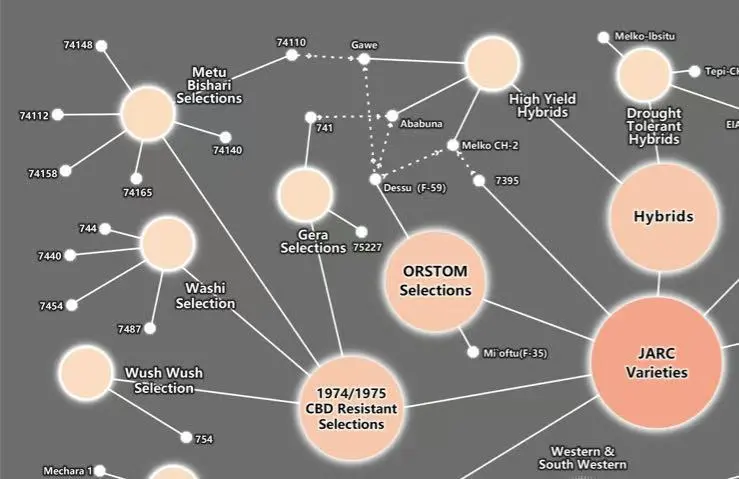
In fact, these numerically named varieties are “disease-resistant, high-quality cultivars” developed by Ethiopia’s official research institutions in response to the threat of severe diseases. Their names come from a combination of the year of collection and sample number. For example, “74” in “74158” indicates that it was collected in 1974, while the last three digits are the code for that particular strain. Similarly, varieties beginning with “75” were collected in 1975. These varieties were all researched by the Jimma Agricultural Research Center (JARC) starting in 1973, when coffee leaf rust and other diseases ravaged the region, drastically reducing yields in many coffee farms and prompting the government and research bodies to actively seek alternative varieties with both disease resistance and superior flavor.

After two years of field surveys and laboratory screenings, the research team selected 13 of the most promising strains from over 600 samples, including the now widely recognized 74110 and 74158. These varieties not only demonstrated a high level of disease resistance but also performed exceptionally well in cultivation—they generally have shorter plant stature and compact canopies, which make them easier to manage and also result in relatively high yields per unit area. More surprisingly, these numbered varieties did not fall short in flavor complexity either, and have even consistently topped various Ethiopian green bean evaluations. In particular, 74158 has often secured top spots on competition lists with its small, round bean appearance and richly diverse cup profiles.
Thanks to the combination of these three major advantages—disease resistance, high yield, and extraordinary flavor—this series of numerically coded varieties quickly gained favor among local farmers and international buyers. Among them, 74158 has become the preferred choice for many specialty coffee brands due to its stable and layered aromatic profile. Among the various 74158-producing regions and processing mills, two beans in particular stand out: the “Ethiopia · ALO 74158” and “Ethiopia · Hamashu 74158” featured in a certain coffee brand’s lineup.
Let’s first take a look at the “Ethiopia · ALO 74158” from a certain brand. This bean is produced by Ethiopia’s local Alo Coffee PLC, and originates from the Bensa region in the Sidamo area. Known for its high altitude and rich biodiversity, Bensa is an ideal place for cultivating premium coffee. ALO uses the natural (sun-dried) processing method, with an altitude of about 2180 to 2280 meters, classifying it as G1 grade high-quality beans. In cupping, this bean exhibits a rich tropical fruit profile, featuring classic citrus and berry aromas along with distinct notes of pineapple and mango. It also presents elegant magnolia and passionfruit undertones. The overall aroma is layered and complex, with a prominent sweetness—making it a favorite among many pour over enthusiasts, whether beginners or more experienced drinkers.

Next is another bean that also uses the 74158 variety—the “Ethiopia · Hamashu 74158.” This bean also comes from the Bensa region, but is produced and processed by the local Hamashu washing station. The altitude is slightly lower, ranging from about 1920 to 2020 meters, and it also employs the natural processing method. Though originating from the same 74158 variety as ALO, Hamashu shows a different personality in flavor—it delivers a fresher, lighter fruitiness, such as the sweet aromas of strawberry, guava, and green grapes, paired with the bright acidity of sweet orange. This is complemented by a honey-like smooth texture and subtle floral notes. The overall mouthfeel is round and smooth, with clear layers—making it suitable for those who prefer brighter acidity and fruity flavor profiles.
In summary, these numerically coded Ethiopian coffee varieties are not just products of scientific research, but also practical choices that combine local terroir, disease resistance needs, and market preferences. Especially 74158, with its stable yield and versatile, captivating flavors, is gradually carving out a niche in the global specialty coffee market. Whether you’re a beginner in pour over or a coffee enthusiast seeking unique flavor expressions, you can discover a different coffee experience from these numbered varieties.
The above content is compiled by CoffeeHunters, a coffee news website.


