







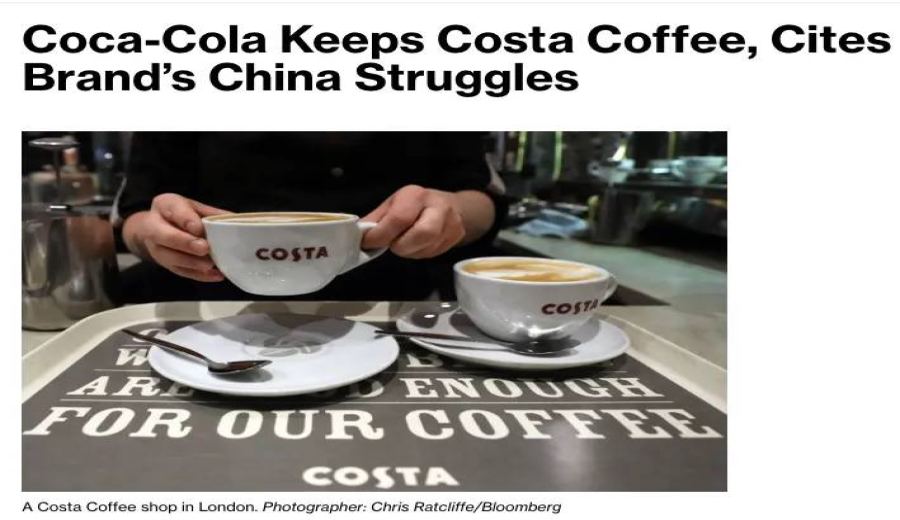
Introduction:The world’s leading beverage giant Coca-Cola has announced it will retain full ownership of the UK coffee brand Costa, but has initiated an independent assessment specifically for the Chinese market. Faced with continuously declining store numbers and fierce competition, this decision has drawn industry attention to the brand’s future direction. This article provides an in-depth analysis of Coca-Cola’s strategic considerations, breaks down the actual performance of Costa’s three major business segments in China, and reveals key factors behind the store contraction trend through market data.
Coca-Cola recently made it clear that it will continue to hold 100% equity in the UK coffee chain Costa, but its financial executives revealed that a dedicated assessment is underway for the Chinese market. This move has focused observers on a core question: as the number of Costa stores in mainland China continues to decline year by year and the brand faces pressure from both domestic and international competitors, will the beverage giant adjust its global layout strategy?
According to the latest news, Coca-Cola’s Chief Financial Officer emphasized in an interview that there are currently no plans for immediate action regarding Costa, but the company hopes to drive overall brand performance improvement. He pointed out that while Costa maintains stable development in key Western European markets such as the UK and Ireland, the actual performance of its business in China is “more challenging than expected.” This regionally differentiated evaluation logic reflects multinational companies’ flexible approach to different market environments.
Notably, this is not the first time Coca-Cola has adjusted its strategy for Costa. As early as the beginning of this year, British media reported that the group had suspended the nearly six-month-long auction process for Costa’s business, abandoning the plan to quickly recoup funds by selling non-core assets at low prices. Now, choosing to retain 100% equity while separately examining the performance of the Chinese market demonstrates its prudent judgment on the brand’s long-term value.
From market feedback, the challenges Costa faces in mainland China are quite evident.According to industry monitoring data, as of mid-January this year, the total number of Costa stores in mainland China was approximately 321, a decrease of about 15% compared to the same period last year.This contraction trend has persisted for several years, reflecting the growth bottlenecks the brand is encountering in a rapidly changing consumer environment. Professional analysts point out that compared to major competitors such as Starbucks, Costa is at a disadvantage in both store scale and expansion speed, and the cost of acquiring new customers continues to rise.
Faced with this situation, industry insiders are generally concerned about whether Coca-Cola will follow Starbucks’ example by selling its Chinese business or restructuring capital to optimize resource allocation. However, current signs indicate that while this possibility exists, it is not inevitable. The key variable lies in the divergent performance of Costa’s three major business segments in the Chinese market: the physical store network is under pressure, but the fast-moving consumer product lines such as ready-to-drink coffee and packaged coffee beans maintain relatively stable sales performance, while self-service coffee machines and quick coffee selection services fall somewhere in between.
Particularly noteworthy is that Coca-Cola had previously identified the ready-to-drink product line as a key retention focus when evaluating Costa’s business. According to informed sources, there is currently no information indicating that the Chinese ready-to-drink business has been included in this special assessment. This means that although the store business is under pressure, packaged coffee products may continue to serve as an important pillar of the brand in the Chinese market. This product mix strategy aligns with the recent global trend of increasing consumer demand for convenient coffee solutions.
Regarding potential strategic adjustment directions, market observers have proposed various possibilities. Given the limited scale of Costa’s stores in mainland China and the diminishing marginal benefits of new store openings, large chain competitors may be less inclined to take over. Instead, companies with cross-industry resource integration capabilities might show interest in acquiring the Chinese business alone. But analysts also bluntly state,compared to leading brands like Starbucks, the appeal of Costa’s standalone sale of its Chinese store assets is indeed relatively limited.。
From a strategic perspective, Coca-Cola’s independent assessment of the Chinese market is essentially a dynamic optimization process of its global investment portfolio. By distinguishing performance differences across regional markets, the company can allocate resources more precisely, concentrate efforts on strengthening its advantageous areas, and prudently handle business units facing challenges. This refined management mindset is key to how multinational companies maintain competitiveness in complex market environments.
The above content is compiled by CoffeeHunters, a coffee news website.


