







Introduction:Luckin Coffee announced that starting from February 1, 2025, it will terminate its "Unlimited All-Day 9.9 RMB" promotion and shift to a partial special-offer zone model. This pricing war strategy, which began in 2023, once drove the overall market price down to as low as 3.9 RMB. This article provides an in-depth analysis of the market signals behind Luckin’s adjustment, exploring the ripple effects this shift in pricing strategy may have on consumer choices, brand competition, and the franchise model.
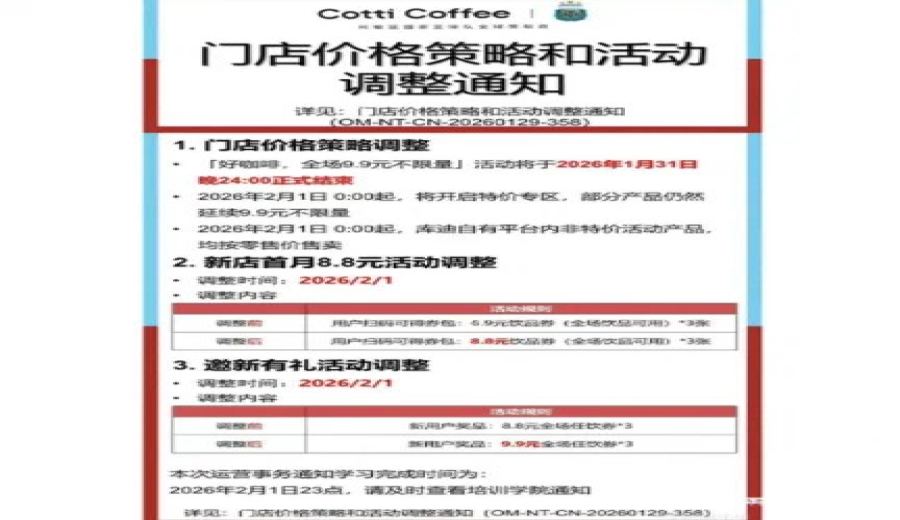
Recently, a notice regarding Luckin Coffee’s adjustment of store pricing strategy has sparked heated discussion in the industry. It is understood that Luckin will officially end its nearly two-year "Unlimited All-Day 9.9 RMB" promotion at midnight on January 31, 2025, transitioning to a special-offer zone operating model starting February 1. After the adjustment, only certain designated products will maintain the 9.9 RMB price, while the rest will return to normal retail price ranges.
The focus of this strategic shift is that Luckin will no longer offer a uniform 9.9 RMB price across the board, but will instead adopt a differentiated pricing strategy. Under the new system, specific drinks within the special-offer zone will still be available at the preferential price of 9.9 RMB, but products outside the zone will be sold at their original prices. Meanwhile, the discount incentives for new store openings in the first month and the referral reward mechanism will also be adjusted accordingly, reflecting further optimization of the brand’s operational strategy.
Looking back at market development, Luckin was the pioneer that launched the 9.9 RMB price war in February 2023. This move immediately prompted other brands, including Luckin’s major rival Ruixing, to follow suit, leading to an ongoing industry-wide price competition that continues to this day. Notably, Luckin’s management had previously stated publicly on multiple occasions that it would adhere to this pricing strategy for at least three years, with plans to extend it until the end of 2026, and had promised corresponding price subsidy support for its franchisees.
The two-year-long 9.9 RMB price war has profoundly influenced consumer behavior patterns, with many people having developed the habit of consuming affordable coffee daily. During this period, market competition intensified further, and last year’s外卖 platform battle even pushed the price of individual items down to historic lows of 3.9 RMB or even 4.9 RMB, greatly altering the public’s perception of coffee value.
Market reactions to this pricing strategy adjustment have been polarized. Some consumers have expressed discomfort with the sudden price increase, worrying about losing access to cost-effective options; meanwhile, some observers question whether Luckin, if it loses its price advantage, might face customer attrition to competitors such as Guming and Xingyun Ka, which still offer products under 9.9 RMB. Notably, Wallace’s launch of a "9.9 RMB Enjoy 210 Cups Coffee Monthly Card" has driven the per-cup cost down to an astonishing 5 fen.
In response to market rumors, both Luckin’s official channels and franchisee networks have confirmed that the price adjustment is indeed taking place. A Luckin spokesperson further explained that although the unlimited 9.9 RMB promotion is ending, some star products will retain this preferential price, and through subsidies on delivery platforms, the actual final price for certain combinations may still be below the 9.9 RMB threshold.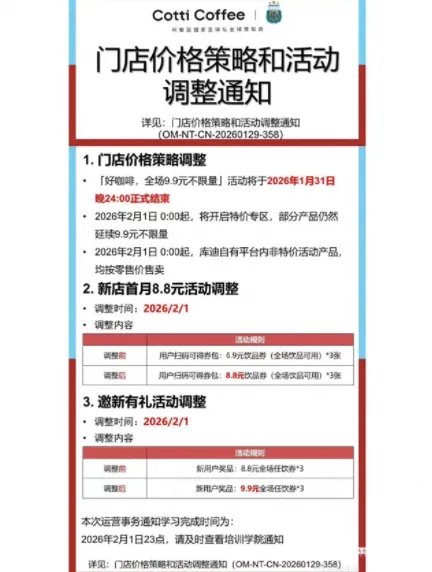
Industry experts point out that this move may mark a new phase in China’s coffee market, shifting from pure price competition to a more comprehensive contest of quality and service. For franchisees, the pricing strategy adjustment will directly impact average order value and profit margins, necessitating a reassessment of operational models and cost structures. For consumers, it means re-evaluating their own coffee consumption habits and budget allocations.
Overall, Luckin’s strategic shift is not just a business decision by a single brand, but could also serve as a significant indicator for observing the broader trends in the coffee industry’s development. After two years of market baptism through the price war, participants are now at a crossroads of transformation, and the future direction is worth continued attention.
The above content is compiled by CoffeeHunters, a coffee news website.


