







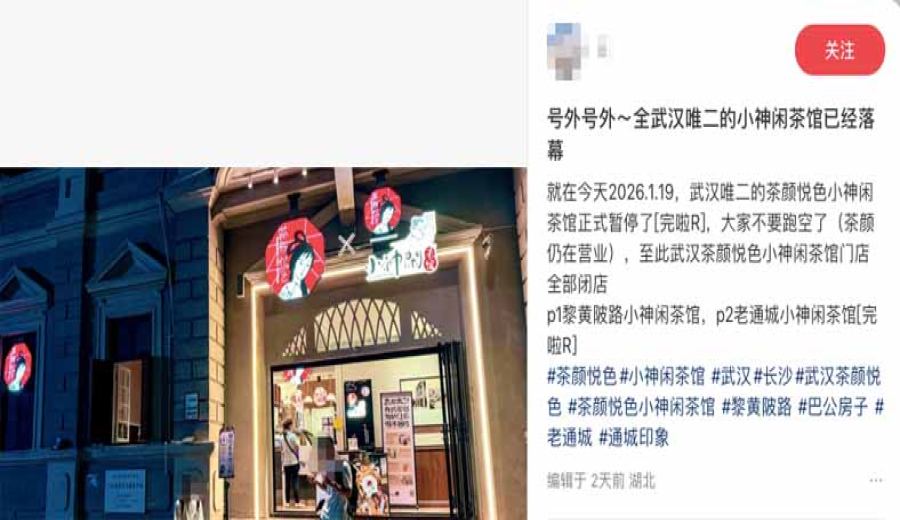
Introduction:Xiao Shenxian Teahouse, a sub-brand under Cha Yan Yue Se that focuses on traditional Chinese slow tea culture, has recently withdrawn from the Wuhan market entirely. Its two stores officially closed on January 19. From its high-profile entry to its quiet exit, the brand’s development in the local market reflects the challenges faced by traditional Chinese slow teahouses in adapting to modern consumer habits. This article delves into its operational bottlenecks and explores the direction for adaptation and adjustment of the slow teahouse model in the market.
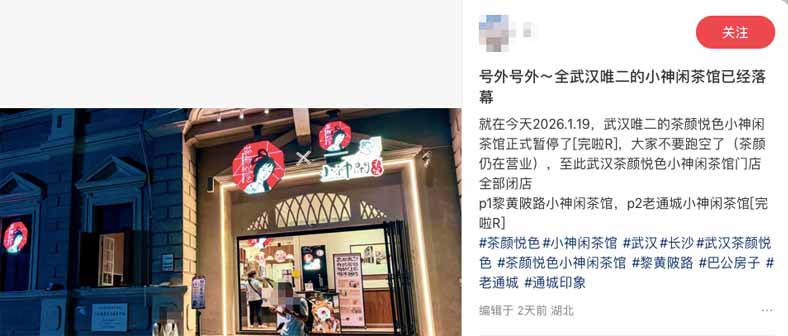
Xiao Shenxian Teahouse, a sub-brand of Cha Yan Yue Se positioned as a traditional Chinese slow teahouse, has come to an end in the Wuhan market. The brand’s two stores, located on Li Huangpi Road and near Lao Tongcheng, both ceased operations on January 19, marking its official withdrawal from Wuhan.
Looking back to 2023, Cha Yan Yue Se introduced Xiao Shenxian Teahouse to Wuhan with great fanfare. At that time, it planned to open four new stores within a year, demonstrating strong confidence in the market. The first batch included flagship locations on Li Huangpi Road, near Lao Tongcheng, and the first store at Vientiane City, which initially attracted many visitors eager for photo opportunities—especially on weekends and holidays, when the storefronts were often crowded with tourists taking pictures.
However, there was a significant gap between expectations and reality. Aside from those three stores, none of the other planned branches opened as scheduled. By June 2024, the flagship store at Vientiane City closed due to consistently low foot traffic, officially citing “normal store optimization” as the reason, sparking speculation about the brand’s strategic adjustments.
Now, with the permanent closure of the Li Huangpi Road and Lao Tongcheng stores on the same date, Xiao Shenxian Teahouse has officially withdrawn from Wuhan entirely. Many local fans expressed surprise and disappointment, especially since these stores were located in popular cultural and tourism areas, seemingly bustling with visitors even on regular days.
But according to nearby residents, the stores’ revenue mainly relied on tourists. During regular weekday business hours, foot traffic dropped significantly, making overall operations difficult and likely resulting in long-term losses. To avoid further losses, the brand’s decision to close the stores in a timely manner was a reasonable response to market conditions.
It is worth noting that Xiao Shenxian Teahouse’s business model emphasizes pour over tea paired with delicate desserts, aiming to create a space where customers can slow down and immerse themselves in the atmosphere of traditional Chinese tea culture. However, most current tea beverage consumers prefer “fast and convenient” services, favoring grab-and-go options—a stark contrast to the slow-paced experience promoted by Xiao Shenxian Teahouse.
Not only in Wuhan, but Xiao Shenxian Teahouse also faces challenges in its home base of Changsha. Entering 2025, the number of its stores in Changsha has gradually decreased from a peak of 10 to just three remaining outlets—those located in the city’s core commercial districts with stable customer flow. This adjustment further indicates that the slow teahouse model’s adaptability in the current tea beverage market still remains to be seen.
The industry generally believes that Xiao Shenxian Teahouse’s contraction and adjustments reflect the brand’s keen response to market demand. Striking a balance between operational costs and consumer preferences is a challenge every brand must face. For entrepreneurs looking to venture into the traditional Chinese slow teahouse business, how to adjust product structures, optimize customer service processes, and accurately grasp the consumption habits of target customer groups are all practical details worth deeper consideration.
Overall, while Xiao Shenxian Teahouse’s withdrawal is regrettable, it also provides valuable market validation for the industry. In the future, if traditional Chinese slow teahouses are to gain a firm foothold in the highly competitive tea beverage market, they will inevitably need to make more adjustments and efforts in their business models, product innovation, and customer experience.
The above content is compiled by CoffeeHunters, a coffee news website.


