








Introduction:At a coffee festival in Jiangmen, Guangdong, one booth offered coffee beans as payment for Japanese translation services, sparking widespread discussion. Some commented that it was unprofessional, while others joked they might consider it if the beans were good enough. This article delves into the full story behind the incident, explores common misconceptions about compensating labor with physical goods, and supplements practical details on recruiting volunteers for events.
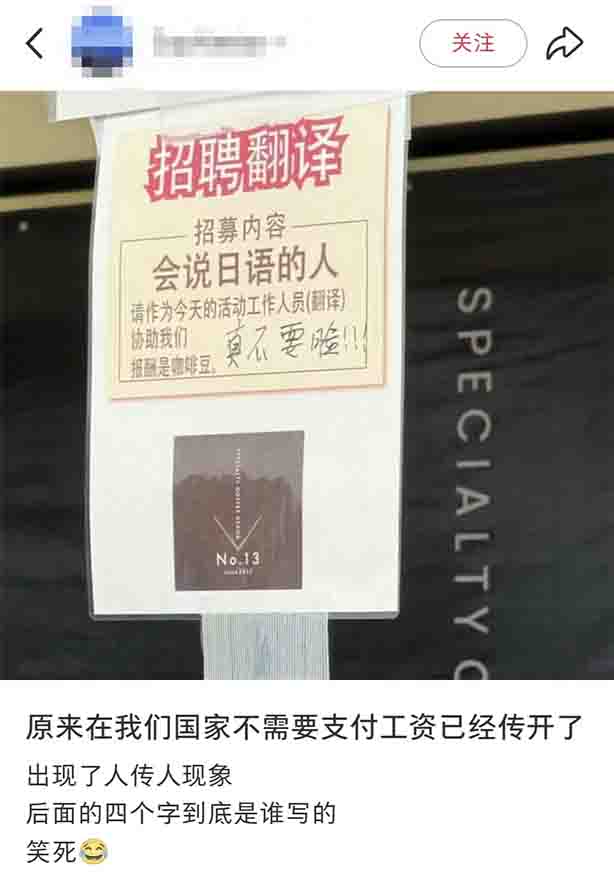
At the coffee festival held in Jiangmen, Guangdong, a booth selling coffee beans displayed a notice recruiting a Japanese translator. Surprisingly, the vendor offered coffee beans as compensation. After a passerby photographed and shared the notice online, it quickly went viral.
From the on-site photos, it can be seen that someone had boldly written the words “How shameless” in black pen in the blank space of the recruitment notice, making it particularly eye-catching. This message immediately drew numerous reactions from netizens on social media platforms.
Many netizens familiar with the translation industry pointed out that depending on the language, content, and duration of the work, professional translators usually have a standard rate. Taking common exhibition interpreting as an example, daily rates typically range from several hundred to over a thousand yuan; for simultaneous interpretation, the pay is even higher. Therefore, many believe that if the vendor genuinely wanted to hire a professional translator to assist with customer communication, offering only coffee beans as compensation clearly did not meet market standards.
There were also plenty of sarcastic comments online, such as: “Why not just pay in Happy Beans?” “Are they pure gold coffee beans?” “One word for one bean — is that fair?” These remarks highlighted public skepticism and humorous reactions to this form of compensation.
However, some netizens took a more open-minded stance, jokingly saying: “If there are enough coffee beans and they’re of good quality, I’d consider it even if it’s 10 tons.” “Give me a jin of Panamanian Geisha, and I’ll find you two translators right now.” This shows that if the in-kind compensation has certain value, many are actually not opposed to this kind of exchange.
On the other hand, some netizens speculated based on the content of the notice that the vendor may have originally just wanted to recruit a Japanese-speaking volunteer to help with communication during the event and intended to offer coffee beans as a thank-you gift afterward. Such practices are not uncommon in temporary events, and some vendors do indeed offer coffee beans or brand merchandise as tokens of appreciation.
However, some observers noted that if the original intention was to recruit volunteers, the notice should not have used more commercial terms like “recruitment” or “compensation,” which could lead to misunderstandings or controversy. In this case, the use of the word “compensation” might have led outsiders to assume it was a formal employment arrangement.
According to the person who posted the photo, they took it while visiting the coffee festival, found the content interesting, and decided to share it. They were unsure whether the vendor actually found a suitable translator through the notice. Additionally, the poster mentioned that the booth owner who put up the notice seemed not to understand Chinese, and from what they observed, the vendor laughed upon seeing the comments and didn’t seem to realize their negative connotation. The vendor even displayed the notice openly without trying to cover up the comments.
Besides sparking discussions about forms of compensation for services, this incident also serves as a reminder to event organizers and vendors to clearly communicate intentions and compensation details when recruiting volunteers or professionals, so as to avoid unnecessary misunderstandings. For language professionals wishing to participate in events, understanding their own rights and market rates is also a key step in avoiding misleading recruitment offers.
The above content is compiled by CoffeeHunters, a coffee news website.


