








Introduction:In recent years, Starbucks has adjusted its staffing structure in first- and second-tier cities by reducing the recruitment of full-time baristas and shifting towards hiring a large number of part-time employees from society and students. Some store managers even have to oversee 2 to 3 stores simultaneously. This transformation is closely related to the brand’s digital upgrade and cost control efforts. What kind of shift in human resource strategy does this reflect? And what impact will it have on service quality and employee stability? This article delves into the reasons behind the adjustments and their potential consequences.
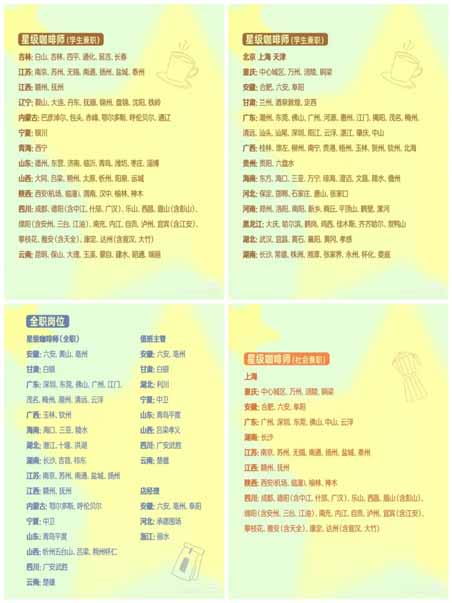
Starbucks has undergone a significant shift in its human resource strategy in China in recent years, especially in first- and second-tier cities, where the brand has gradually reduced the recruitment of full-time baristas and instead filled staffing gaps with a large number of part-time workers from society and students. Looking at the job postings on its official recruitment platform “Join Starbucks,” on January 14 alone, there were vacancies in 269 regions, with student part-time positions accounting for as much as 61.7%, social part-time positions at 17.8%, and full-time positions making up only 20.4%.
A further analysis of the platform’s year-round recruitment data shows that although full-time positions are available across 343 cities, their frequency is notably lower in first-tier cities such as Beijing, Shanghai, Guangzhou, and Shenzhen. For instance, Shenzhen had only 4 postings, Shanghai just 2, while the majority of full-time demand is concentrated in third-tier and lower-tier cities. This clear regional disparity indicates that the brand is gradually adjusting the focus of its workforce allocation.
It is worth noting that despite the reduction in full-time positions in first- and second-tier cities, Starbucks’ actual pace of store expansion has not slowed down. Stores such as Shanghai Xujiahui Center, Beijing Zhongguancun Dorint Hotel Mall, and Shenzhen Huaidewanxianghui have all opened successively in 2025. From this, it can be inferred that the brand’s overall demand for store staff is actually continuing to rise, but the workforce structure is shifting towards part-time employment.
According to frontline staff, some stores have already suspended the recruitment of full-time employees and prefer to hire part-time workers instead. Such adjustments are more common in higher-tier cities, while newly expanded areas or third-tier cities still maintain a certain proportion of full-time positions. As of now, Starbucks China has not officially commented on this trend, so it remains unclear whether it represents a long-term, systematic strategic shift.

In addition to the reduction in full-time positions, there have also been changes in internal staffing at Starbucks. Some staff members have noted that certain full-time store managers now have to oversee the operational management of 2 to 3 stores simultaneously. This approach can be traced back to the “Sailing Project” launched in early 2025, when the brand attempted to integrate some stores into multi-store communities managed by a single manager.
Considering the varying customer traffic and operational characteristics of different business districts, this model was initially only tested in selected stores. However, with the comprehensive upgrade of the brand’s digital systems, the multi-store community management model has gradually been integrated into all operational systems, making the “one manager for multiple stores” approach smoother and more widespread.
In the past, Starbucks in the Chinese market has always been regarded as an employer benchmark in the industry, not only offering bonus schemes but also actively supporting employees returning to their hometowns for employment and even providing insurance for employees’ parents, attracting numerous job seekers. However, according to Starbucks’ global financial reports, labor costs have always been a major burden on store operations, with employee salaries and benefits accounting for nearly 58% of total store expenses and about 26.5% of global net revenue.
It can be seen, therefore, that by increasing the proportion of part-time workers and implementing a multi-store management system for store managers, the brand can effectively reduce fixed labor costs and improve resource utilization efficiency, which provides tangible help in alleviating overall operational pressures. However, this strategy has also drawn market attention, with observers noting that over-reliance on gig workers may affect service consistency and product quality control in stores, as well as potentially weakening employees’ sense of career stability and loyalty.
With Boyu Capital set to complete the acquisition of a 60% stake in Starbucks China, it remains to be seen whether the brand will further adjust its operational strategy with a focus on cost control in the future. Striking a balance between pursuing operational efficiency and maintaining service quality will be the key challenge for Starbucks moving forward.
The above content is compiled by CoffeeHunters, a coffee news website.


