







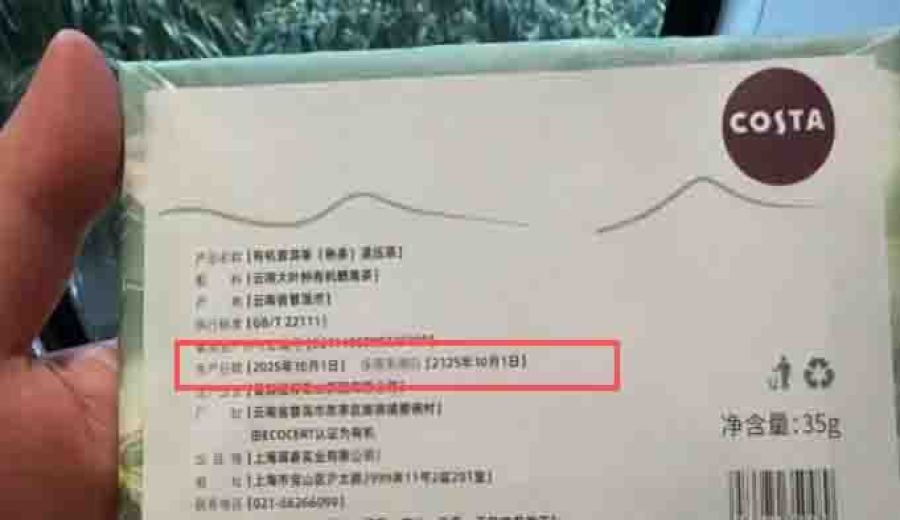
Introduction:Recently, a Pu'er compressed tea product on the market with a labeled shelf life of 100 years has sparked widespread discussion among consumers and industry professionals. Can Pu'er tea truly be stored for a century? Does such labeling have any scientific basis? This article delves into the preservation principles of Pu'er tea, national standard requirements, and the potential risks of long-term storage to help readers correctly understand the preservation and brewing value of Pu'er tea.
A Pu'er compressed tea product on the market has recently stirred controversy due to its packaging claiming a "shelf life of 100 years." It is reported that the production date on this product is labeled as October 1, 2025, with an expiration date of October 1, 2125 — spanning a full century. Such labeling has left many consumers puzzled: is it a packaging design error, or can this Pu'er tea really last a hundred years without deteriorating?
In response to public skepticism, customer service from an e-commerce platform stated that Pu'er tea "gets better with age," and as long as it is stored in a suitable environment — such as away from light and at room temperature — it can be preserved for a long time. However, when asked whether there were any relevant experiments or scientific evidence to support a 100-year shelf life, the customer service merely emphasized that the packaging label should be taken as the standard and did not provide further proof.
It is worth noting that the product is still available for sale on some e-commerce platforms, though the shelf life has been revised to 9,999 days, which is approximately 27 years. Regarding this, some customer service representatives explained that Pu'er tea "ages over time and becomes more fragrant the longer it is stored." But only after persistent questioning by consumers did they admit that "it can generally be stored for 3 to 5 years, depending on the storage environment, though it may last even longer."
In reality, most Pu'er tea products on the market are labeled as "long-term storage" or "suitable for long-term storage under proper storage conditions," with very few indicating a specific expiration date.Industry insiders point out that "suitable for long-term storage" means that under ideal conditions, Pu'er tea can be stored for an extended period. As long as it does not get damp or moldy and maintains stable tea quality, it can continue to be consumed.
Experts indicate that currently, China does not have a unified shelf life limit for Pu'er tea. Different types of tea have different standards based on their characteristics. Although Pu'er tea is generally believed to be capable of aging due to its post-fermentation properties,the notion that "the older, the more fragrant" only applies when the tea is properly stored. Excessively long-term storage may still lead to mold growth or quality deterioration, posing clear food safety risks.
Some experts bluntly state that a "100-year shelf life" is more like a marketing gimmick lacking empirical evidence, and the hidden risks behind it should not be overlooked.Experts warn that if Pu'er tea is not stored properly, the leaves may clump together or even carbonize after several decades, rendering them completely unfit for normal brewing and consumption.
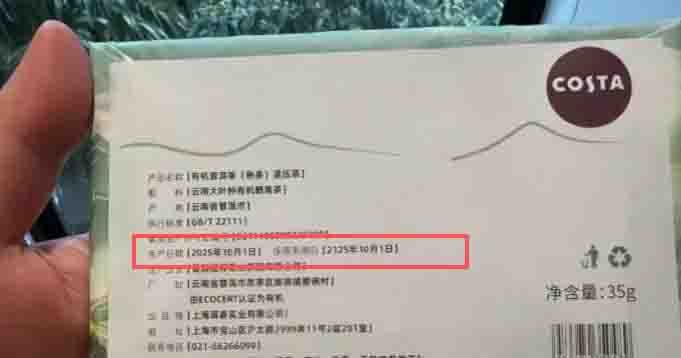
Legal experts also point out that according to China's national standard GB/T 22111—2008 "Geographical Indication Product — Pu'er Tea," Pu'er tea should be labeled as "suitable for long-term storage under the storage conditions specified in this standard," rather than with a specific number of years. Therefore, labeling the shelf life as "100 years" not only deviates from the standard definition but also overlooks the fact that "long-term storage" must be based on "meeting the storage conditions."
Additionally, the food industry generally believes that the so-called "long-term storage" should be premised on scientifically verified food safety and quality stability.A 100-year label far exceeds the consensus on quality controllability shared by the industry and regulatory authorities, raising concerns of excessive promotion.
In summary, Pu'er tea does indeed possess certain aging potential, but this is contingent upon a stable, dry, and well-ventilated storage environment. When purchasing Pu'er tea, consumers should view shelf life labels rationally, pay attention to the storage recommendations on the product packaging, and avoid buying products with potentially high risks due to misplaced trust in exaggerated marketing claims.
The above content is compiled by CoffeeHunters, a coffee news website.


