







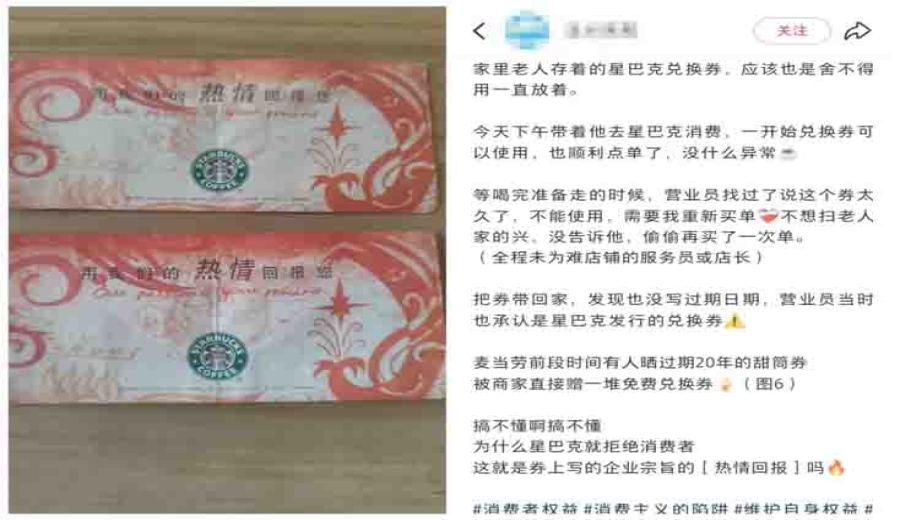
Introduction:A long-time Starbucks customer in Shanghai brought in two paper vouchers for a free medium drink, which they had received 14 years ago, only to have them rejected at the store for being "too old." The incident sparked heated online discussion, with Starbucks customer service adjusting their compensation offer twice before finally allowing the customer to keep the two historically significant paper vouchers. This article details the sequence of events and explores how brands should handle expired redemption coupons.
Recently, a loyal Starbucks customer shared on social media that they took two old free medium drink vouchers, found by an elder family member, to a Shanghai branch, but encountered staff who initially allowed the use of the vouchers at the point of ordering, then demanded payment again upon checkout, citing the vouchers’ "advanced age." The matter quickly went viral online, becoming a focal point of attention regarding consumer-brand interactions.
According to the original poster, the two paper vouchers bore no expiration date and were believed to be from before Starbucks updated its logo in 2011 — making them at least 14 years old and qualifying as "antique-level vouchers." On December 27, the poster accompanied family members to a Starbucks outlet in Shanghai to try redeeming them. Initially, the staff raised no objections, and the order was placed smoothly. However, when the customers were about to leave, they were informed that the vouchers were no longer valid and that they would need to pay again.
After the incident, the individual called Starbucks’ official 400 customer service hotline for an explanation. The customer service representative responded by phone, stating that the paper vouchers had expired and could not be used. They also suggested mailing the vouchers to Starbucks’ Shanghai headquarters for authenticity verification, and offered to replace them with buy-one-get-one-free electronic vouchers as an alternative.
Subsequently, the original poster posted images of the two pink paper vouchers on social media, resonating with many netizens. Numerous veteran customers recalled how Starbucks once attracted consumers by distributing paper membership discount coupons. It is particularly noteworthy that these types of vouchers are believed to have been issued by Taiwan’s Uni-President Enterprises Group, which managed Starbucks operations in the Jiangsu-Zhejiang-Shanghai region at the time, giving them special historical significance.
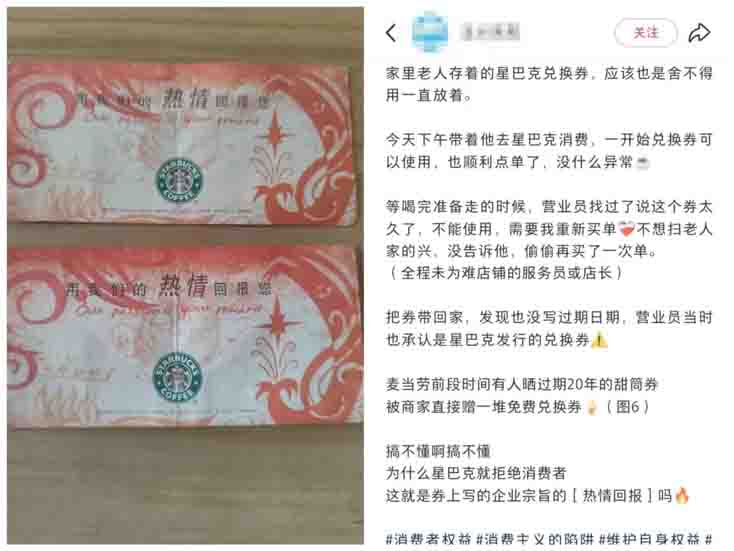
Several former Starbucks employees who had worked in the Jiangsu-Zhejiang-Shanghai area commented that these paper vouchers were referred to as "thank you vouchers," primarily used to show appreciation for customers’ help or support — a way for the brand to express gratitude. In addition to thank you vouchers, apology vouchers were also issued at the time, reflecting the emotional bond between the brand and its customers. However, these employees also mentioned that prior to Starbucks reclaiming operational rights in the Jiangsu-Zhejiang-Shanghai region, stores had publicly announced final usage deadlines for such paper vouchers, after which they would be considered invalid. Therefore, the on-site staff had some grounds for refusing them.
Some netizens also cited examples of how other brands handled similar situations — for instance, McDonald’s and Mixue Ice Cream & Tea had proactively contacted customers holding expired vouchers and gifted them equivalent electronic vouchers as a token of thanks. They felt Starbucks’ handling of this case seemed somewhat "lacking in warmth," missing an opportunity to build deeper emotional connections with long-term customers.
On December 28, the situation progressed further. Starbucks’ Shanghai headquarters first publicly apologized for the actions of the store and customer service, then proposed a compensation plan: offering two free medium electronic vouchers, but requiring the customer to tear up the original paper vouchers and send back photos of them. This proposal was not accepted by the individual involved.
On the same day, Starbucks adjusted the compensation terms again, ultimately deciding not to require the customer to destroy the paper vouchers. Instead, the company would record the voucher numbers internally and invalidate them, allowing the customer to retain the two meaningful paper vouchers as collectibles. Additionally, the amount paid for the day’s purchase was refunded to the customer in the form of electronic vouchers, demonstrating a more flexible approach to resolution.
This incident not only triggered discussions among consumers about how expired redemption coupons should be handled, but also led the public to reconsider the long-accumulated emotional value between brands and their customers. For many loyal customers, these paper vouchers are not just discount certificates — they carry precious memories of the brand’s early interactions with its patrons.
The above content is compiled by CoffeeHunters, a coffee news website.


