







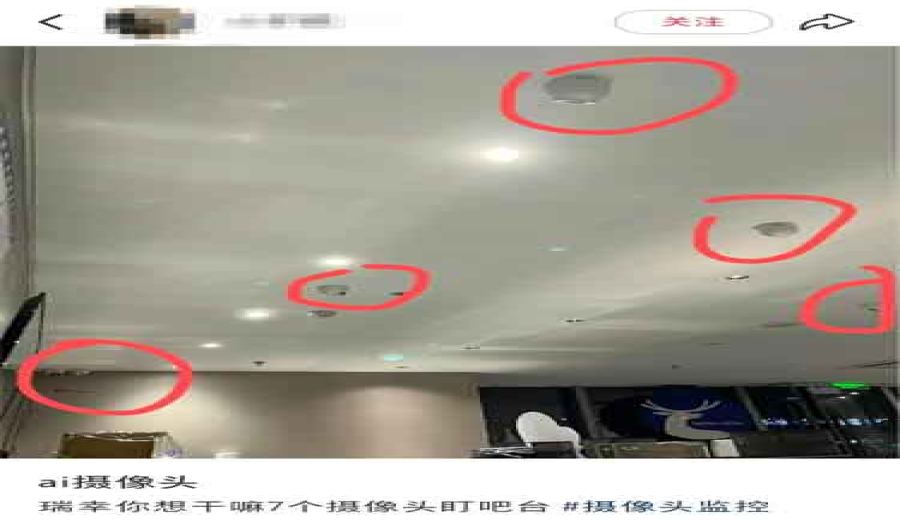
Introduction:In recent years, Luckin Coffee, a major coffee chain brand, has installed a large number of AI surveillance cameras in some of its outlets, covering both the barista operation area and customer dining spaces. This has sparked discussions among employees and consumers regarding privacy and workplace pressure. These high-definition cameras can instantly detect operational errors and individual behaviors, causing heightened stress among staff and discomfort among customers. This article delves into the actual impact and related controversies surrounding the deployment of these cameras.
Working in a modern coffee shop, taking a short break to use a mobile phone was once a small comfort for many baristas. However, some Luckin Coffee outlet employees have recently found that such brief moments of respite are gradually disappearing. The reason is that a significant number of AI surveillance cameras have been installed on the ceilings of these outlets, almost comprehensively recording every movement in both the barista work area and customer seating zones.
These cameras are not only capable of detecting common mistakes such as employees failing to wash their hands or pressing the wrong buttons on the coffee machine, but they can also automatically take and upload photos, instantly alerting on-duty staff via in-store screens. One employee revealed that some of the cameras are directionally monitored, enabling high-precision capture of specific areas.
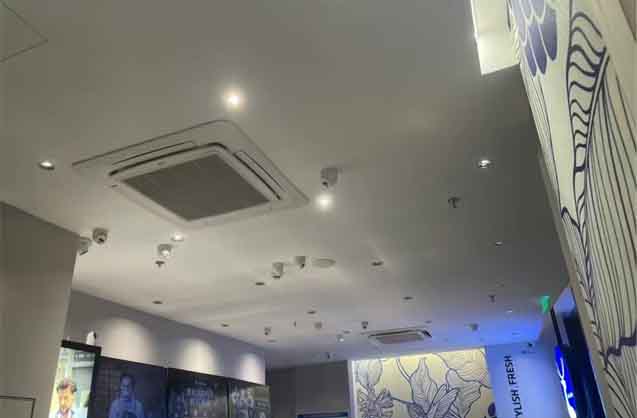
A Luckin Coffee employee stated that working under approximately seven to eight high-definition cameras densely positioned above one’s head is “simply suffocating,” even joking that “there are more cameras than colleagues in the store.” Moreover, based on on-site observations, the image quality captured by these cameras is extremely sharp,to the extent that it can clearly discern the measurement markings on milk pitchers, as well as the content displayed on mobile phone screens, leaving little to no room for privacy.
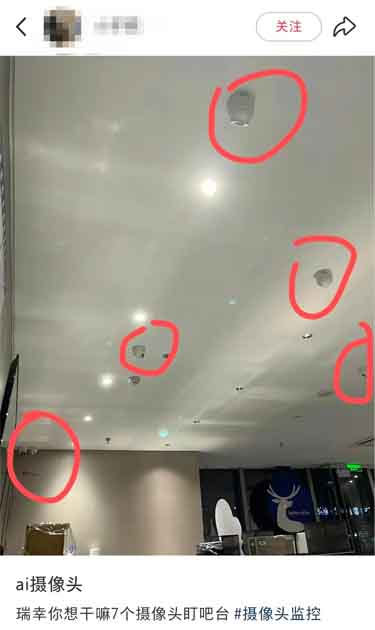
This high-density surveillance approach has also caused unease among many customers entering the stores. Although surveillance cameras in public spaces have become commonplace, customers still feel highly uncomfortable when they realize they are surrounded by as many as eight or nine cameras. Some customers mentioned, “I always feel like there’s an eye watching me from behind,” especially when using their phones to place orders or simply taking a break.
What concerns some customers even more is that these high-definition cameras might inadvertently capture private information displayed on mobile phone screens, or even the process of entering passwords,posing potential risks of personal data leakage. This has made privacy-conscious customers hesitant about staying in such environments.
However, some argue that the introduction of such surveillance systems aligns with current policies in the food and beverage industry advocating for “transparent kitchens.” Supporters point out that the cameras can fully document the beverage preparation process, not only helping to enhance food safety transparency but also providing solid evidence in cases of customer disputes—such as finding foreign objects in drinks—thus aiding in clarifying responsibilities and handling complaints.
Nevertheless, how to strike a balance between ensuring food safety and protecting the privacy of both employees and customers remains a shared challenge for the industry and consumers alike. The surveillance controversy triggered by Luckin this time has also led the public to re-examine the application scope and ethical boundaries of “smart surveillance” in the service sector.
The above content is compiled by CoffeeHunters, a coffee news website.


