







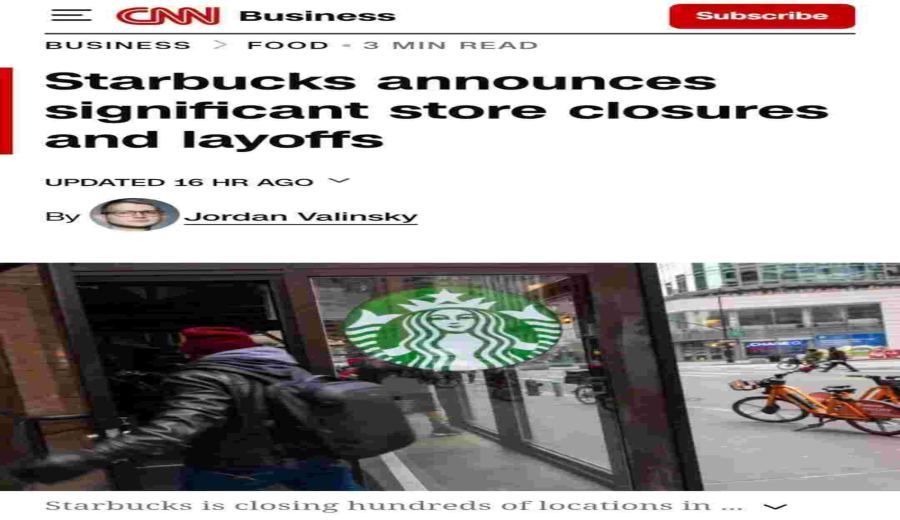
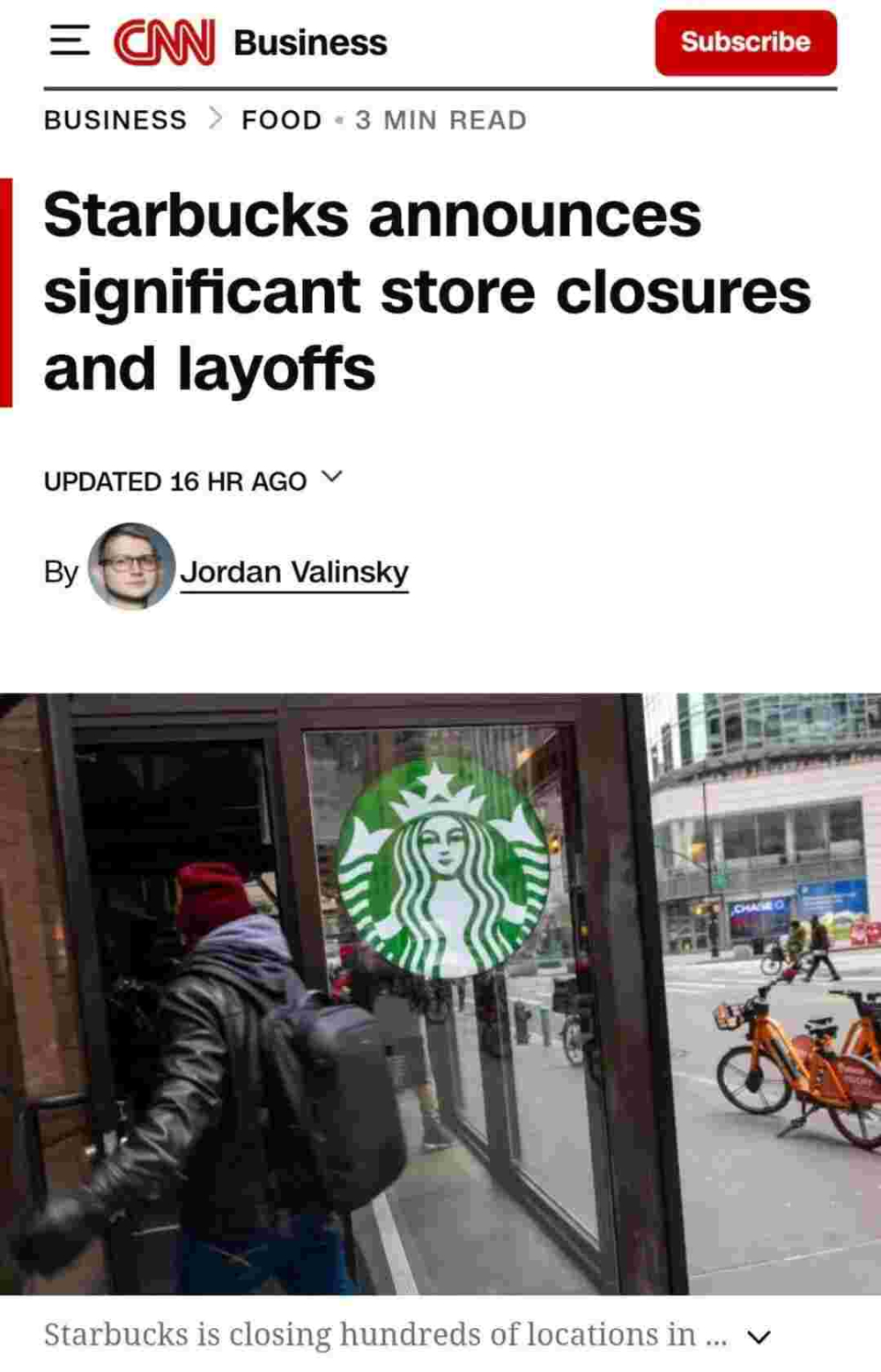
Introduction:Starbucks has announced a $1 billion restructuring plan focused on closing underperforming stores and streamlining its organization. The sudden permanent closure of its first-ever Seattle Roastery has drawn significant attention. This article provides an in-depth analysis of the details of the restructuring, including $850 million in asset disposal costs, layoffs of 900 non-retail positions, and the strategic logic behind expanding in some European markets while contracting in others—helping readers understand the business rationale behind the transformation of this global coffee giant.
Starbucks, the leading global coffee chain brand, recently officially disclosed a $1 billion strategic restructuring plan. Key measures include systematically closing underperforming company-owned stores and implementing a second round of layoffs. According to official filings submitted to the U.S. Securities and Exchange Commission (SEC), the entire restructuring process is expected to be completed within the 2025 fiscal year. Of this, $150 million is earmarked specifically for employee severance compensation, while the remaining $850 million will go toward lease termination fees and fixed asset disposals.
In an internal public letter, CEO Laxman Narasimhan explicitly stated that this adjustment targets stores that “have failed to meet financial targets or deliver the customer experience we strive for,” with decisions taking effect immediately. Although the company has not publicly disclosed the exact number of closures, multiple international media outlets, citing sources, report that the impact spans hundreds of stores in the U.S. and Canadian markets. One of the most symbolic cases is the Seattle Capitol Hill Roastery, which opened in 2014—this iconic building was not only the brand’s first flagship space integrating coffee roasting and retail but also became a key focal point in labor relations after unionizing in 2018.
A noteworthy detail is that the roastery closure occurred without the usual advance notice period. The store had already posted an official closure notice, with black coverings on its street-facing glass windows. On-site photos show people stopping to view the “Permanently Closed” tag updated on Google Maps. Industry analysts pointed out that this move may intensify employees’ skepticism about management’s alleged suppression of union organizing, as union members at this location had previously held multiple collective protests. The latest statistics also show that the closure rate of unionized stores is significantly higher than the average.
The Starbucks Workers Union issued a statement emphasizing that “management is once again implementing major changes without consulting baristas,” and revealed that the current list of stores slated for closure includes a disproportionately high number of union locations. They are preparing a formal letter demanding that the company disclose the full closure list along with corresponding employee relocation plans. Meanwhile, around 900 non-frontline retail staff will soon receive layoff notices. This marks the second wave of workforce optimization under Narasimhan since becoming CEO in 2022, following a similar round affecting 1,100 employees back in February 2023. The company explained that these moves aim to improve operational efficiency in non-store business units.
The adjustment strategy in the European market shows clear regional differences. While the UK, Middle East & Africa division claims to be proceeding with expansion as planned—aiming to open 80 new stores in the UK and 150 new locations across the broader region (including Europe, the Middle East, and Africa) in the current fiscal year—some UK locations, as well as certain stores in Switzerland and Austria, have already been included in the investment portfolio review. Industry observers note that this round of adjustments reflects Starbucks’ strategic shift in mature markets toward “carefully selecting store locations and optimizing individual store performance,” especially implementing stricter performance evaluation criteria in core urban areas with high rental costs.
Supplementary explanation of key parameters: The $850 million in asset disposal costs for this restructuring mainly covers penalties for early termination of long-term leases, depreciation of residual renovation value, and related real estate transfer taxes. The $150 million in employee compensation is calculated in accordance with U.S. labor laws, including statutory items such as accrued but unused leave, tenure bonuses, and job retraining assistance. For consumers, it’s particularly important to note that store closures may affect membership points redemption services in certain markets. It is advised to check the nearest operating location in advance via the official app.
The above content is compiled by CoffeeHunters, a coffee news website.


