








Introduction:Want to brew a rich, non-bitter deep-roast iced pour over with a pronounced aftertaste at home? Many people trying deep-roast iced pour over for the first time often encounter issues such as weak flavor, overly watery body, or even bitterness. This article takes an in-depth look at how to improve extraction efficiency by adjusting water temperature, coffee-to-water-to-ice ratio, and multi-stage pouring techniques—preserving bold flavors while avoiding over-extraction. Includes practical parameters and step-by-step instructions, making it easy even for beginners to get started.
On hot summer days, iced coffee has become an essential daily beverage for many to beat the heat. Even coffee lovers who usually prefer the bright acidity of light roasts may occasionally want to switch things up and try the richer, more intense flavors of deep-roast iced pour over, with notes of caramel and nuts. However, using the same brewing logic for light roasts on deep-roast beans often leads to thin-tasting coffee, obvious wateriness, or even unpleasant bitter aftertastes—quite disappointing.
The reason behind this actually lies closely with the brewing characteristics of iced pour over. When making iced pour over, we add ice cubes to quickly lower the temperature, and as the ice melts, it dilutes the coffee liquid. To counter this, we usually reduce the total amount of water poured to increase overall concentration. But reducing the water also means less soluble flavor compounds are extracted—especially larger molecules that dissolve more slowly—which are more likely to be lost this way.
The flavors of light-roast coffee mainly come from small molecules such as acids and sugars released early in the brew. Even if some extraction is reduced, these can still deliver a certain level of flavor. However, the unique body and sweetness of deep-roast beans rely more on larger molecules that are released later in the process. If the reduced water volume shortens the brewing time, these key components won’t fully dissolve, resulting in a dull, watery deep-roast iced coffee.
 Therefore, the key to brewing a good deep-roast iced pour over is to “improve extraction efficiency while avoiding over-extraction that leads to bitterness.” For deep-roast beans, due to their looser structure and easier release of compounds, too high a water temperature or too fine a grind can cause bitter substances to be released too early. Rather than adjusting temperature or grind size, it’s better to optimize the pouring technique—especially by using multi-stage pouring to extend the overall extraction time.
Many people, after reducing the water volume, instinctively go for a finer grind to maintain extraction yield, but overlook the changes in water flow and pouring duration. When water volume decreases but the number of pours and flow rate remain similar to hot pour over, the overall brewing time will shorten noticeably, affecting flavor balance. Therefore, breaking the pour into more stages—such as four, five, or even six stages—can effectively extend the contact time between water and coffee grounds, improving extraction uniformity and overall body.
 Practical tests have found that when using 15 grams of coffee for a hot pour over with 225 ml of hot water, the total extraction time is about 2 minutes; but when switching to iced pour over using only 150 ml of hot water with the same three-stage pour, the overall time shortens to around 1 minute and 30 seconds, drastically reducing extraction efficiency. Therefore, it’s recommended to use a more detailed multi-stage pouring method—even if beginners find it hard to control extremely fine streams, staged pouring helps achieve stable and extended extraction.
To brew a great deep-roast iced pour over, in addition to technique, bean selection is equally crucial. If you prefer low-acidity, full-bodied flavors, it’s recommended to choose medium to dark roast or deep-roast beans—for example, those with prominent roasty aromas, chocolate notes, or nutty characteristics. These types of beans better showcase the intense profile of iced pour over. For this practical session, we selected a deep-roast bean with plump, evenly sized particles and a clear, layered flavor profile.
Specific practical parameter recommendations are as follows: use20 grams of coffee grounds, ground to a fineness where80% passes through a #20 sieve(approximately equivalent to Ek43 grinder setting 10, or the coarseness of fine sugar); using acoffee-to-water-to-ice ratio of 1:10:6, which means20 grams of coffee with 200 ml of hot water and 120 grams of ice;water temperature controlled between86–89°C—too high risks bitterness, too low results in underwhelming flavor; use a slower-flow filter cone such as theKono filter coneto help stabilize extraction; employa five-stage pour, pouring40 ml of hot waterper stage, for a total brew time of about 2 minutes and 10 seconds.
In terms of steps, start with thebloomby pouring 40 ml of hot water, let it sit for 30 seconds, and pour in a circular motion from the center outward to ensure all coffee grounds are evenly saturated. After the bloom, proceed with the next four stages of pouring, each using 40 ml of water, poured with a fine stream in slow circles. Wait until the water fully drains before moving to the next stage, until a total of 200 ml of hot water has been poured. Finally, remove the filter cone to end the extraction.
Once brewing is complete, it’s recommended to gently swirl the server to mix the coffee liquid for even temperature and concentration. Once the coffee has cooled to a suitable drinking temperature, it’s ready to enjoy.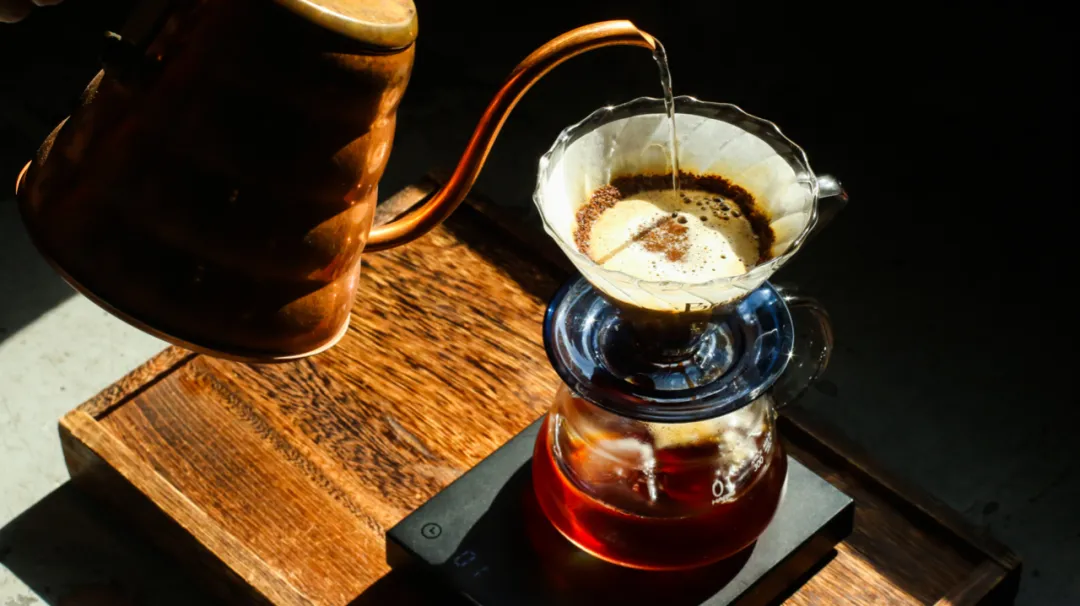 This deep-roast iced pour over is not only rich and full-bodied with no noticeable bitterness, but also shows excellent sweetness and aftertaste even when served cold. Flavor notes include chocolate, nuts, and spices—all hallmarks of dark roasts—while the finish carries subtle hints of caramel and pine, delivering a solid mouthfeel and a memorable taste. Absolutely worth a try!
The above content is compiled by CoffeeHunters, a coffee news website.


