







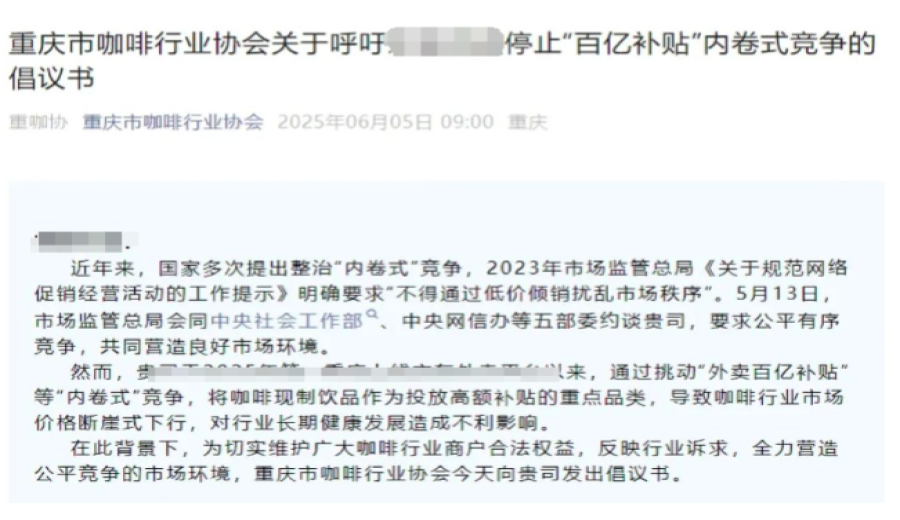
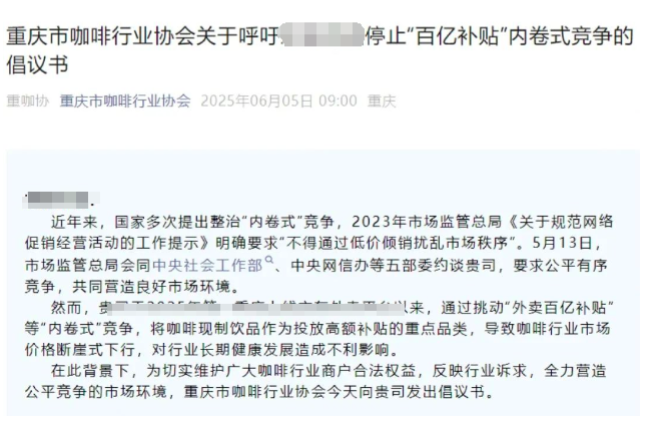
Introduction:The Chongqing Coffee Industry Association recently issued a public appeal regarding the “Hundred Billion Subsidy” strategy on food delivery platforms, pointing out that excessive subsidies have led to a sharp decline in the price of freshly brewed coffee, severely impacting the operations of small and medium-sized independent coffee brands. This article delves into the background of the incident, the positions of various stakeholders, and explores how independent cafés can maintain competitiveness through product and service differentiation amid fierce platform competition.
Recently, the Chongqing Coffee Industry Association published an official appeal letter focusing on the subsidy policies of food delivery platforms, with particular attention on JD.com’s “Hundred Billion Subsidy” campaign. This policy significantly reduced the prices of freshly brewed coffee beverages, causing an abrupt drop in overall market pricing and delivering a notable blow to the operations of local independent coffee brands. Some shops have seen both their online sales revenue and average order value decline.
This appeal quickly sparked heated discussions within the community. Many food and beverage professionals resonated deeply with the vicious competition triggered by platform subsidies, expressing concerns that such practices could harm the healthy development of the industry in the long run. On the other hand, consumers generally showed strong support for low-priced coffee, believing it allows them to enjoy their daily pick-me-up at more affordable prices.
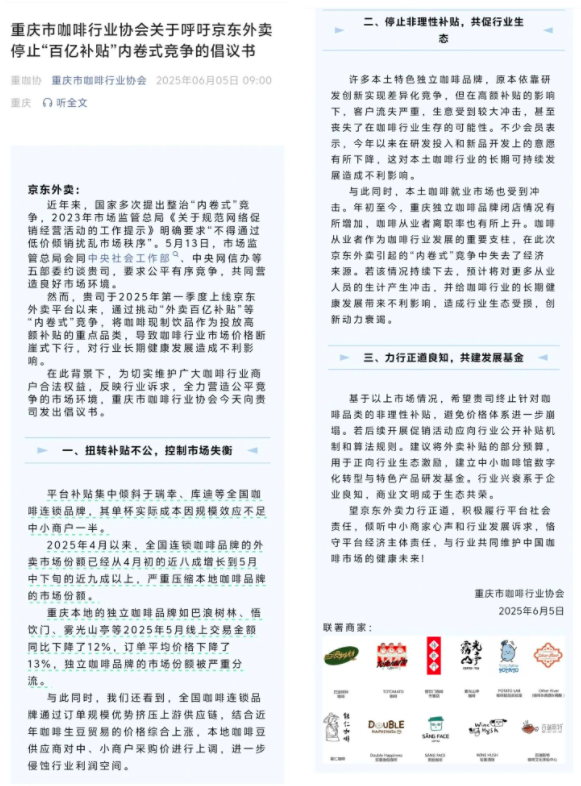
According to the association’s analysis, since JD.com entered the food delivery market, its large-scale subsidy strategy—particularly targeting freshly brewed coffee—has led to significant disorder in the overall market pricing system. In particular, national chain coffee brands, benefiting from economies of scale, have a per-cup cost far lower than that of typical small and medium-sized businesses, further exacerbating unequal competition in the market.
Data shows that since April 2025, the market share of national chain coffee brands on food delivery platforms has rapidly climbed from nearly 80% to nearly 90% by mid-to-late May. This has noticeably squeezed the operational space for local Chongqing coffee brands. Some independent brands experienced around a 12% decline in online transaction volume and a 13% drop in average order price during May 2025 compared to the same period last year, indicating a rapid redistribution of the market landscape.
The Chongqing Coffee Industry Association, a non-profit organization established in November 2019 dedicated to promoting the development of the local coffee industry, joined forces with 11 local brands to issue this call. They hope that food delivery platforms will acknowledge the operational challenges faced by small and medium-sized businesses and adjust their overly subsidy-driven competitive models. This appeal was also republished by the official Chongqing Rule of Law Online website, drawing broader social attention.
Faced with the platform subsidy policies, many food and beverage operators admitted that some chain brand coffee items have dropped in price to as low as 2 to 3 RMB. With such highly attractive pricing, these chains have successfully drawn a large number of consumers away, leaving small and medium-sized brands grappling with the dual challenges of losing orders and shrinking customer bases.
However, consumer opinions are clearly divided. Some netizens actively support the platform subsidy policies, believing that low-cost coffee perfectly fits their daily needs. Some even jokingly refer to themselves as “members of the subsidy association,” stating that the end of subsidies would directly affect their quality of life. Many users emphasized that for most consumers, coffee is merely a tool for staying alert, and price often becomes the primary factor in purchasing decisions.
Additionally, some observers have noted that independent coffee shops mostly focus on the specialty coffee route, with a target customer base distinct from that of mainstream chain brands. Consumers who prioritize cost-effectiveness tend to opt for more affordable chain coffee, while those seeking ambiance and nuanced coffee flavors remain loyal to their favorite independent shops. As a result, some netizens believe that as long as independent brands continue to deepen their distinctive characteristics, they can still solidify their market position even in a fiercely subsidy-driven competitive environment.
It is worth mentioning that the widely discussed appeal has since been voluntarily removed by its original publisher and is no longer accessible on external official platforms, adding further layers of discussion to the unfolding situation. In the face of the market shifts brought about by platform subsidies, how small and medium-sized coffee brands can seek breakthroughs through product innovation, service upgrades, and precise marketing will be key to their continued growth in an increasingly competitive landscape.
The above content is compiled by CoffeeHunters, a coffee news website.


