







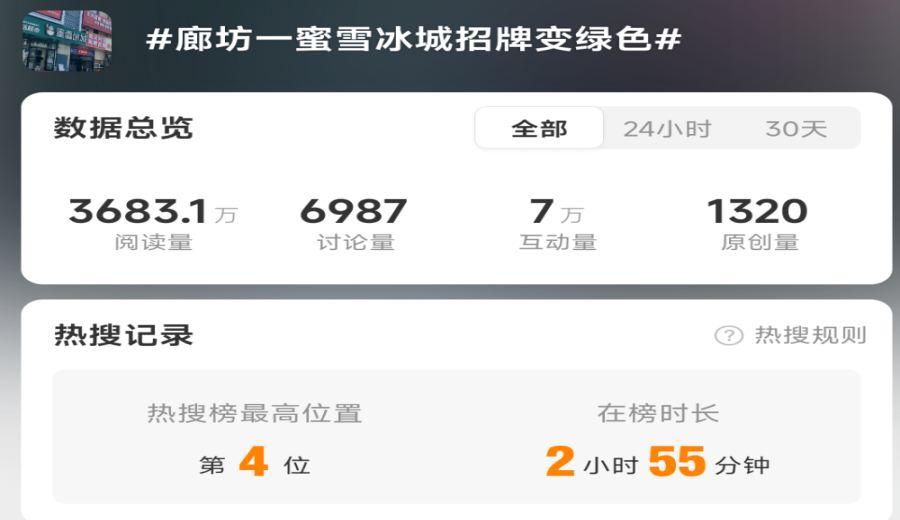
Introduction:Recently, the requirement for merchants in Yanjiao, Sanhe, Hebei to change their shop signs to red, blue, or black has sparked heated discussion. Multiple stores, including those of Mixue Ice Cream & Tea, were forced to switch their signs to green or gray-black, with the removal costs borne by the businesses themselves. This move is seen as an extension of the "unified shop signage" policy, but lacks clear official documentation, targets common commercial color schemes, and reduces brand visibility. This article reviews the incident and analyzes the logic and controversies behind urban planning decisions.
Recently, news about the rectification of shop sign colors in the Yanjiao area of Sanhe City, Hebei, has drawn attention. Local urban management authorities orally notified merchants to change the colors of red, blue, and black storefront signs, with the costs of removal and replacement to be covered by the businesses. As a result, brands such as Mixue Ice Cream & Tea had their signs changed to green or gray-black, and the topic quickly trended on Weibo.
On April 6, a netizen posted photos showing that the sign of a Mixue Ice Cream & Tea store in Sanhe City had been changed to gray-black. On the 7th, staff at the store confirmed to the media that urban management personnel had previously visited and orally informed them that red storefronts were not allowed, but this was only communicated verbally, with no written notice provided. On the morning of the 8th, staff at another Mixue Ice Cream & Tea store located in the Yanjiao Development Zone said their sign had been changed to green because "urban management said that all storefronts near major intersections are not allowed to use red," and that stores close to main roads had generally been adjusted, while those not on the streetfront were unaffected.

In addition to Mixue Ice Cream & Tea, staff at a chain eyewear brand store in Yanjiao with a red storefront also confirmed that they had received an oral notification from urban management to change the red sign. Another reporter noted that one shop owner, who changed their red sign to blue-green, had posted a video in advance warning customers “not to go to the wrong place.”
A staff member from the relevant department of the Sanhe City Urban Management Bureau explained that this adjustment was made according to the city government's urban planning requirements.Except for red, blue, black, and the base colors of storefront signs, other colors may be used.The staff admitted that currently "the relevant departments have not yet issued any documents," but emphasized that "we will make changes in advance in accordance with urban planning," and that related information would be pushed on the official account in the future.
However, a staff member from the local government office stated they were "unaware of the situation," indicating a possible gap in information synchronization between the implementation and decision-making levels. This rectification not only lacks clear official documentation, but also targets only red, blue, and black—three common and basic commercial color schemes—which reduces brand visibility. At the same time, the costs of removal and replacement being borne by the merchants have sparked controversy over fairness.
Similar "unified shop signage" phenomena have precedent in other regions. On social platforms, many netizens have shared cases where merchants were required to unify fonts, backgrounds, colors, and sizes of their signs, all in the name of creating a neat and uniform street appearance. Urban management departments often promote sign rectifications under the rationale of "enhancing the overall image of the city," but in this case in Sanhe City, the adjustments are limited to colors and lack sufficient justification, making it difficult to gain recognition from both merchants and the public.
This incident highlights the challenge of balancing "uniformity" and "commercial individuality" in urban planning. How to maintain urban aesthetics while also considering brand recognition and the economic burden on businesses remains a key issue that authorities need to carefully consider.
The above content is compiled by CoffeeHunters, a coffee news website.


