







Introduction:Delving into the internal challenges faced by the UK-based coffee chain Costa in the Chinese market — from high employee KPI pressure and shrinking benefits to store closures — this article analyzes the reasons behind its declining competitiveness. It explores how frontline staff struggle between sales targets and on-the-ground realities, and how these changes are impacting customer experience and brand development.
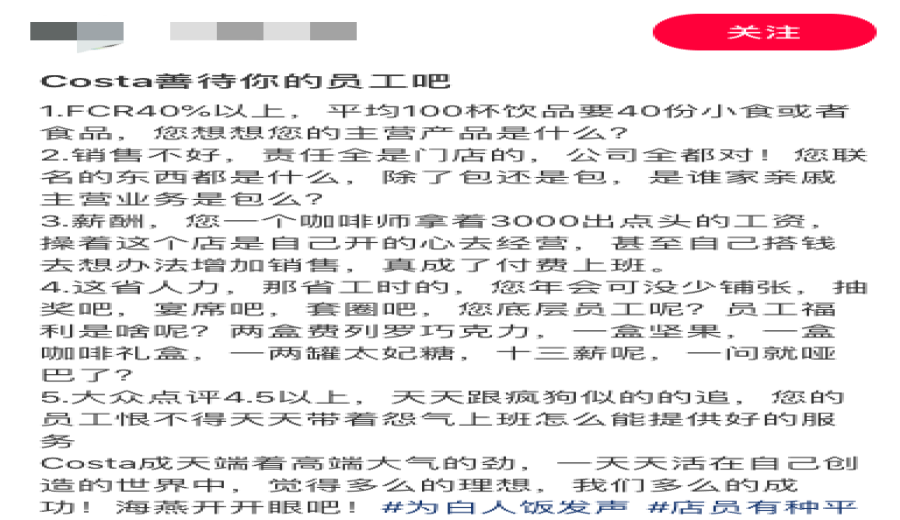
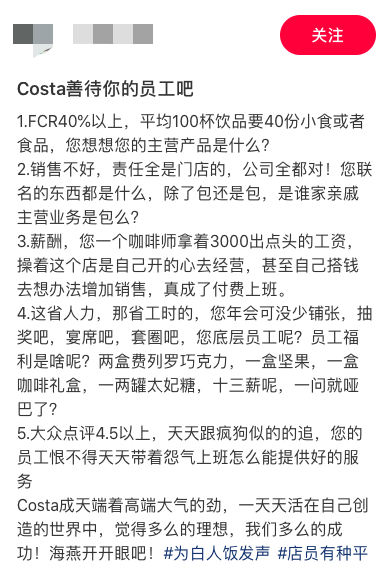
Recently, a post by a Costa employee complaining about the company’s high KPI pressure sparked widespread discussion on social media. According to the employee, stores are required to sell more than 40 food items for every 100 drinks sold, pushing some employees to cover the shortfall out of their own pockets just to meet targets — joking that they are essentially “paying to work.”
The employee further pointed out that while the brand has significantly raised its food sales targets for stores, many outlets in reality find it extremely difficult to meet such lofty demands. To fulfill the goals set by management, some staff members have resorted to using their own money to buy food items just to hit the sales figures — a situation that has left them feeling helpless.
This situation has resonated with many other employees also grappling with high KPIs. In the comments section, netizens have voiced their dissatisfaction: “Just give away the food and coffee for free, why even bother making coffee?” “My points are all used up, and I’ve already covered quite a bit of money,” “I can’t even finish the lollipops I’ve hoarded,” and “Might as well just turn into a convenience store.” These remarks reflect the helplessness felt by frontline workers under unreasonable targets.
One veteran employee, who had previously quit but later returned part-time, noted that only after returning to work did he realize the brand’s recent closure of numerous stores may be linked to chaotic internal management. He recalled that in the past, a food KPI of “30 was already considered impressive,” yet now it has skyrocketed to 40 — stating bluntly that such targets place far too much pressure on frontline employees.
Beyond the stress brought by high KPIs, employees have also pointed out that Costa’s employee benefits have been gradually diminishing year by year. One staffer mentioned that this year’s New Year gift only included simple items like chocolates and candies — a far cry from the rich holiday packages of previous years. Even more upsetting for employees is that the once-standard 13th-month salary has now become an “undiscussable secret,” with inquiries often met with no clear response.
Compared to other chain coffee brands like Starbucks and Tims, Costa’s development in recent years has clearly hit a bottleneck. Many customers report that the brand’s product quality and in-store service have significantly declined. Some loyal customers, dissatisfied with the flavor of the drinks and the service experience, have switched to more affordable options like Manner and Tims, or to more consistently quality brands like Starbucks and Peet’s Coffee.
Customer attrition has directly impacted store performance. Over the past year, a number of poorly performing older outlets have closed one after another due to lease expirations or insufficient profitability, leading to a sharp reduction in store count. As a result, this British brand — once a key competitor to Starbucks in the Chinese market — is gradually losing its market presence. Some newcomers to coffee don’t even know that the red-and-white branded Costa was once a major rival to Starbucks.
Due to the brand’s underwhelming performance in the Chinese market, headquarters has implemented a series of cost-cutting measures: on one hand, raising store sales targets and pressuring employees to more aggressively promote higher-margin items such as desserts, snacks, and membership cards; on the other hand, quietly reducing employee benefits, resulting in a noticeably lower perceived treatment among staff. Many frontline employees admit that with increasing work pressures, quitting has become a serious consideration.
The above content is compiled by CoffeeHunters, a coffee news website.


