







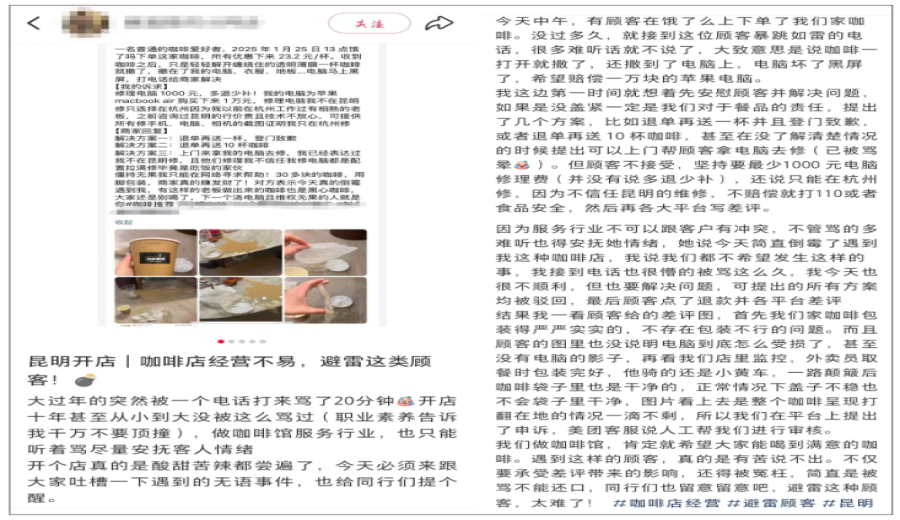
Introduction:When a takeaway coffee spilled accidentally, damaging a customer’s laptop, the customer demanded substantial compensation from the café—but surveillance footage and photos showed that the packaging was intact. This article delves into the reality of such consumer disputes, exploring the leak-proof standards for takeaway beverage packaging, the burden of proof on customers, and reasonable strategies for businesses facing unjustified claims, providing reference for both the industry and consumers.
A takeaway coffee spilled unexpectedly, causing damage to a customer’s laptop and sparking a compensation dispute amounting to as much as ten thousand yuan, leaving a café in an indefensible predicament. The claimant stated that as soon as they opened the takeaway coffee, the liquid suddenly poured out, leading to their notebook computer going black and malfunctioning, and insisted that the café compensate them for a brand-new device. However, the café reviewed the procedures for that day and found that the coffee packaging and sealing processes were all standard, and surveillance footage confirmed there were no obvious abnormalities when the order was handed out.
According to the café owner, they received an emotionally charged call from the customer, who blamed the poor coffee packaging for the incident. Initially, the café tried to offer various forms of compensation, including remaking the drink for free, additional compensation, and even offering to help with repairs, but the customer insisted on at least one thousand yuan for repairs, threatening to call the police and leave a flood of negative reviews if not. The café owner was scolded on the phone for twenty minutes and was unable to defend themselves effectively, ultimately having to silently endure the unfounded accusations and the impact of online negative reviews.
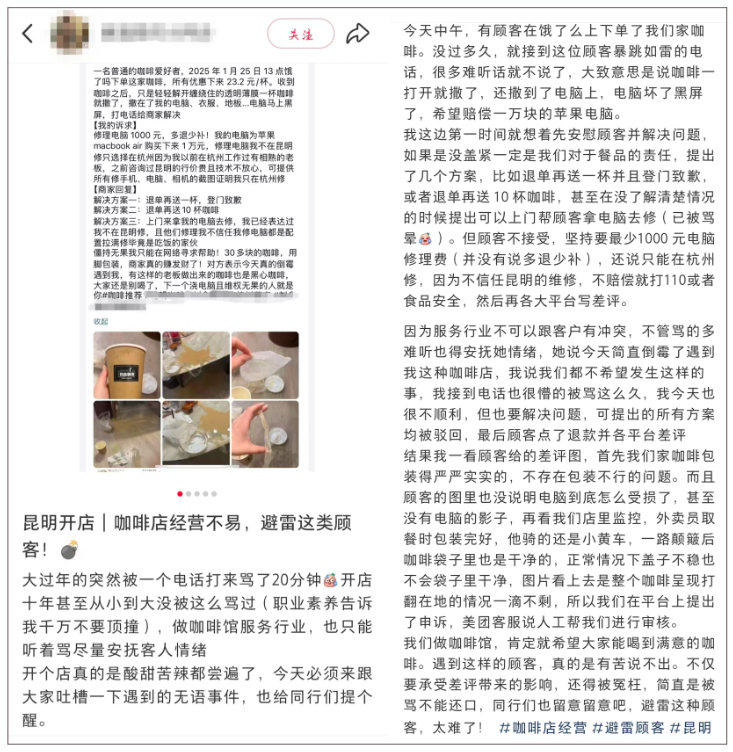
Afterwards, the café reviewed the in-store surveillance footage to verify the coffee packaging process at the time—including the tightness of the cup lid, the use of sealing film, and the leak-proof design of the takeaway bag—all of which conformed to standard operating procedures. Although the photos shared by the customer showed a large amount of coffee liquid on the tabletop, the inside of the takeaway bag was unusually clean, with no signs of liquid leakage, making this detail one of the keys to determining responsibility for the accident. Most netizens observing the situation questioned: “If it had really leaked during delivery, the inside of the bag would not have been this clean,” and “when a consumer claims damage, they should bear the burden of proof, rather than unilaterally demanding compensation.” They also noted, “without specific photos of the damaged laptop, it’s hard to conclude that the coffee caused it.” These opinions highlight that in service industry disputes, both parties need to approach the matter rationally and base negotiations on actual evidence.
This incident sparked widespread discussion on social media, with many regular customers vouching for the café, stating that they had never encountered similar issues with their long-term takeaway packaging and questioning why the customer failed to provide complete evidence. Netizens pointed out: “If it was really a delivery problem, the inside of the bag couldn’t have been this clean,” “if a consumer is claiming damages, they should bear the burden of proof, rather than just demanding compensation,” and “without clear photos of the damaged laptop, it’s difficult to determine that the coffee caused it.” These comments underscore that in service-related disputes, both sides need to deal with the issue rationally, using real evidence as the basis for resolution.
Industry professionals note that the design of takeaway drink packaging is primarily focused on leak prevention. Generally, qualified takeaway cups should have tightly fitting lids, leak-proof sealing films, and shock-absorbing takeaway bags, all of which can effectively reduce the risk of spills during transport. However, consumers should also be aware to ensure the cup is stable before opening, avoiding sudden tilting or forceful opening that may cause the liquid to splash. If an accident unfortunately occurs, it is recommended that both parties take photos as evidence first and preserve the remaining drink and the intact state of the packaging to facilitate subsequent clarification of responsibility.
Regarding such high-compensation cases, legal experts advise businesses facing unreasonable claims to remain calm and prioritize protecting their rights through objective materials such as recordings, surveillance, or photos. If the other party continues to threaten or demand excessive compensation, seeking police assistance or legal advice is advisable, to avoid making hasty compromises under emotional pressure. At the same time, establishing sound customer communication processes and packaging inspection mechanisms can also significantly reduce the likelihood of similar disputes.
In summary, this “takeaway coffee damages laptop” incident not only highlights issues of trust and responsibility between consumers and businesses, but also reminds both the industry and customers that when disputes arise, actual evidence should be the basis, and problems should be resolved through rational communication and proper channels. For businesses, maintaining high-standard packaging quality and sound serving procedures is the first step in preventing potential disputes; for consumers, rationally stating facts and reasonably assessing damages are equally important principles in safeguarding their own rights.
The above content is compiled by CoffeeHunters, a coffee news website.


