







Introduction:Volcano pour over is a highly distinctive extraction method within Japanese pour-over techniques, renowned for its unique blooming bed phenomenon and prominent sweet flavor profile. This small-stream intermittent pouring method, designed specifically for dark roasted coffee beans, not only delivers a visually stunning experience but also effectively enhances sweetness and body while reducing bitterness and dryness. This article will delve into the principles behind the volcano pour, explain why it suits dark roasts, how to achieve high concentration with low extraction, and provide a complete practical workflow along with recommended parameters to help you master this visually captivating and flavorful pour-over technique.
The volcano pour-over method is a highly recognizable extraction technique in the Japanese pour-over system, named for the visual effect during brewing where the coffee bed continuously bubbles and rises like a volcanic eruption. This technique is tailored for dark roasted coffee beans, employing a strategy of small water streams, multiple small pours, paired with a core concept of high concentration and low water volume, ultimately presenting a cup of coffee with distinct sweetness, rich body, and smooth texture.
The appeal of this method lies not only in its unique visual experience but also in its ability to bring out the rich caramel sweetness and deep notes of dark nuts and chocolate from dark roasted beans, offering more layers and aftertaste compared to conventional extraction methods. This article will start with the principles, detailing the technical highlights of the volcano pour, including the blooming bed mechanism, reasons for suitability with dark roasts, benefits of high concentration with low extraction, and will present a complete, battle-tested operational workflow along with recommended parameters, enabling you to grasp this both visually appealing and delicious brewing secret.
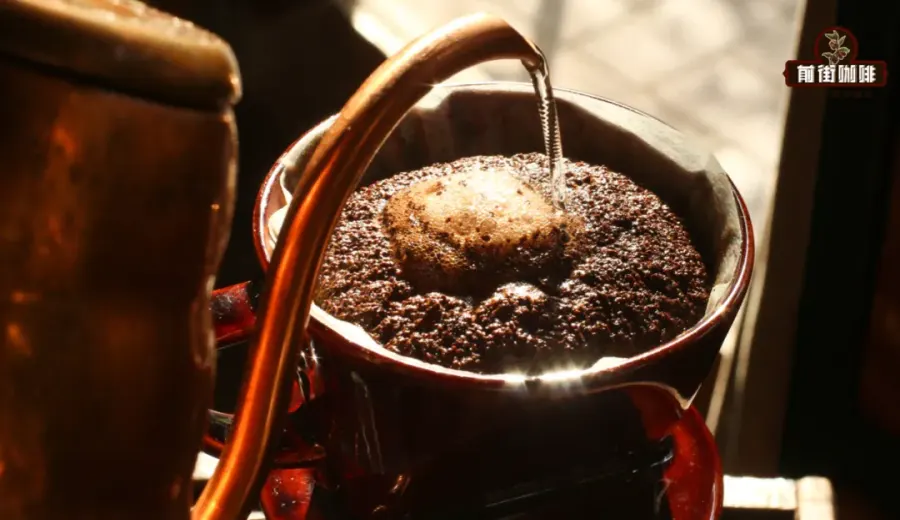
The so-called "volcano pour" refers to the way the coffee bed continuously bubbles and rises during brewing, resembling volcanic activity and creating a dynamic scene akin to an eruption. This unique visual effect is primarily due to the use of small amounts of water and small water streams throughout the pour, with each pour limited to the center area and minimal swirling, preventing the carbon dioxide inside the coffee bed from being released all at once, but rather seeping out intermittently drop by drop.
Before the actual pouring begins, the coffee grounds undergo a pre-infusion (bloom), during which carbon dioxide release causes the bed to expand and rise. When hot water is poured in, the previously suppressed CO₂ seeks an escape route in the coffee bed. If the pouring stream is small and done in increments, only part of the gas is gradually released, causing bubbles to continually emerge from the pour point, resulting in a continuous “bubbling” phenomenon. This is also why the volcano pour can deliver such vivid visual effects.
However, not all coffee beans are suitable for successfully achieving this “volcanic eruption” effect in the coffee bed. The key lies in the coffee beans having sufficient expansion rate and abundant carbon dioxide content, characteristics typically fully expressed only in dark roasts. Light roasts, due to their higher density, limited expansion, and lower CO₂ release, struggle to achieve the desired visual and extraction effects, hence the volcano pour is more recommended for dark roast beans.
Beyond its visual spectacle, another major feature of the volcano pour is its ability to highlight the sweet aspects of the coffee. This is thanks to its adoption of a “high concentration, low extraction” strategy — using a larger dose of coffee grounds with relatively less total pour water, thereby reducing the total amount of substances extracted per unit of water and avoiding early extraction of excessive bitterness and negative flavors.
Traditional methods that involve large amounts of water may quickly extract flavors but can also easily pull out undesirable compounds, especially when improperly executed, often resulting in bitterness. The volcano pour, through small, multiple, and spaced-out pours, on one hand controls each pour to maintain a low concentration, aiding extraction efficiency; on the other hand, extends the overall extraction time, allowing for more thorough contact between water and coffee grounds, further optimizing flavor release.
Of course, too many pour segments and overly long extraction times carry risks, potentially releasing off-flavors. Therefore, using a slightly coarser grind size (for example, a 11-setting on the Ek43 grinder, roughly 60% sieved through a #20 mesh, resembling coarse sugar) is necessary. This helps avoid over-extraction while extending contact time.
For practical application, it’s recommended to choose a classic dark roast bean, such as Sumatra’s Golden Mandheling, whose flavor profile is dominated by woody notes, black chocolate, and caramel sweetness, aligning well with the characteristics of the volcano pour technique. Below is a set of standard parameters tested and recommended: use 20 grams of coffee grounds with a 1:12 coffee-to-water ratio (i.e., total water volume of 240 milliliters), set the water temperature at 88°C, and a Kalita trapezoid dripper can be used to ensure stable flow rate and laminar flow effect.
In terms of the actual operation process, the entire procedure is divided into two main stages: first is the bloom, where 40 milliliters of hot water are evenly poured over the coffee grounds and allowed to sit for about 30 seconds, during which the coffee bed will gradually expand and rise. After the bloom, the main extraction phase begins, using small pours of 20 milliliters each, poured mainly at the center with small-radius swirling. The interval between each pour is controlled just before the coffee bed begins to collapse (about every 5 seconds). This operation continuously stimulates the coffee bed to release carbon dioxide, creating the continuous bubbling “volcano” visual effect.
Due to the relatively small total water volume, the final brewed coffee liquid has a high concentration, and drinking it directly may be too intense. It is recommended to add an additional 50–60 milliliters of hot water at the end for dilution, adjusting to a palatable strength. At this point, the coffee’s flavors become more balanced, with clear notes of pine, spices, accompanied by prominent caramel sweetness and rich black chocolate aroma. The overall mouthfeel is rich yet smooth, making it a Japanese pour-over masterpiece that combines visual enjoyment with taste satisfaction.
The above content is compiled by CoffeeHunters, a coffee news website.


