








Introduction:Yirgacheffe is one of Ethiopia’s most iconic coffee-growing regions, renowned for its bright acidity and citrusy, floral aromas, making it a favorite among pour over enthusiasts. But do you know why many coffees from this area are named after cooperatives or villages? This article delves into the administrative divisions of Yirgacheffe, the background of garden cultivation, and the founding story and flavor profile of the Kochere Cooperative, offering insights into the backstory of this classic bean and brewing recommendations.
Ethiopia has long been regarded as the cradle of specialty coffee worldwide, and its Yirgacheffe region is especially celebrated for its distinctive fruity notes and crisp acidity, often serving as the gateway choice for many pour over coffee lovers. Walk into any specialty café, and you’ll frequently see coffee beans labeled “Yirgacheffe,” “Kochere,” or “Koke.” These names actually stem from the local farming model and cooperative system. This article will guide you through the origins of Yirgacheffe’s regional divisions, why the cooperative model thrives here, and focus on the well-known Kochere Cooperative in Gedeb town, analyzing everything from the growing environment to the coffee’s flavor profile.
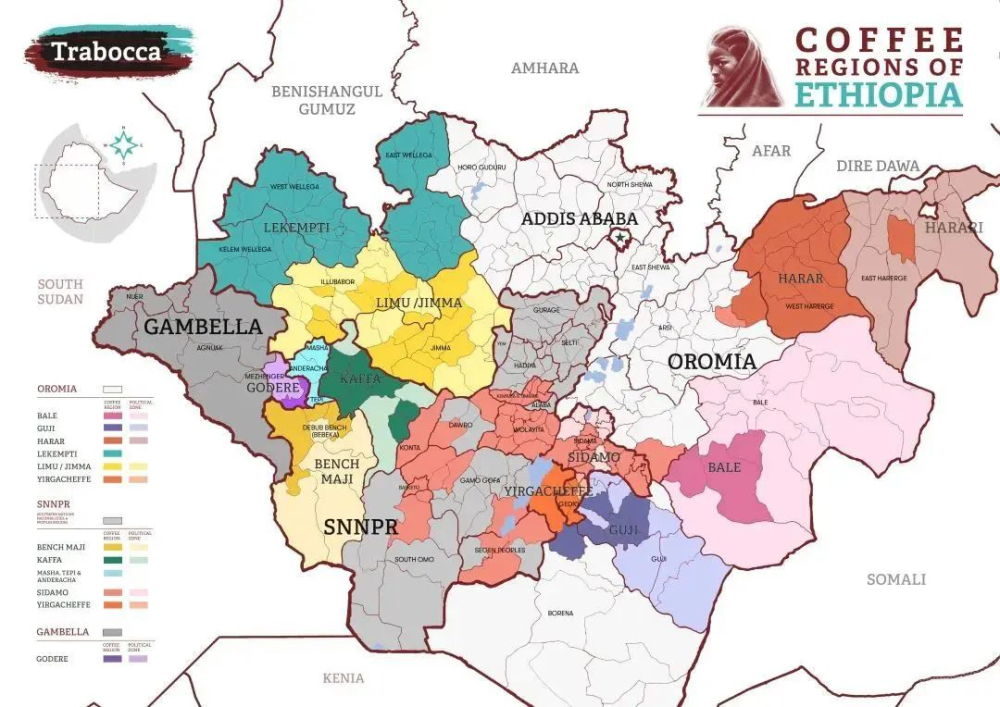
Yirgacheffe was originally just a small town within the Sidamo province. Due to its outstanding flavor performance, it was later elevated to an independent region, standing alongside Sidamo as one of Ethiopia’s two classic coffee-producing areas. In 2004, the Ethiopian government officially registered “Yirgacheffe” as a geographical indication to protect its uniqueness and market recognition. Although the name originates from the town, the Yirgacheffe region actually encompasses several surrounding villages, including Wenago, Kochere, and Gedeb. These sub-regions also benefit from high altitudes and excellent terroir, producing coffees with similar flavor profiles, hence they are all grouped under the broader Yirgacheffe appellation.

Coffee cultivation in the Yirgacheffe area is predominantly carried out through “Garden Coffee,” meaning coffee trees are usually planted around homes, intercropped with other crops such as bananas and legumes, rather than on large-scale commercial farms. This planting method results in relatively low yields per farmer, but overall, this smallholder economic model contributes to over half of Ethiopia’s total coffee production. During harvest season, farmers pick ripe coffee cherries themselves or sell them to middlemen, who then deliver them to nearby processing stations. While this process preserves tradition, it also exposes farmers to exploitation by middlemen, resulting in meager profits.
To address this challenge, many small-scale farmers began forming cooperatives to pool resources for building processing facilities and to unify harvesting, processing, and sales of coffee beans. Through cooperatives, not only can production costs be reduced and quality more effectively controlled, but farmers can also directly engage with international buyers, enhancing their bargaining power. Today, there are over 40 officially registered coffee cooperatives in the Yirgacheffe region, among which the “Kochere / Gedeb – Gedeb Cooperative” is one of the most representative examples.
The Kochere Cooperative is located in Gedeb town, which is about 60 kilometers from Yirgacheffe town. It is one of the higher-altitude sub-regions within the Yirgacheffe area, with coffee generally grown at elevations between 1900 and 2200 meters. The high altitude slows the ripening of coffee cherries, helping accumulate flavor compounds and resulting in richer acidity and aroma. The Kochere area includes several villages, such as Worka Sakaro, Halo Bariti, Banko Gotiti, and Banko Dahato, all of which are known for producing high-quality coffee.
Interestingly, the Kochere Cooperative was originally part of the Worka Cooperative under the Yirgacheffe Coffee Farmers Cooperative Union (YCFCU). As the specialty coffee market grew, consumers demanded greater traceability and consistency in coffee origins, prompting a more detailed division of growing regions. In 2012, around 300 farmers from the villages of Kochere decided to establish their own cooperative, officially forming the “Kochere Cooperative” with a focus on producing high-quality, distinctive coffee beans.
The Kochere Cooperative adheres to a traditional yet meticulous washed processing method. From harvesting to pulping, fermentation, washing, and drying, every step emphasizes detail and quality control, successfully preserving the unique flavor characteristics of the region’s coffee. This coffee typically exhibits bright lemon and citrus acidity, paired with delicate floral notes and berry undertones, and a caramel-like sweetness in the finish. The overall cup is clean and refreshing, making it highly suitable for pour over enthusiasts who appreciate fruity acidity and layered flavors. For brewing, a medium-light roast is recommended, with a grind size around medium-fine (such as that for a pour over filter), and water temperature controlled at 90-92°C. A multi-pour extraction method can better showcase its complex flavor profile.
In summary, the reason why many Yirgacheffe coffees are named after cooperatives or villages reflects the characteristics of the local smallholder economy and the evolution of the industry structure. Through the cooperative model, farmers can improve quality and income, while consumers can enjoy coffee with more distinct origin flavors. As a standout among them, the Kochere Cooperative not only showcases the potential of high-altitude coffee but also brings to the global specialty coffee market a truly unforgettable classic flavor.
The above content is compiled by CoffeeHunters, a coffee news website.


