








Introduction:Gain an in-depth understanding of the two renowned Mandheling-producing regions on Indonesia’s Sumatra Island — Lintong and Gayo (Gayo Mountain), and explore their unique geographical environments, climatic characteristics, and flavor profiles. At the same time, uncover the true identity of the commonly known Ateng variety, and learn how this misunderstood Catimor-type coffee has taken root in Indonesia. This article takes you on a comprehensive journey through the terroir of the producing regions to the background of the varieties, to fully appreciate the charm of Mandheling.
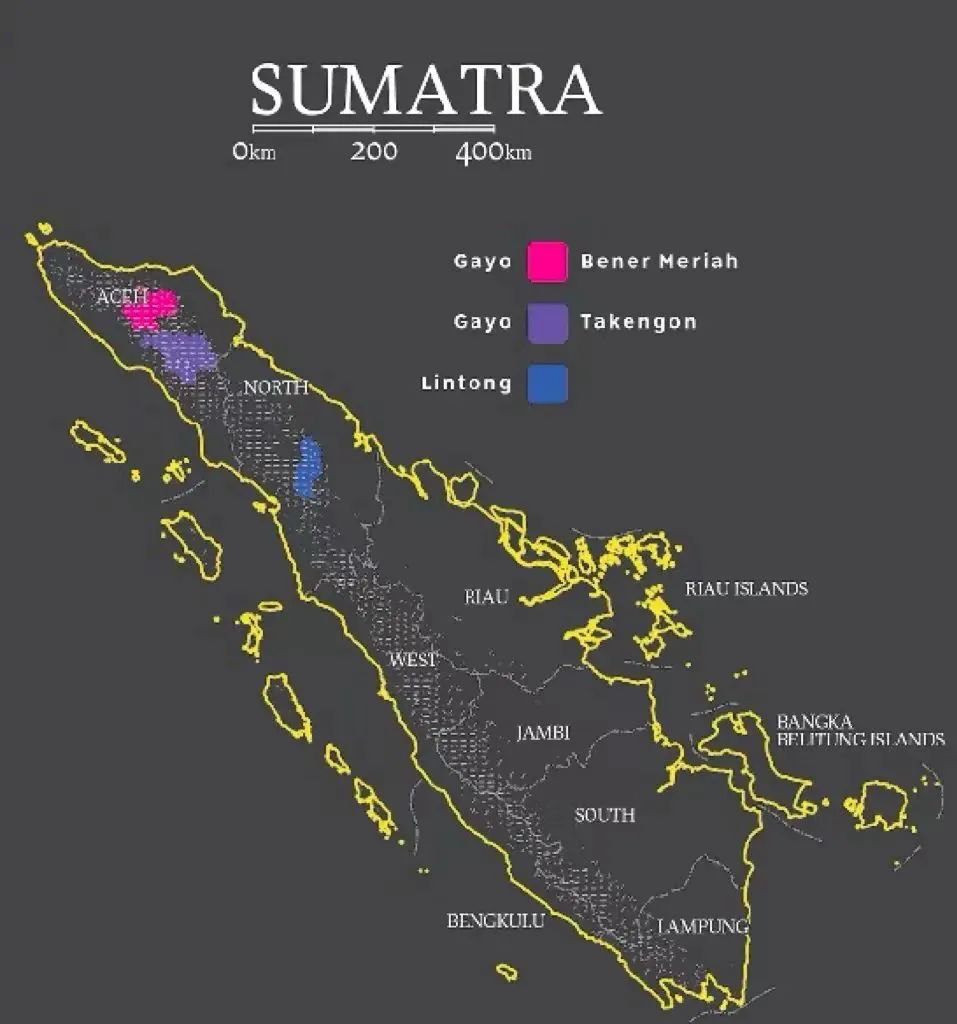
Mandheling coffee is one of Indonesia’s most representative specialty coffees, widely loved by coffee enthusiasts around the world for its rich, full-bodied, low-acid, and bold bitter taste. However, many people still have only a vague understanding of its origin and variety background. As its main production area, Sumatra boasts two highly representative core regions — Lintong in North Sumatra and Gayo Mountain in Aceh Province. These two areas not only differ greatly in terrain and microclimate, but also produce Mandheling coffees with distinct and unique flavor characteristics.
The Lintong region is located south of Medan, the capital of North Sumatra, adjacent to Lake Toba, the world’s largest volcanic lake. Coffee plantations here are mostly distributed on volcanic slopes at altitudes of 1,400 to 1,800 meters. The soil, enriched by historical volcanic activity, is rich in minerals, providing excellent growing conditions for coffee trees. Lintong Mandheling produced in this area typically exhibits notes of herbs, dark chocolate, and caramel, with a syrupy mouthfeel and a distinctly sweet aftertaste. Such flavor profiles make it a popular entry-level choice for many coffee newcomers exploring Indonesian Mandheling.

Another important region — Gayo Mountain (Gayo), is located in the special region of Aceh at the northern tip of Sumatra, with cultivation altitudes ranging between 1,300 and 1,600 meters. This area is also surrounded by volcanic landscapes and features numerous lakes, among which Lake Lawar is the most well-known. Mandheling from the Gayo region is known for being rich and layered. Typical flavors include toasted bread, pine wood, caramel, and cocoa. It has a full and bold entrance, good acidity-sweetness balance, and a long-lasting caramel sweetness in the aftertaste. The Golden Mandheling produced in this region is considered a classic among many advanced coffee enthusiasts.
When talking about Sumatran Mandheling, one cannot avoid mentioning the term “Ateng,” a common yet often misunderstood variety name. Many people assume it is some kind of independent native variety, but in fact, Ateng is the Indonesian colloquial term for the Catimor variety. Catimor is an F1 hybrid group resulting from a cross between the Timor variety and Caturra, known for its strong disease resistance, particularly against leaf rust, enabling it to grow stably in Indonesia’s humid and disease-prone island environment.
The Timor variety itself is a natural hybrid of Arabica and Robusta. Although classified as Arabica, it inherited Robusta’s disease-resistant genes, a trait also passed on to Catimor. Caturra, on the other hand, is a natural mutation of the Bourbon variety, characterized by shorter plants and slower growth, which facilitates dense planting, increases yield per unit area, and is suitable for cultivation at relatively lower altitudes. For these reasons, Catimor demonstrates high adaptability in tropical, high-humidity environments like Sumatra that are prone to pests and diseases.
However, Catimor also has its drawbacks, such as being susceptible to diseases like eye spot (commonly known as Ojo de Gallo), coffee berry disease, and nematodes, requiring more diligent management from farmers. In Indonesian, the word “Ateng” means “small,” reflecting the relatively short stature of the Catimor plants. Additionally, the Timor variety is locally referred to as Tim Tim in Indonesia, and these names reflect the uniqueness of local planting culture and linguistic conventions.
Currently, apart from Ateng (Catimor), the main Arabica varieties planted in Indonesia also include Typica, Tim Tim (the local name for Timor), and USDA, among others. Among them, Ateng, due to its stable yield and strong disease resistance, has long been the dominant commercial variety for local cultivation and serves as the base for many export-grade Mandheling coffees.
The above content is compiled by CoffeeHunters, a coffee news website.


