







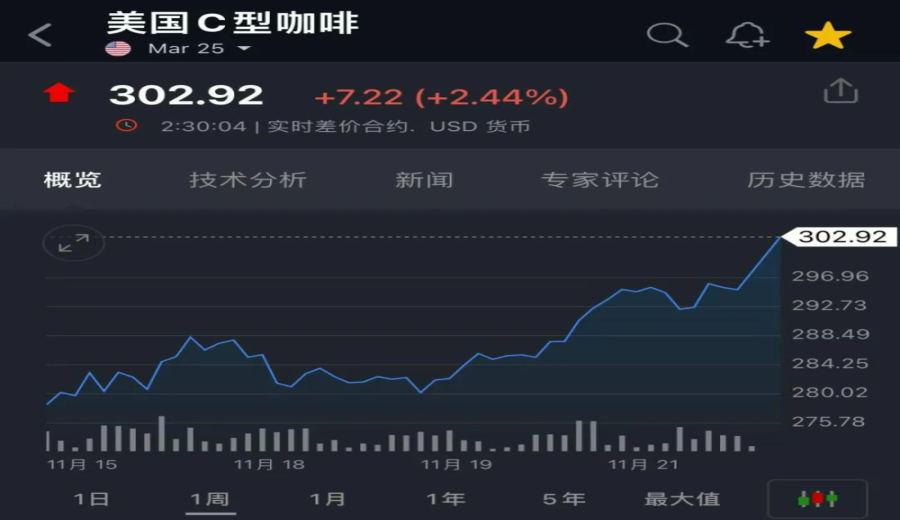
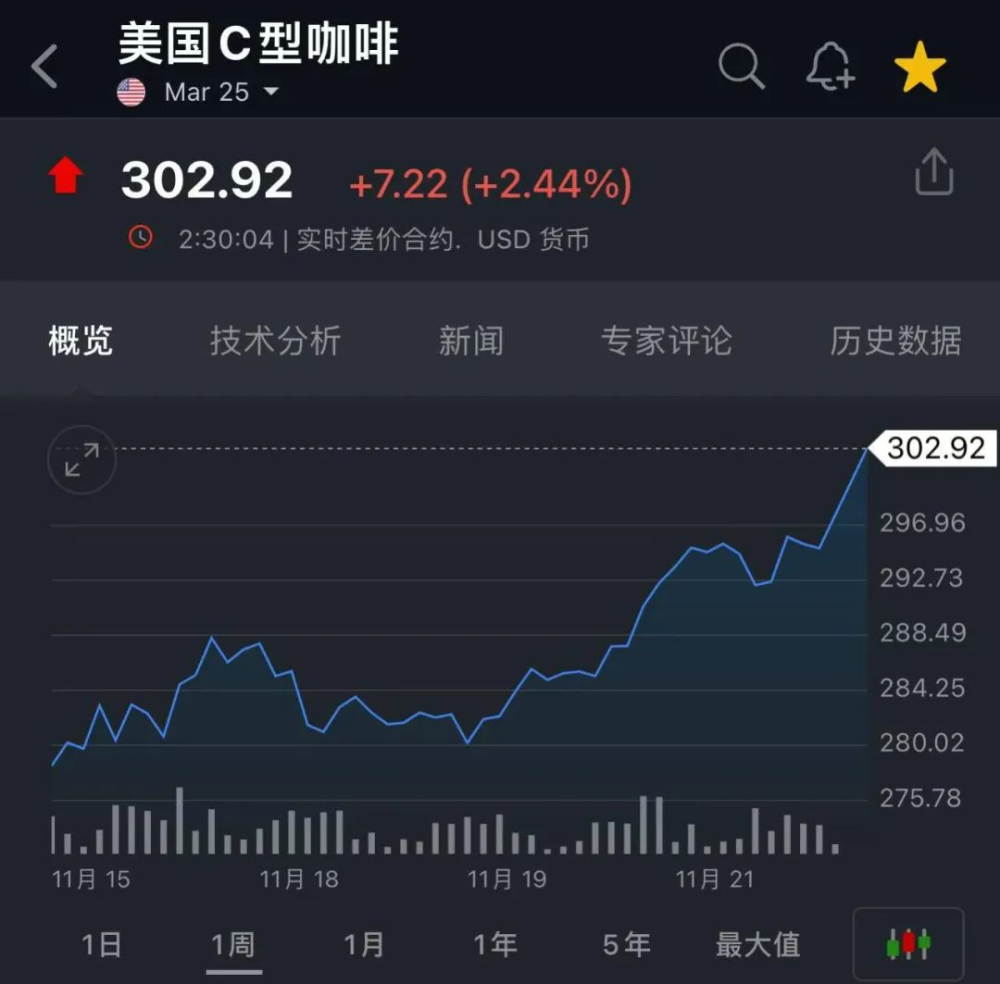
Introduction:Recently, the global coffee futures market has been shaken by volatility. For the first time ever, the U.S. C-market coffee futures price surged past the 300-cent-per-pound mark, briefly touching a 13-year high of 303.93 cents, while also driving up the price of Robusta futures. This article delves into the key drivers behind this surge—including Brazil’s worst drought in half a century, a sharp decline in inventory, and reduced output from major producing countries—helping you stay on top of market trends and future developments.
The global coffee market has recently witnessed a dramatic price movement, as the U.S. C-market coffee futures officially broke through the psychologically significant 300-cent-per-pound barrier, peaking at 303.93 cents during trading before closing at 302.92 cents. This marks the highest level since 2011, and the upward trend has also lifted the price of Robusta futures. Market analysts point out that this rally is not driven by a single factor but rather a combination of multiple negative influences.
As the world’s largest coffee producer, Brazil’s production trends have always been a key indicator influencing international coffee prices. According to the latest forecast from the U.S. Department of Agriculture’s Foreign Agricultural Service (FAS), Brazil’s coffee production for the 2024/25 season is estimated to be only 66.4 million bags (each bag weighing 60 kilograms), a significant downward revision of 5% from the previous USDA projection of 69.9 million bags. Even more concerning is that FAS also forecasts that Brazil’s coffee inventory will drop sharply to just 1.2 million bags by the end of the season, a year-on-year decline of 26%.
The regular supply and demand reports published by the USDA have long been crucial references for the international futures market. These reports provide detailed analyses of key data such as planting area, yield forecasts, and inventory changes, directly impacting futures prices. The substantial downward revision of Brazil’s production outlook has immediately sparked intense market concern about potential supply shortages, becoming the direct catalyst for the rise in Arabica coffee futures prices.
Notably, in addition to the FAS forecasts, Brazil’s official agency Conab has also revised its 2024 coffee production estimate downward—from 58.8 million bags to 54.8 million bags. Most international analysis agencies have followed suit with downward adjustments, reflecting a broadly conservative stance on Brazil’s coffee supply for the coming year. This collective pessimism has further intensified the upward pressure on prices.
Since April of this year, Brazil has been hit by persistent and abnormal drought conditions. According to data from Brazil’s National Center for Monitoring Natural Disasters (Cemaden), this marks the most severe drought the country has experienced since 1981. Particularly in the country’s central-southern regions, which are major coffee-growing areas, rainfall has consistently remained below historical averages, with some areas even experiencing extreme conditions where no effective rainfall occurred for over five consecutive months. Such climatic conditions have severely impacted the flowering stage of coffee trees and could further jeopardize the yield prospects for the 2025/26 season.
Although rainfall has returned to Brazil starting in October, providing some relief to the drought, experts note that it is no longer sufficient to fully compensate for the damage caused by the earlier dry spell. Notably, while international coffee prices remain high, Brazilian green coffee traders have chosen to slow down their sales pace. Due to uncertainties about future production, these suppliers are inclined to retain more inventory to meet potential demand, and this reluctance to sell has also contributed to the upward push in international coffee prices.
Brazil is not the only affected producing region. Honduras, the world’s fourth-largest Arabica coffee producer, has recently been hit hard by Tropical Storm Sara, triggering severe flooding and leading the country to declare a 30-day state of emergency. Local reports indicate that coffee crop losses in Lempira Province alone amount to as much as 400,000 quintals (approximately 20,000 metric tons), with other regions also experiencing varying degrees of agricultural facility damage.
Although the European Union has postponed the implementation of the EUDR (EU Deforestation Regulation) by one year, and Colombia—the second-largest Arabica producer—has seen an increase in output, uncertainty surrounding Brazil’s production outlook as the world’s largest supplier, combined with simultaneous production declines in multiple countries, has kept international coffee futures prices elevated and volatile. Market experts predict that this tight supply situation is likely to persist into 2025, continuing to support global coffee prices.
For investors and consumers monitoring the coffee market, understanding these fundamental changes can help better assess future price trends. This is especially important for roasters and retailers reliant on imported coffee beans, for whom proactive inventory planning and risk management have become increasingly critical.
The above content is compiled by CoffeeHunters, a coffee news website.


