







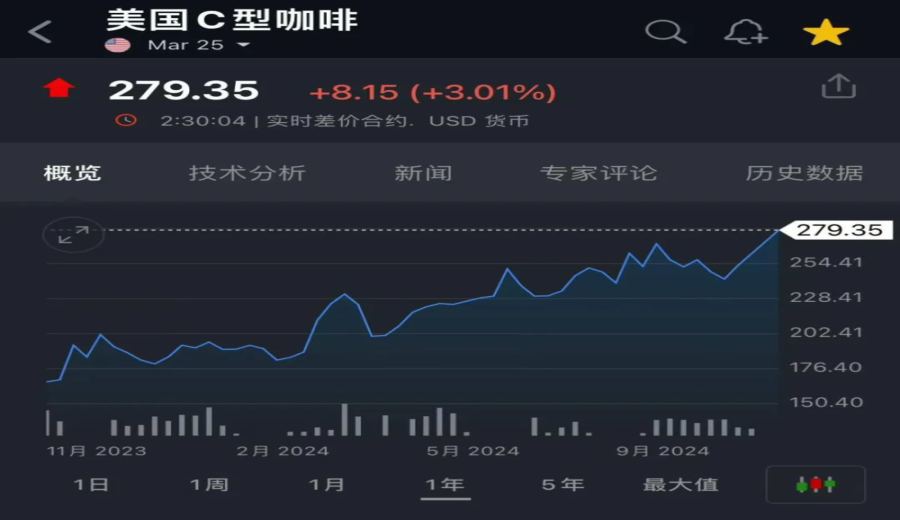
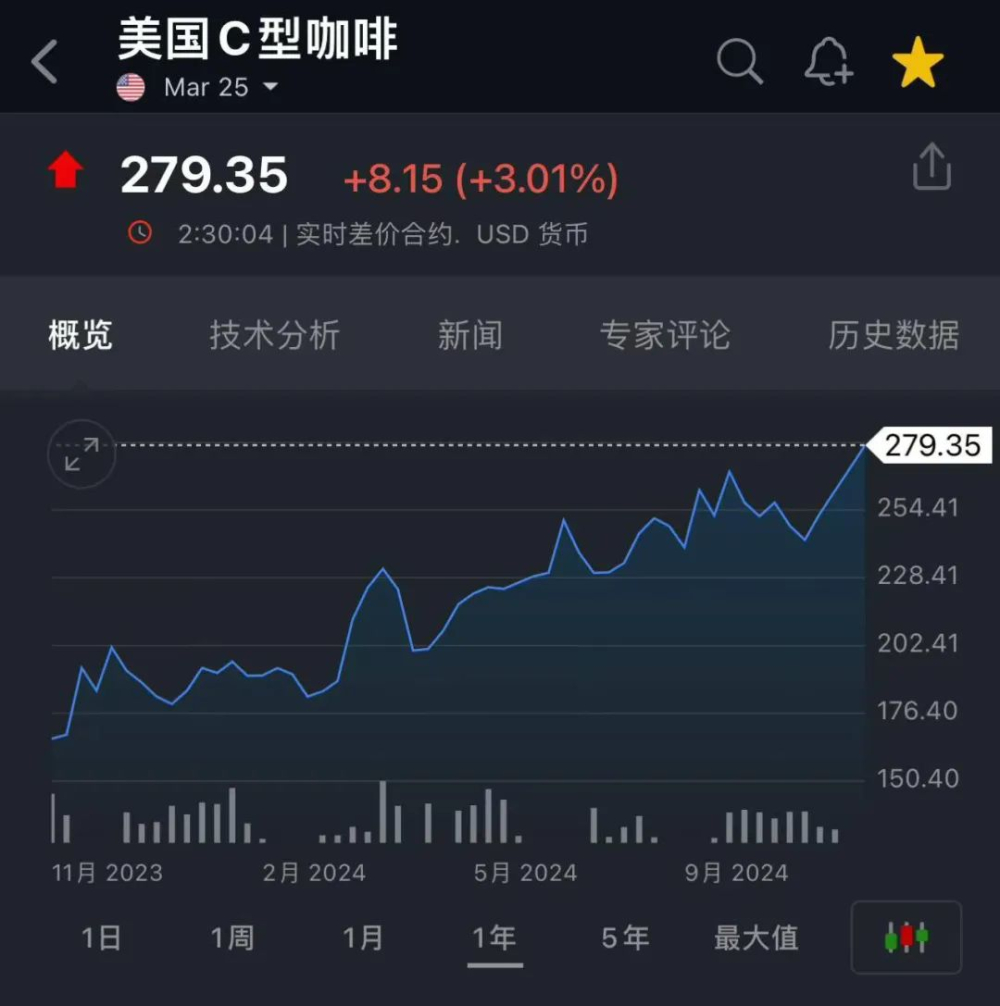
Introduction:Global coffee futures prices have recently hit record highs, with the U.S. C-market coffee futures briefly soaring to 284.93 cents per pound and ultimately closing at 279.35 cents per pound, marking a historic milestone. This surge is not driven by a single factor, but rather the result of multiple challenges piling up — including droughts in South America, regulatory changes in the European Union, and soaring shipping costs. This article dissects the six key reasons behind the price spike and analyzes short-term market trends to help readers understand the complex shifts in the coffee supply chain.
The global coffee market has recently been shaken, with the U.S. C-market coffee futures once again rewriting history. The price hit an intraday high of 284.93 cents per pound and closed steadily at 279.35 cents — a figure that not only sets a new recent peak but also draws market attention to future trends. This sharp rise is not caused by a single event, but rather the result of multiple complex factors interacting together.
Looking back to the end of September this year, when the U.S. C-market coffee futures broke through 273.4 cents per pound, it had already reached a ten-year high. At that time, the market generally attributed the surge mainly to unprecedented droughts and forest fires hitting major coffee-producing regions in South America, particularly Brazil and Colombia. These extreme weather events directly threatened the growing environment of coffee trees, and market concerns about future supply were quickly reflected in futures prices.
However, by October, the European Commission announced a one-year delay in implementing the “No Deforestation Regulation (EUDR),” pushing its enforcement to 2025. European buyers, who had previously stockpiled heavily in anticipation of stricter regulations, slowed their import pace as a result, leading to slight corrections in both Arabica and Robusta coffee futures prices. Nonetheless, this relief was only temporary.
On November 14, the European Parliament officially voted to approve the decision to postpone EUDR implementation by 12 months, along with a series of amendments adjusting the regulation’s content. While the market generally understands that this decision helps alleviate short-term supply pressures, many international coffee traders remain cautious about the globally tight supply situation, believing that the EUDR delay will not fundamentally resolve the supply-demand imbalance.
Turning to Brazil, the world’s largest coffee producer, after enduring a severe drought, the country has finally entered its rainy season. The rainfall has helped ease soil moisture deficits and reduce stress on coffee tree roots. However, industry experts point out that the current level of precipitation is only enough to maintain basic soil humidity and offers limited benefits to coffee trees damaged by previous droughts and fires. In some severely affected areas, production may drop by 20% to 30%, with overall output expected to decline by approximately 6.8%.
Even more concerning is that Brazil’s meteorological department predicts that the main coffee-growing regions could once again face dry, rainless weather in the coming days, further heightening market anxiety about production prospects in the next few months.
Meanwhile, the annual Atlantic hurricane season in the Americas, which typically runs from June to November, has been unusually active this year. According to forecasts by the U.S. National Oceanic and Atmospheric Administration (NOAA), the 2024 hurricane season is expected to be “extraordinary,” with an 85% probability of exceeding normal activity levels. Reality has borne out this prediction, as hurricanes have impacted not only North America but also several coffee-producing countries in Central and South America.
Countries such as Colombia, Costa Rica, Honduras, and Panama have all experienced severe impacts on their coffee plantations and supply chains due to heavy rains, floods, and landslides brought by hurricanes. This has further intensified market concerns over supply stability and become another major factor driving up futures prices.
In addition, the recent U.S. presidential election has also had a significant impact on the coffee futures market. During the election period, the U.S. dollar had already shown an upward trend, and after Trump announced his victory, the U.S. Dollar Index climbed rapidly, reaching 107.06 on the evening of November 14 — a recent high. Since coffee is a globally traded commodity priced in dollars, a stronger dollar means higher import costs for other currencies. Importers need to pay more of their local currency to buy the same amount of coffee, which naturally pushes up coffee prices in the market.
Another factor that cannot be overlooked is geopolitics and the Red Sea crisis. Since November last year, tensions in the Red Sea shipping routes have continued to escalate, not only leading to increased costs across multiple critical transport routes but also extending transit times. Several African countries have seen rising prices due to disrupted shipping routes, which has further driven up the overall cost of coffee.
Recently, container shipping prices have also risen again, mainly due to congestion at some ports on the Europe-Americas routes, waves of strikes, and the concentrated export of foreign trade orders during the Christmas season. This has led to a shortage of container supply, further increasing coffee transportation costs. All of these have become key contributors to the continuous rise in coffee futures prices.
Taking all these factors into account — including abnormal weather, policy adjustments, transportation bottlenecks, and international political instability — coffee futures prices have been pushed higher under multiple pressures. Even though the EU has passed the resolution to delay EUDR implementation, coffee futures prices are likely to remain high in the short term. Market participants need to continue monitoring the development of various variables.
The above content is compiled by CoffeeHunters, a coffee news website.


