







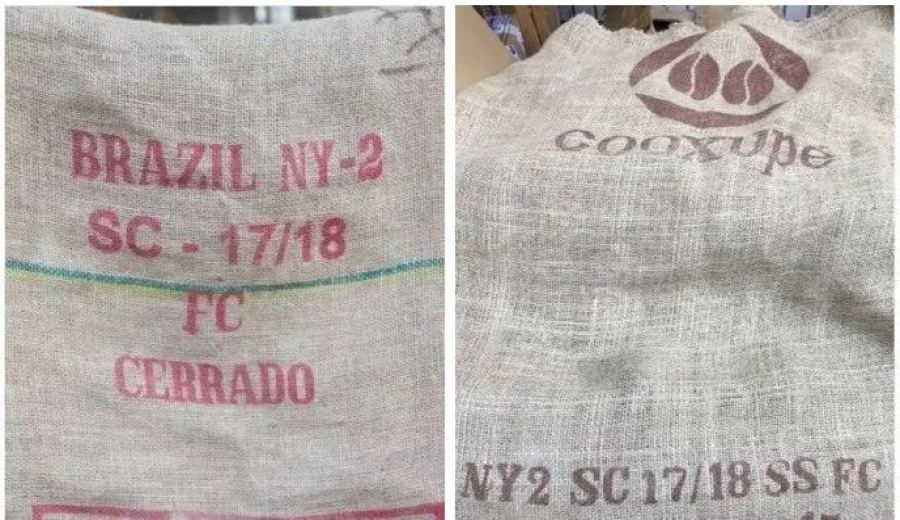
Introduction:Brazil is the world’s largest coffee producer, and its green beans are commonly found in various blended coffee recipes. However, when sourcing, the letters and numbers printed all over the jute sacks can be quite perplexing—such as markings like ‘SS’, ‘FC’, or ‘SC-17/18’. Behind these codes lies a rigorous grading system. This article will take you through a comprehensive breakdown of Brazil’s green coffee grading system, covering aspects such as origin, defect rate, screen size, cupping score, and sensory grade. By the end, you’ll be able to decipher the professional codes on those sacks at a glance and select the coffee beans that best suit your needs.
As the global leader in coffee production, Brazil accounts for about one-third of the world’s coffee exports. Its green beans are known for their low acidity, high sweetness, and full-bodied flavor, making them a foundational component in many espresso blends. When you open a bag of Brazilian green beans, you’ll often see labels like ‘CERRADO NY-2 SC-17/18 SS FC’. These seemingly random letters and numbers actually convey key information based on Brazil’s official grading system, covering five main aspects: origin, defect rate, screen size, cupping performance, and sensory evaluation.
To correctly interpret these codes, it’s essential first to understand their origin. This grading system was established by Brazil’s Ministry of Agriculture, Livestock and Supply (MAPA), aiming to provide international buyers with a clear and unified reference for quality. Overall, the grading of Brazilian green coffee is assessed across five dimensions: origin, defect ratio, screen size, cupping score, and final sensory grade.
Let’s start with origin. Brazil has 26 states, 17 of which produce coffee. Each state can even be further divided into different sub-regions. Common region names include ‘CERRADO’ (Cerrado), a well-known sub-region, along with others such as MOGIANA (Mogiana) and SUL DE MINAS (South of Minas). Sometimes you may also see port names on the sacks, such as ‘Santos’, indicating that the coffee was exported from Brazil’s Port of Santos.
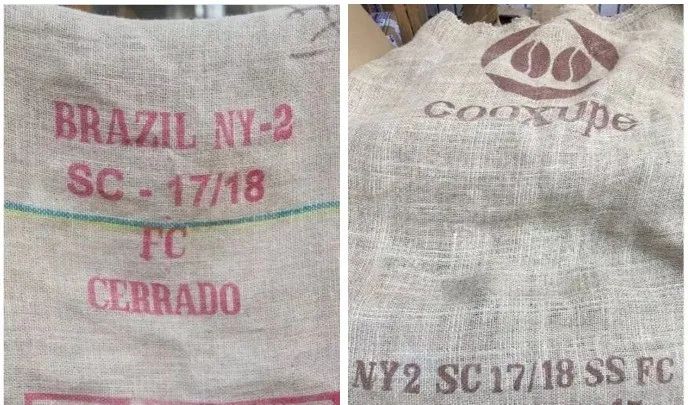
Next is the assessment of defect rate. Brazil adopts the standards of the Green Coffee Association of New York, using ‘NY’ as the prefix. It’s worth noting that there is no ‘NY1’ in Brazil’s grading system—the highest grade is ‘NY2’. This is because Brazil primarily relies on large-scale mechanical harvesting, which, while improving efficiency, inevitably results in some defective beans, making zero defects almost impossible. The numbers following NY, such as 2, 2/3, 3, 3/4, and 4, represent the ratio of defects. The smaller the number, the higher the quality. Defects are typically calculated by taking a 300g sample of green beans and counting the number of defective ones to determine the grade.
After confirming the defect grade, the next step is screening by mesh size. Here, ‘SC’ refers to the aperture size of the screen, or in other words, the size of the coffee beans. Common grades include ‘SC-17/18’, indicating that the beans in this batch are sized between 17 and 18 screens. Generally, beans sized 17 and 18 are considered high-quality grades because larger beans tend to perform more consistently during roasting and extraction. It’s important to note that Brazilian coffee comes in both flat beans and peaberries; flat beans usually fall within a range of 10 to 19 screens, while peaberries range between 8 and 13 screens. Therefore, a size of 17/18 is already considered top-tier for flat beans.
After size screening, the next step is cupping. The scoring method follows the standards set by the Specialty Coffee Association (SCA) and classifies the beans into several grades based on flavor performance, including: Strictly Soft (SS), Soft (S), Softish, Hard, Hardish, Rioy/Rioysh, and Rio. Among these, ‘SS’ is the highest grade, typically representing a cupping score of 85 or above, with excellent flavor balance and delicate taste. Next is the ‘S’ grade, with scores between 80 and 84. Further down is ‘Softish’, scoring around 75 to 79, with relatively ordinary flavor performance.
The final element is the sensory grade, also known as the ‘cup quality grade’, which is divided into six levels: Fine Cup (FC), Fine, Good Cup, Fair Cup, Poor Cup, and Bad Cup. Among these, ‘Fine Cup (FC)’ and ‘Good Cup (GC)’ are the two most common classifications, with ‘FC’ typically indicating that the coffee has a good and consistent flavor profile in sensory evaluation—a grade favored by many importers and roasters.
Putting all this information together, for example, if you see a sack labeled ‘BRAZIL NY-2 SC-17/18 SS FC CERRADO’, it means that these beans come from Brazil’s Cerrado region, have a defect rate grade of 2 (relatively low), a bean size of 17 to 18 screens, a cupping performance that meets the high standard of Strictly Soft, and a sensory evaluation of Fine Cup. This makes them a batch of very high-quality green beans. They are also one of the base bean types commonly used by many well-known coffee brands in their blends.
The above content is compiled by CoffeeHunters, a coffee news website.


