








Introduction:Explore how El Naranjo Estate in Honduras has risen to prominence on the international coffee stage, thanks to its 1800-meter altitude and masterful cultivation techniques. This article delves into the unique characteristics of the estate’s Catuaí and Geisha varieties, the key factors behind its Cup of Excellence victories, and the impact of its distinctive orange tree shade system on flavor—offering an in-depth look at the rise of Honduras’ specialty coffee and its sustainable farming practices.
In recent years, Honduras has emerged as one of the world’s leading coffee-exporting nations, ranking third in Latin America and fifth globally in export volume. This once-overlooked Central American country is now reshaping the international market with its high-quality specialty coffee. Located in the Marcala region, El Naranjo Estate (El Naranjo), with its astonishing altitude of 1800 meters and the perfect combination of Catuaí and Geisha varieties, has claimed top honors multiple times at the Cup of Excellence (COE) competition, becoming a model for Honduras’ specialty coffee.

The transformation of Honduras’ coffee industry began in the mid-20th century. In the early days, due to poor transportation and underdeveloped infrastructure, coffee was limited to domestic sales. With the government’s push for road construction, participation in free trade agreements, and the establishment of the official IHCAFE agency in the 1970s—which aimed to improve production and quality—the country’s coffee output surpassed that of neighboring regions by 2011. Notably, the unique microclimate of the Marcala region—featuring mild, humid valley conditions and mineral-rich volcanic soils—provides ideal growing conditions for specialty coffee.
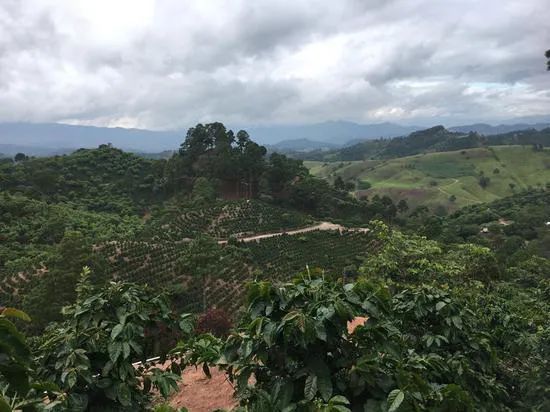
The Montecillos region, where El Naranjo Estate is located, is known for its diverse terrain and abundant rainfall.The estate sits at an altitude of 1800 meters, making it one of the few ultra-high-altitude coffee-growing areas in Honduras. This elevation creates a significant diurnal temperature variation, a key factor in developing bright acidity and complex aromas. The dense canopy of orange trees on the estate provides a natural shade system that not only moderates sunlight intensity but also imparts a unique citrusy character to the coffee.
The estate is managed by third-generation coffee farmer Roger Antonio Dominguez Marquez and his wife Carmen, whose family has accumulated over half a century of cultivation experience. In addition to El Naranjo Estate, they also oversee other estates such as Flor de Montaña and Guava Estate, located at altitudes of 1300-1500 meters, forming a comprehensive variety-testing system. Notably,El Naranjo Estate focuses on cultivating two main varieties: Catuaí and Geisha—the former is known for its balanced berry notes and full body, while the latter showcases jasmine floral aromas and a tea-like finish.
In terms of production processes, the estate strictly adheres to IHCAFE’s guidelines for high-quality coffee production. Starting with the manual harvest of fully ripe cherries, the beans undergo meticulous washed processing and at least 20 days of drying on African beds, with each batch sorted by bean size using screens. The owners revealed that they regularly send samples to IHCAFE laboratories for testing, with a focus on monitoringkey parameters such as moisture content (maintained at 11-12%) and defect bean ratio (with premium batches kept below 3%).
The coffee from El Naranjo Estate boasts a highly distinctive flavor profile:A bright lemony acidity leads into fruity notes of peach and orange, followed by mid-palate white flower and honey sweetness, with a lingering warm spice note in the finish. This flavor combination has consistently earned favor from judges at the COE competition, particularly scoring highly in categories such as “brightness of acidity” and “aroma complexity.”
Beyond its competition achievements, the estate actively participates in IHCAFE’s origin certification program. By implementing sustainable practices such as terraced farming, preserving native tree species for shade, and controlling pesticide use, the estate not only protects local biodiversity but also ensures long-term soil fertility. This comprehensive quality management strategy makes El Naranjo Estate a prime example of the evolution of Honduras’ specialty coffee.
The above content is compiled by CoffeeHunters, a coffee news website.


