







Introduction:Although not as well-known as Brazil or Colombia, Peru is an important organic coffee-producing country in South America, where high altitudes and diverse microclimates foster unique coffee flavors. This article will take you on an in-depth exploration of the characteristics of Peru’s three main coffee-growing regions, the outstanding performance of Pedregal Estate in the COE competition, and the local bean classification system based on altitude and bean size—helping you better understand Peru coffee’s potential and key quality indicators.
Among the many coffee-producing countries in South America, Brazil and Colombia often steal the spotlight. However, Peru, nestled deep in the Andes Mountains, also harbors coffee potential that should not be overlooked. Thanks to its exceptional geographical environment—including high-altitude mountainous regions, fertile volcanic soils, and varied climates—Peru has firmly established itself as a major global coffee supplier and is also one of the world’s largest producers of organic coffee.
The Andes Mountains run the length of Peru from north to south, with about one-third of the country’s land consisting of mountainous terrain. The country can be broadly divided into three major regions: the western coastal plains, the central mountain plateau, and the eastern Amazon rainforest. Although located in the tropics, Peru's diverse topography gives rise to as many as 28 different climate types within its borders. This climatic diversity is a key reason for the rich flavor profiles found across its coffee-growing regions.
Coffee cultivation in Peru is mainly concentrated in the central Andean highlands, which feature a tropical mountain climate with stable summer rainfall. As altitude increases, both temperature and humidity gradually decrease—conditions that are highly favorable for coffee tree growth. Most coffee here is grown on slopes, benefiting from ideal conditions such as high altitude, volcanic soil, and moderate day-night temperature variations. These factors help coffee cherries accumulate flavor compounds, resulting in a balanced acidity and sweetness, along with rich aromatic profiles.
Peru’s history of coffee cultivation dates back to the 18th century, making it one of the earlier countries in the Americas to grow coffee. However, coffee production in the early days was primarily for domestic consumption and only began to expand for export in the early 20th century. For a long time, the industry was driven by smallholder farmers with limited access to technology and funding, resulting in slower development. Yet, this also meant that much of Peru’s coffee retained traditional farming methods—such as using natural fertilizers, hand-picking, and rigorous selection—preserving the beans’ original flavor characteristics.
With the rising global demand for specialty coffee, Peru’s coffee industry has gradually gained recognition. Today, it is not only a major global coffee exporter but also one of the world’s largest producers of organic coffee. Its coffee is widely known for sustainable and natural cultivation practices, earning favor among international buyers and cupping judges.
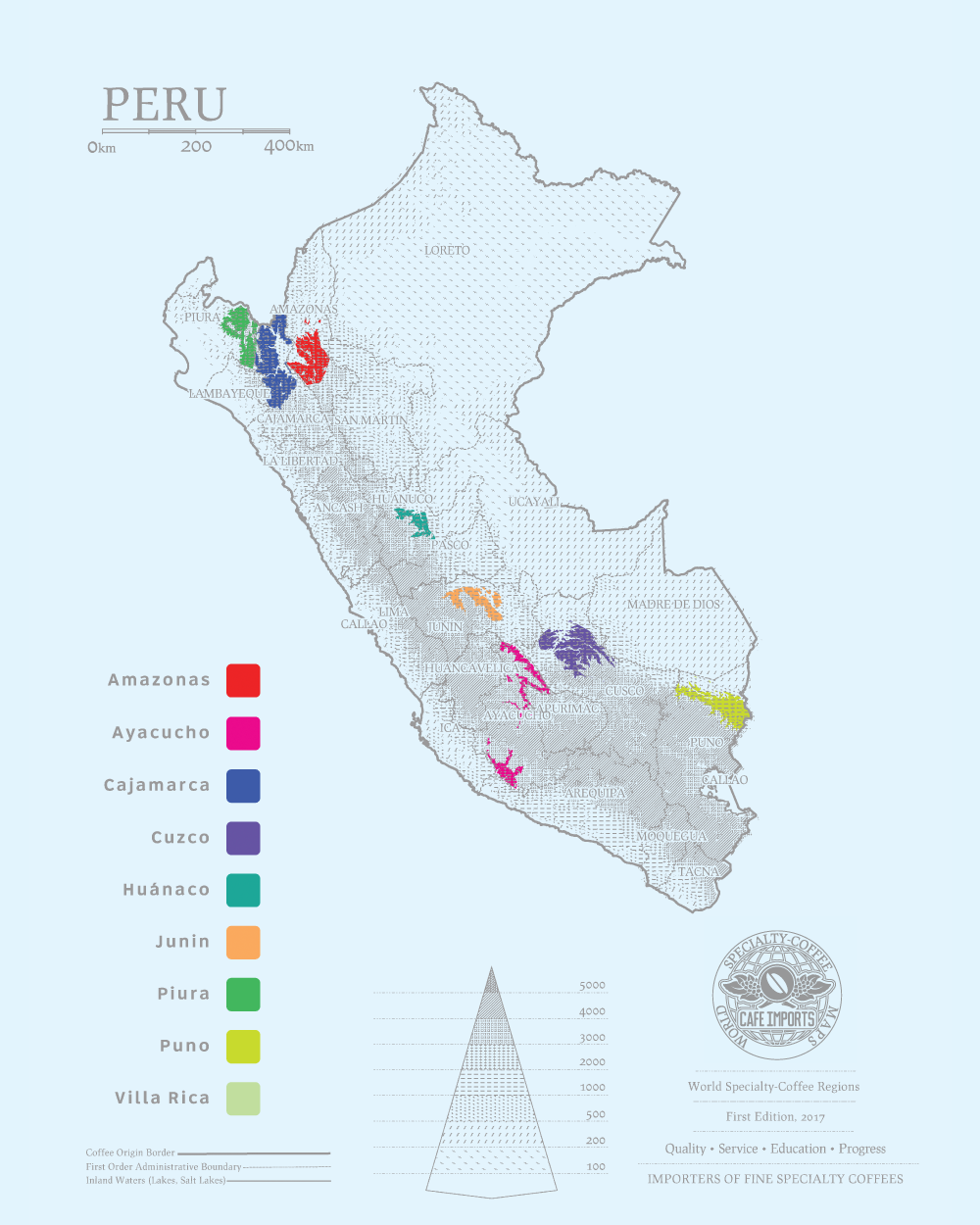
Peru’s coffee-growing regions can generally be divided into northern, central, and southern zones, with main cultivation altitudes ranging between 1,000 and 1,800 meters. Among them, the northern Cajamarca, central Junín, and southern Cusco regions are particularly renowned because their coffees have repeatedly been selected for the Peru Cup of Excellence (COE) competition. These regions not only benefit from superior geography but also maintain distinctive regional flavors and delicate profiles through small-scale, meticulous farming.
Take the 2023 Peru COE competition as an example: Pedregal Estate, located in the southern part of the Cusco region, won fourth place with a washed Geisha variety scoring 90.15 points. Managed by owner Abel Raymundo Arotaype Huayllas and his family, the estate is situated in a rather remote location but boasts excellent natural surroundings and growing conditions.
Pedregal Estate began planting coffee in 2005, initially cultivating traditional varieties such as Typica, Bourbon, and Catimor. Over time, the estate gradually shifted its focus to Geisha. Sitting at an impressive altitude of 2,240 meters, the high elevation slows the ripening process of coffee cherries, allowing more complex aromas and flavor layers to develop. Coupled with the region’s humid climate, mineral-rich soils, shaded cultivation, and symbiotic growing environment with surrounding fruit trees—all providing natural organic nutrients—these factors further elevate the coffee’s quality.
The Cusco region is not only a famous historical and cultural destination in Peru, but also an important source of mountain-grown coffee. It features spectacular landscapes, including Ausangate Mountain, which rises 6,374 meters above sea level, and the Urubamba River—referred to as the “Sacred River”—that flows through the area, ensuring ample water supply. Moreover, due to varying elevations, the mountainous areas enjoy cool climates while valleys are relatively warmer. These shifting microclimates offer diverse growing environments for coffee trees, contributing to the complexity and uniqueness of the region’s coffee flavors.
In Peru, the coffee bean grading system is primarily based on altitude and bean size, supplemented by defect counts as evaluation criteria. Generally speaking, the higher the altitude, the greater the bean density and hardness, which helps stabilize flavor release during brewing. Common grading categories include:
Strictly High Bean (SHB)SHB (Strictly Hard Bean): Grown at altitudes above 1,350 meters, these beans typically feature bright acidity and rich aromatics.
High Bean (HB)HB (Hard Bean): Grown at altitudes between 1,200 and 1,350 meters, these beans offer balanced flavors and a full-bodied mouthfeel.
In addition, origins also screen beans based on size and defect rates to ensure consistent quality. Many buyers also refer to cupping results as supplementary indicators of flavor performance. When selecting Peruvian coffee, these grading standards are considered together to help assess the beans’ potential flavor profile and overall quality level.
In summary, although Peruvian coffee may be less prominent on the international stage, its premium natural conditions and increasingly refined regional management have made it a noteworthy origin for consumers seeking fresh flavors and sustainable coffee. If you’re curious about regional flavor profiles, processing details, or bean grading systems, diving deeper into Peru will add a new dimension to your coffee experience.
The above content is compiled by CoffeeHunters, a coffee news website.


