








Introduction:Pacific Coffee has once again made headlines with store closure news. All of its directly operated stores in Zhuhai will cease operations by mid-October, leaving only three franchised outlets — marking the continued contraction of what was once China’s second-largest coffee chain brand. This article details the store closures in Zhuhai, traces the brand’s recent downsizing trajectory, and explores consumers’ complex feelings about its future as well as market observations.
Pacific Coffee has once again become the focus of market attention. It is understood that several of the brand's directly operated stores in Zhuhai will gradually close by mid-October, including well-known locations such as the Huafa Waterfront Store, Haitian Station Store, and City Balcony Store along the Lovers' Road. After this round of adjustments, all directly operated stores in Zhuhai will be completely withdrawn, leaving only three franchised stores to carry on. The brand, which once boasted nearly 500 stores and was China’s second-largest coffee chain, now has fewer than 100 outlets — a sharp decline that has drawn widespread sighs from the market.
It is reported that the Huafa Waterfront Store has announced it will cease operations after October 13th. According to online user tracking, the Haitian Station Store and the City Balcony Store are also set to close between October 13th and 14th. These outlets, located along Zhuhai’s Lovers' Road, not only enjoy prime locations but have also become popular photo spots for many travelers due to their unique styles. The closure of these stores has left many local residents feeling quite regretful.
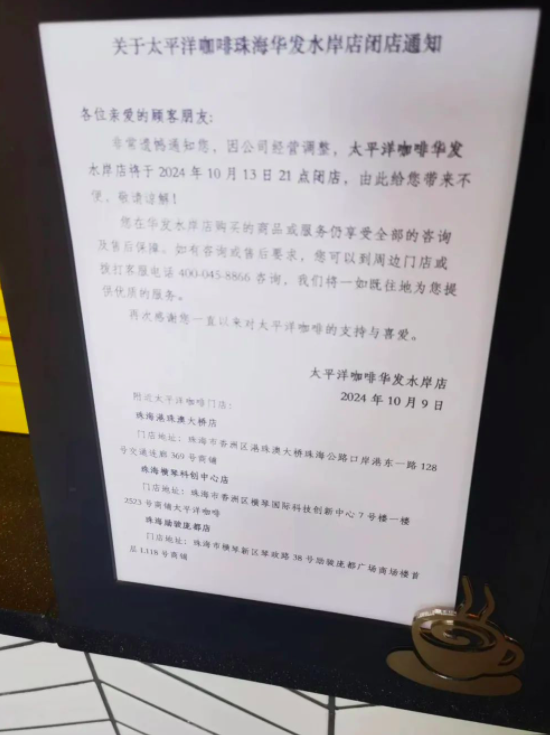
Notably, after this round of adjustments, all remaining stores in Zhuhai under the Pacific Coffee brand will be franchised, indicating that the brand is completely exiting the directly operated market in Zhuhai. In fact, signs of the brand’s store shrinkage had already emerged. As early as the end of last year, media reported that Pacific Coffee was facing a large-scale wave of store closures, with the total number of outlets plummeting from a peak of nearly 500 to just over 100, drawing much concern and unease among consumers.
According to recent statistics, as of October 7th, the number of Pacific Coffee’s operating stores across China was 203. Excluding the 104 stores in Hong Kong and the 1 store in Macau, there are only about 98 stores still operating on the mainland. However, further examination of its official mini-program shows that even fewer — just 68 stores — are currently marked as open. In cities such as Chengdu, Hefei, and Dongguan, there are no stores left at all, while in places like Hangzhou, Huzhou, and Chongqing, although 1 or 2 stores may still appear on the list, most are shown as “temporarily closed,” leaving their actual operational status yet to be confirmed.
Pacific Coffee, which once had a dense presence in Guangdong Province, is now also facing severe reductions. Previous reports indicated that five of its stores in Dongguan have successively closed. If the complete withdrawal of directly operated stores in Zhuhai proceeds, the number of stores in Guangdong will be reduced to just 21, further diminishing the brand’s influence in the region.
As one store after another closes, the mood of many coffee enthusiasts has shifted from initial disappointment to regret. Many consumers say that Pacific Coffee is actually not inferior to mainstream brands like Starbucks or Luckin in terms of ingredient selection and coffee quality. Backed by the powerful capital of China Resources Group, it should have been able to expand further — especially setting up shop in high-traffic malls such as MixC and MixC World — yet it failed to seize the opportunity and gradually lost competitiveness amid market changes.
Some commentators point out that Pacific Coffee should have been a strong player in the market, but its failure to keep pace with industry trends and changing consumer preferences led to a gradual loss of market position. From once being on par with Starbucks, it has slid to the brink of becoming an almost forgotten fringe brand. While loyal customers lament the brand’s decline, they still hope the pace of closures can slow down a little, allowing them a few more chances to savor that once-beloved cup of coffee.
The future of Pacific Coffee remains uncertain, but one thing is clear: in this rapidly evolving coffee market, only by keeping up with consumer trends and innovating services can a brand remain competitive in the fierce landscape.
The above content is compiled by CoffeeHunters, a coffee news website.


