







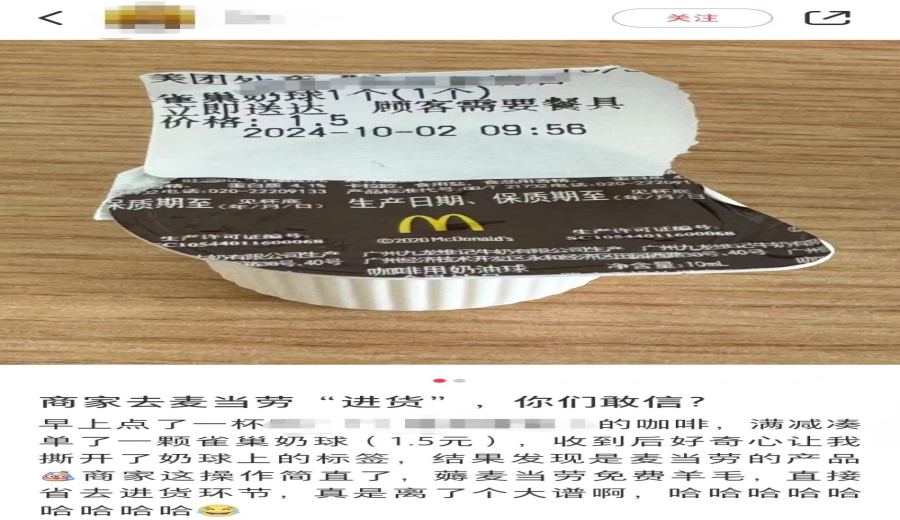
Introduction:A consumer purchased a milk ball labeled as "Nescafé" for 1.5 yuan to meet the minimum order amount, only to find upon opening it that it bore the McDonald's brand logo. This raised questions about whether the seller was reselling free accessories from fast-food restaurants. What is the true origin of this milk ball? Does an official supply channel for branded milk balls exist in the market? This article delves into the truth behind the coffee ingredient supply chain involved in the incident.
When ordering takeout, many consumers often add small items like sugar packets or milk balls to meet the minimum spend requirement. Recently, one customer, aiming to reach the delivery threshold, bought a Nescafé-labeled milk ball for 1.5 yuan from a certain café. However, after receiving the delivery, they peeled off the outer label and were shocked to find that the milk ball inside bore the McDonald's brand logo, prompting their suspicion.
Generally, when McDonald's serves black coffee, it typically includes a milk ball and a packet of sugar, allowing customers to adjust the flavor to their preference. As a result, many regular black coffee drinkers often accumulate leftover milk balls and sugar packets over time. The consumer speculated whether the café in question had collected milk balls freely obtained by customers from McDonald's and then resold them for profit.
The incident sparked heated discussions online. Some netizens recalled instances at McDonald's, KFC, and other fast-food chains where customers, due to personal taste preferences, asked staff for extra milk balls or sugar packets. Some even requested as many as ten or more milk balls for just a single cup of coffee—a practice seen as “coupon hunting” that also increased operational costs for the stores. As a result, multiple fast-food brands, including KFC and Pizza Hut, have in recent years phased out the free provision of milk balls, sugar packets, and stirring sticks, among other coffee accessories.
However, McDonald's has not yet explicitly restricted or announced the discontinuation of these free coffee accessories, and customers can still request them based on their needs. Therefore, some netizens believe that the café owner might be reselling McDonald's free milk balls that had been accumulated over time.
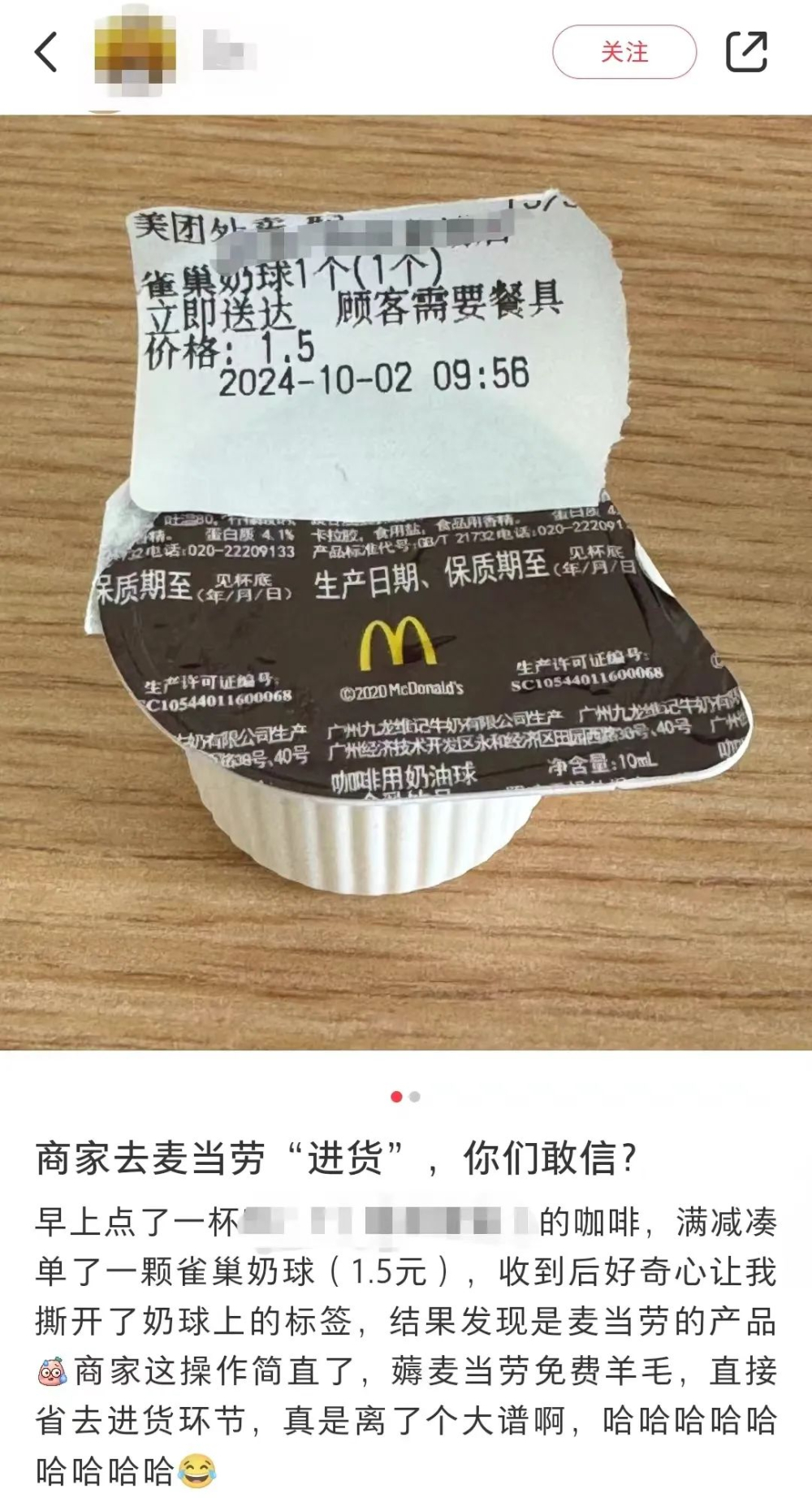
Yet, other netizens countered this theory, arguing that the assumption does not hold. They pointed out that on some e-commerce platforms, products labeled as “McDonald’s style” milk balls can be found. These items are actually legitimate products manufactured by raw material suppliers—not giveaways from fast-food outlets. Thus, it is possible that the milk balls sold by the café were procured through a formal supply chain rather than “sourced” from McDonald’s stores.
In addition, some attentive netizens noticed that the controversial milk ball in question was neither from Nescafé nor McDonald's, but produced by “Vitasoy.” Clear information on the packaging identifies the true brand as Vitasoy, contrary to the labeling commonly used by the store. This discovery also highlights potential mislabeling issues in cafés and serves as a reminder for consumers to pay closer attention to product details when making purchases.
What appears to be a simple consumer incident actually reveals the multifaceted nature of accessory supply in the coffee industry—from free giveaways at fast-food restaurants, to officially supplied products from raw material vendors, to potential oversights in merchant labeling—all of which merit deeper reflection from both consumers and industry players.
The above content is compiled by CoffeeHunters, a coffee news website.


