







Introduction:The international coffee market is experiencing unprecedented price volatility, with Robusta spot prices hitting their highest level in nearly 47 years and futures surpassing $5,285 per ton. A confluence of abnormal weather, geopolitical conflicts, and policy changes has placed global coffee supply under severe strain. This article delves into the ICO’s August report to uncover the key drivers behind the price surge and assess the feasibility of the 2023/24 production and sales forecasts.
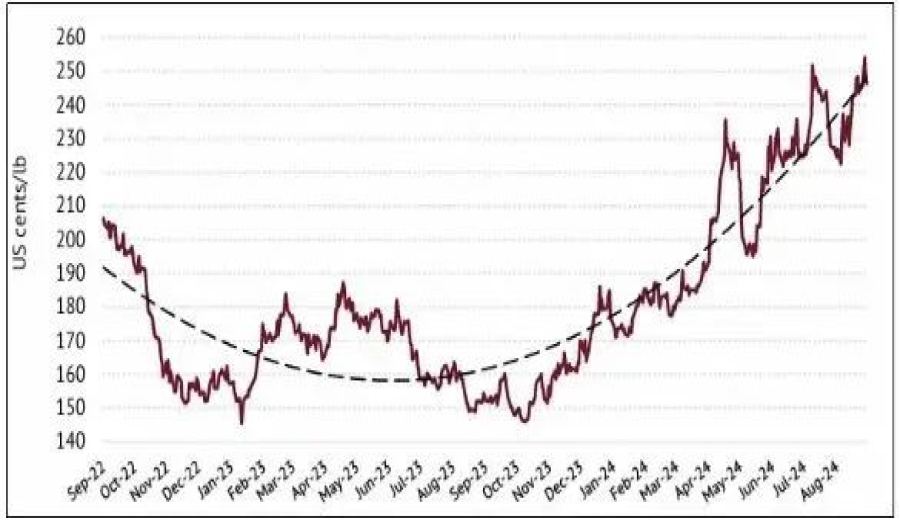
According to the latest industry report released by the International Coffee Organization (ICO) in August, the global composite coffee price averaged 238.92 US cents per pound. Although this represented only a slight monthly increase of 1% from July, it marked a significant year-on-year rise of 54.6%. Over the course of the month, prices fluctuated between 222.58 and 254.12 cents, indicating noticeably heightened market volatility.
Of particular note, Robusta coffee spot prices have remained at their highest levels in nearly 47 years for two consecutive months, while in the futures market, prices have even breached the historic threshold of $5,285 per ton. This price spike has been largely driven by worsening global climate conditions, persistently rising interest rates, and logistical bottlenecks triggered by Middle Eastern geopolitical tensions.
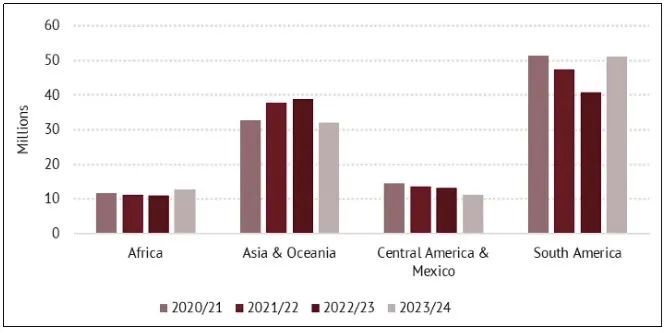
In terms of regional export performance, both Asia-Pacific and Central America saw declines in coffee exports. The Asia-Pacific region recorded an 8.1% drop, while Central America fell by 7.1%. Focusing on Asia-Pacific, Vietnam — a major global Robusta producer — has faced severe drought since the beginning of the year, leading to a sharp decline in coffee output and, consequently, exports. According to data from Vietnam’s General Department of Customs, the country exported 1.216 million bags (60 kg per bag) of coffee in August, slightly higher than the initially estimated 1.16 million bags, but still 14.1% lower than the same period last year. Looking at cumulative 2023/24 season data, Vietnam’s coffee exports have reached 23,441,199 bags, reflecting an annual decline of 12.71%.
In contrast to the Asia-Pacific region, South America showed relatively strong coffee export performance in August. However, starting in September, several countries in the region — including Colombia, Peru, Brazil, and Bolivia — reported severe wildfire incidents, many of which occurred in major coffee-growing areas. Persistent high temperatures and dry weather caused the fires to spread rapidly, causing significant damage to coffee trees and farmland.
Take Brazil as an example. Although the new harvest season had ended by the end of August, prolonged drought and insufficient rainfall during the harvesting period resulted in smaller coffee bean sizes and overall reduced yields. More worryingly, many parts of Brazil continued to suffer from drought and high temperatures after the harvest, triggering large-scale wildfires and burning some farmland, leading to serious air pollution issues. These conditions not only affect the growth and flowering of current coffee trees but could also negatively impact the yield of the 2024 new harvest season.
Additionally, the European Union’s upcoming Deforestation-Free Regulation (EUDR), set to take effect on December 31, 2024, is also a significant factor driving up market prices. To build sufficient inventory ahead of the regulation’s implementation, coffee traders across the EU have recently stepped up their procurement efforts, even purchasing at higher prices, further intensifying supply tightness in the market.
Despite numerous adverse factors, the International Coffee Organization remains relatively optimistic about the 2023/24 global coffee production and sales outlook. The report indicates that global coffee production is expected to reach 178 million bags this year, a 5.8% increase from the previous year. Of this, Arabica production is forecasted at 102.2 million bags, and Robusta at 75.8 million bags. Meanwhile, global coffee consumption demand is projected to grow by 2.2%, reaching 177 million bags.
However, many industry experts remain cautious about these projections, primarily due to concerns over a potential La Niña weather event by year-end. According to the latest assessment by the World Meteorological Organization, the probability of La Niña occurring between September and November this year is 55%, and this figure is expected to rise to 60% between October 2023 and February 2024. Should a La Niña event occur, it would significantly impact the climate in multiple coffee-growing regions, further elevating the risk of reduced yields.
The above content is compiled by CoffeeHunters, a coffee news website.


