







Introduction:The specialty coffee brand Seesaw has recently been embroiled in frequent legal disputes, ranging from a leasing conflict at Chongqing IFS to supply chain and labor disputes across multiple regions nationwide. Coupled with store closures in first-tier cities and poor customer reviews in lower-tier markets, the brand’s future development has drawn significant attention. This article outlines the operational challenges Seesaw is facing, analyzes the pros and cons of its strategic adjustments, and explores the competitive landscape in second- and third-tier cities.
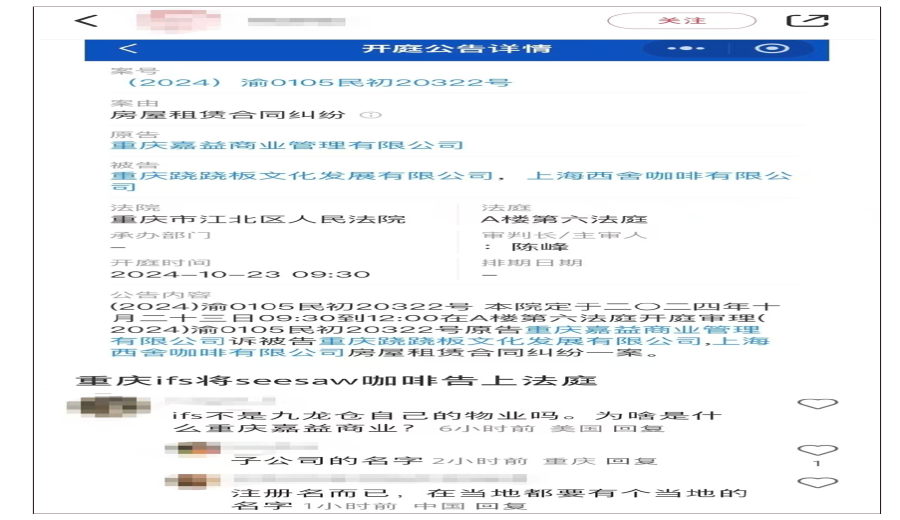
Once holding a notable position in the specialty coffee scene, Seesaw has now become the focus of attention due to a series of legal issues. Recently, it was revealed by netizens that the management of Chongqing IFS has officially filed a lawsuit against Seesaw over a commercial lease contract dispute, with the case expected to go to court in October. The plaintiff is Chongqing Jiayi Commercial Management Co., Ltd., a subsidiary of the mall, while the defendants include Chongqing Qiaoqiaoban Culture Development Co., Ltd. and Shanghai XiShe Coffee Co., Ltd.—the latter being the operating entity of Seesaw.
Seesaw entered Chongqing IFS in 2022, but the store closed around April 2024 and was subsequently taken over by competitor Grid Coffee. Notably, even after closing, the store remained in legal dispute with the landlord, leading outsiders to speculate whether there were rent disagreements or other underlying issues behind its exit.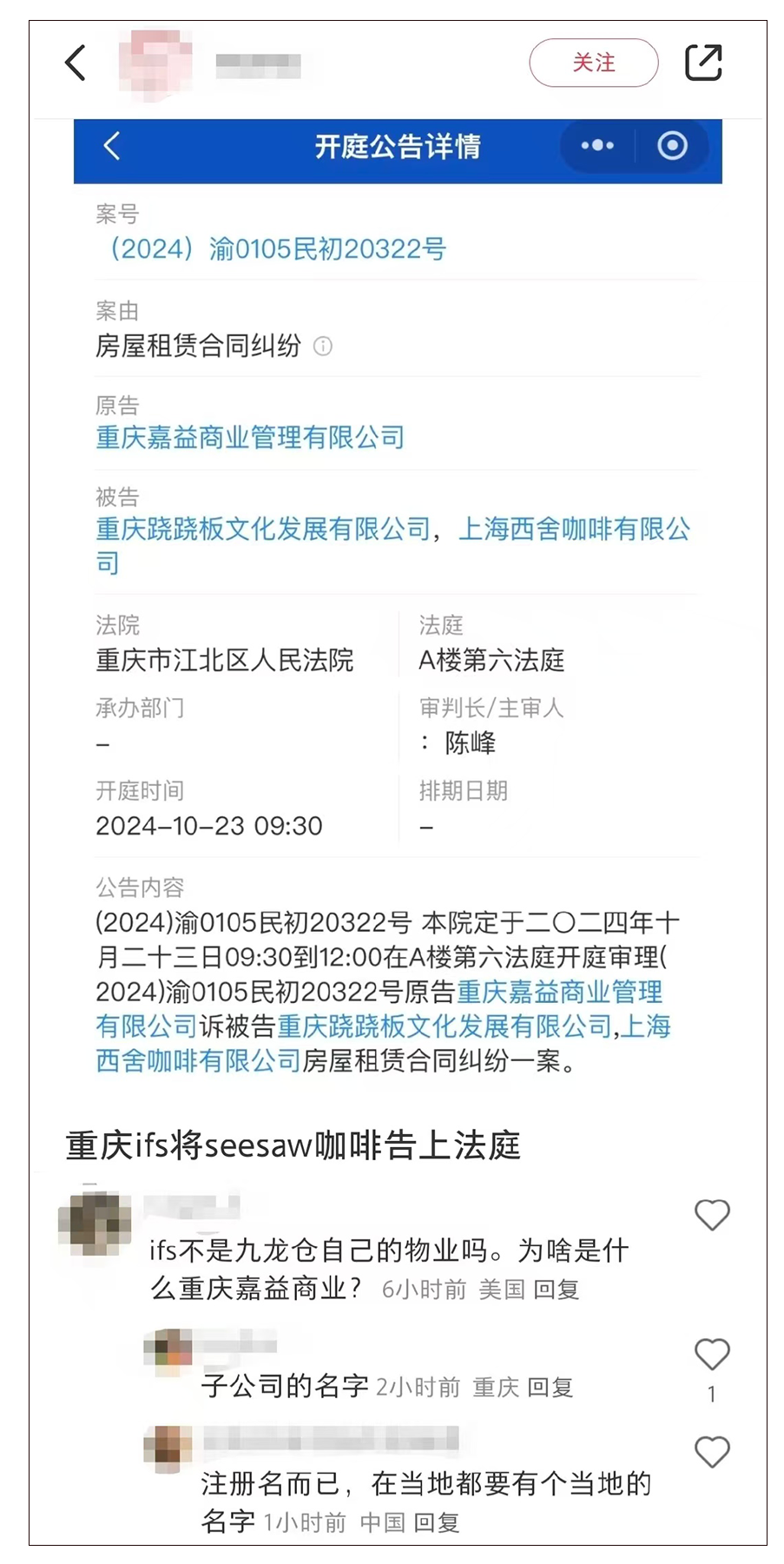
This is not an isolated case. According to data from Tianyancha, Seesaw has been involved in as many as nine legal disputes since 2024, covering types such as sales contracts, online copyright infringement, and service agreements, with some cases already entering the trial phase. In addition to landlords, suppliers and employees have also been involved in disputes—former employees revealed that although labor arbitration rulings have been issued, compensation has yet to be paid; in March this year, media reports also indicated suspected unpaid supplier payments, though the official response referred to it as “normal commercial disputes.” The frequent legal actions have nonetheless raised concerns among fans about the brand’s stability.
Parallel to the legal turmoil, Seesaw has been strategically scaling back in first-tier cities. News of store closures has emerged successively in Shanghai, Beijing, and Shenzhen, with a noticeable reduction in the number of outlets. At the same time, following the brand’s opening of franchising, new stores have concentrated in second- and third-tier cities such as Shandong, Shanxi, Henan, and Guizhou, as the brand seeks growth through these lower-tier markets.
This move is seen by some observers as a turning point—given the saturation of first- and second-tier markets, major chain brands are accelerating their expansion into lower-tier markets. Seesaw’s choice to enter provinces where it previously had less presence may allow it to tap into new customer groups. However, actual performance has fallen short of expectations. User reviews on third-party platforms show that newly opened franchise stores often receive negative feedback such as “poor cost-performance ratio” and “inconsistent product quality,” with some customers stating they would not return after just one try.
Currently, Seesaw only has the Guanghuan store left in Chongqing, which is flanked by Manner and Mstand. Among these three brands all positioned as specialty coffee, although Seesaw was the first to gain recognition, it now faces declining market share. Many local consumers are concerned that if the business situation continues to deteriorate, its last remaining store may follow suit and be replaced by emerging brands.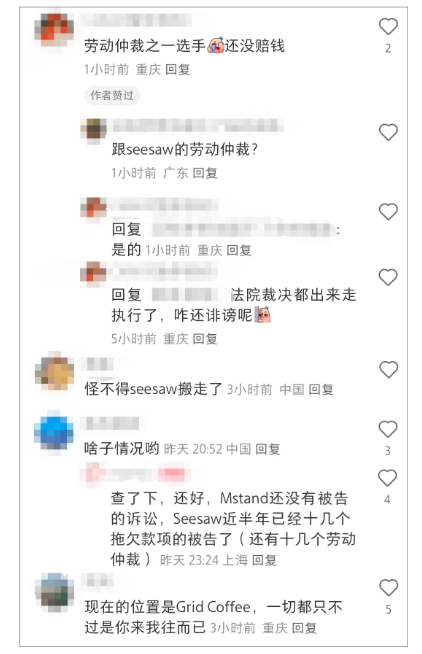
The above content is compiled by CoffeeHunters, a coffee news website.


