







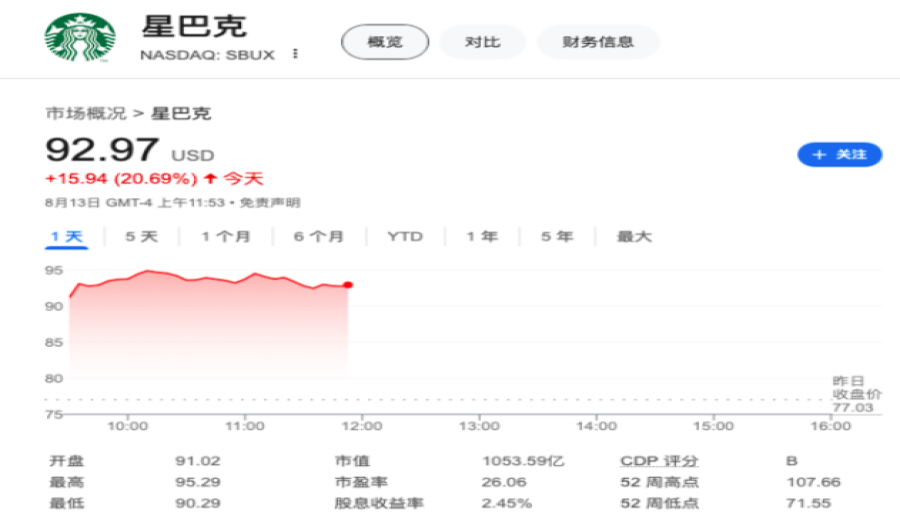
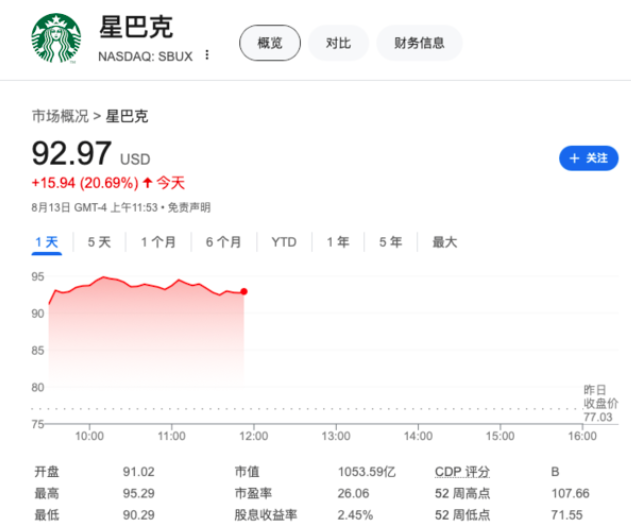
Introduction:Starbucks has announced that Brian Niccol, former CEO of Chipotle, will take over as its new leader, officially assuming the role on September 9. Following the announcement, the company's stock soared by over 20%, pushing its market value back above the $100 billion mark. This legendary figure in the food and beverage industry, who once drove Chipotle’s stock price up by 773%, is now tasked with reversing Starbucks’ ongoing decline in same-store sales and average spend per customer. This article takes an in-depth look at Niccol’s strategic approach, the challenges currently facing Starbucks, and the latest reactions from the Korean and Chinese markets.
The international coffee chain giant Starbucks recently announced a major leadership change, appointing Brian Niccol, former CEO of the well-known restaurant brand Chipotle, as its new Global CEO. He will officially take office on September 9. Current CEO Laxman Narasimhan will step down immediately. Following the announcement, Starbucks’ stock surged by more than 20% in a single day, rapidly recovering its market value to exceed $100 billion. A CEO who hasn’t even officially started yet has already added over $21 billion to the company’s market capitalization.
Brian Niccol is widely regarded in the food and beverage industry as a “turnaround expert.” Over the past six years, he successfully led Chipotle out of an operational crisis and a period of low brand trust. Between 2018 and 2022, under his leadership, Chipotle’s stock price rose a staggering 773%, with sales increasing by over 70%. The brand’s value quickly climbed to third place among global restaurant chains, only behind McDonald’s and Starbucks. His success is not limited to Chipotle. Before joining the brand, Niccol also served as CEO of Taco Bell and held senior positions at major companies such as Pizza Hut and Walmart, demonstrating exceptional corporate operations and market strategy capabilities.
In contrast, Starbucks’ recent financial performance has disappointed the market. According to the quarterly earnings report released at the end of last month, the company has seen consecutive declines in key metrics such as average spend per customer and same-store sales for two quarters. Overall revenue performance has fallen short of expectations, putting continued pressure on its stock price. Prior to the announcement of the new CEO, its shares had already dropped more than 20% from their previous highs. Faced with this performance bottleneck, Howard Schultz, Starbucks’ founder, publicly wrote to the board earlier this year, highlighting the challenges the company is facing and proposing reform suggestions. Therefore, this high-level personnel change is seen as the result of months of careful evaluation and planning by the board, rather than a hasty decision.
In addition to the major leadership change at its U.S. headquarters, Starbucks is also adjusting to cost pressures in some overseas markets. It is understood that Starbucks Korea announced on July 31 that it would adjust beverage prices, with the new pricing policy taking effect on August 2: the prices of large and extra-large drinks will be raised by 300 KRW (approximately 1.58 RMB) and 600 KRW (approximately 2.56 RMB) respectively, while the price of medium-sized drinks remains unchanged and small-sized drinks will be reduced by 300 KRW. This price adjustment mainly reflects the rising cost of international coffee beans and increased supply chain expenses. As the fourth-largest market for Starbucks globally, Korea’s move to adjust prices first has drawn attention to whether other regions will follow suit. However,Market changes depicted in the imagesalso raise questions about whether the new CEO can propose effective solutions to stabilize global operations.
Notably, in response to the leadership shake-up at headquarters, Starbucks China has quickly issued a statement, emphasizing that the change will not affect its operations in the Chinese market. A Starbucks China representative told the media: “The personnel adjustment at headquarters does not involve the Chinese market. Our confidence and commitment to the Chinese market remain as strong as ever, and we will continue to focus on the long-term development of our business here.” This shows that despite the major leadership transition at the global level, China—as Starbucks’ second-largest global market—is expected to maintain its established strategy and operational pace.
As Brian Niccol is set to officially take the helm at Starbucks in September, the industry is watching closely to see if he can bring the successful experience from Chipotle to this coffee giant—particularly in key areas such as enhancing customer experience, optimizing digital services, strengthening brand differentiation, and improving same-store sales performance. Whether he can create another “coffee industry legend” is something the market is eagerly anticipating.
The above content is compiled by CoffeeHunters, a coffee news website.


