







Introduction:Amid fierce price competition and market encroachment from domestic brands, Starbucks China saw both revenue and same-store sales decline in the third quarter of its 2024 fiscal year. CEO Brian Niccol openly discussed exploring strategic partnerships for the first time, sparking market discussions on franchising models and business transformation. This article analyzes the challenges Starbucks China faces, the motivations behind its transformation, and the potential impact of possible cooperation models on its market layout.
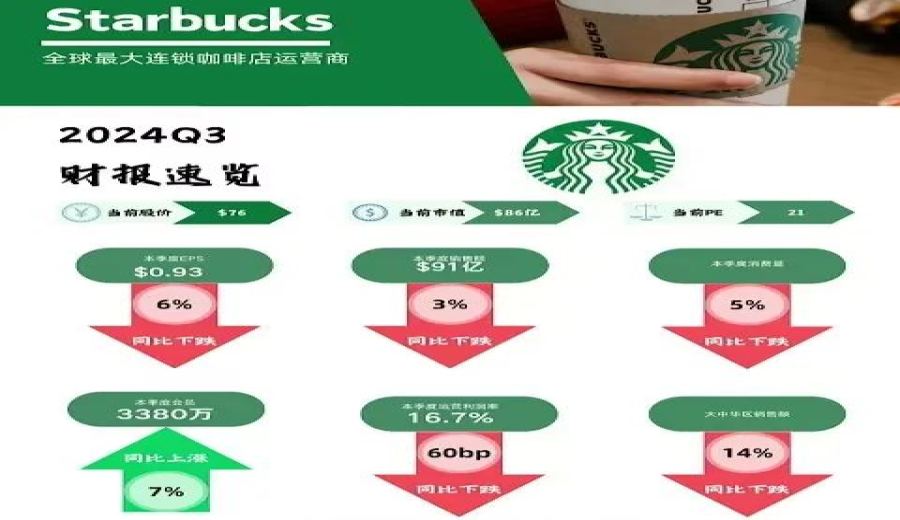
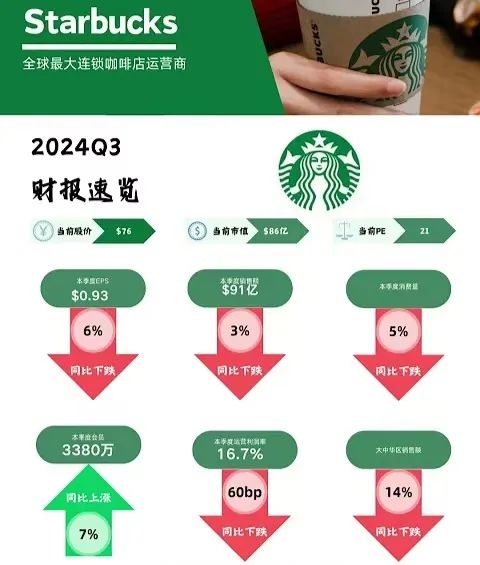
Starbucks’ recently released Q3 2024 financial report shows that its performance in the Chinese market remains sluggish, with revenue reaching $730 million, a year-on-year decline of 11%, and comparable store sales plunging by 14%. Breakdown data reveals that both average spending per customer and comparable transaction volume dropped by 7% respectively — a downward trend that has persisted for three quarters, reflecting the tangible impact of intensified market competition on the brand.
According to the financial details, in Q3 2024 (April 1 to June 30), Starbucks’ global consolidated net revenue was $9.11 billion, a slight 1% decline compared to the same period last year; net income attributable to shareholders fell from $1.14 billion a year ago to $1.05 billion. As a key strategic region, the performance of the Chinese market directly affects overall growth momentum.
During the earnings call, Starbucks CEO Brian Niccol admitted: “Over the past year, the Chinese market has experienced unprecedented store expansion and large-scale price wars. Some brands have been willing to sacrifice same-store sales and profitability, leading to significant and difficult-to-reverse changes in the market environment.” This statement directly points to domestic brands such as Luckin and Cotti using low-price strategies to seize market share, which has visibly impacted Starbucks’ profit structure.
Even as market competition intensifies, Starbucks China Co-CEO Belinda Wong emphasized that the brand remains rational in an environment of frequent promotions and firmly avoids engaging in a “price war,” maintaining its brand positioning and customer experience. However, this strategy has also presented Starbucks with challenges in terms of expansion speed.
In terms of store scale, competitor Luckin announced as early as July this year that its total number of stores had surpassed 20,000, while Cotti, which has been established for just over two years, is rapidly approaching Starbucks in store count. Although Starbucks has accelerated its store-opening pace this year, it still has some way to go before reaching its 2025 target of 9,000 stores, making improved expansion efficiency an urgent priority.
In response to market shifts, Niccol revealed that Starbucks is in the initial stages of exploring strategic partners. Over the past 25 years, the brand has successfully expanded its business through joint ventures and collaborations related to technology, real estate, and supply chains. In the future, it may seek new growth momentum through more flexible and open cooperation models — a signal interpreted by the market as potentially moving toward a franchising or licensing model.
In fact, in the early stages of entering the Chinese market, Starbucks adopted agency and joint venture models: Hong Kong and Guangdong were managed by Hong Kong’s Maxim’s Group; Jiangsu, Zhejiang, Shanghai, and Taiwan were operated jointly with Taiwan’s Uni-President Enterprises; and the northern market was run by H&Q Asia Pacific and Sanyuan Group. It wasn’t until 2017 that Starbucks fully reclaimed control of its stores in China, switching to a fully company-owned model. However, even though the number of stores has nearly doubled since 2019 to over 7,000, overall growth has not been as significant as expected.
Faced with investor calls to improve expansion efficiency in the Chinese market, some industry insiders suggest that Starbucks could consider adopting a franchise model similar to those in other countries, handing operations over to local operators familiar with the market. This could help accelerate store expansion and better adapt to regional consumer preferences. However, Niccol did not explicitly state in his latest remarks whether Starbucks would adopt franchising or licensing, nor did he disclose specific partnership forms or future plan details. He only emphasized that the brand is currently in the exploration stage, and the direction going forward remains to be seen.
Overall, Starbucks China is facing multiple tests including intensified market competition, brand positioning, and expansion strategy. Whether it will adjust its business model, open up franchising, or deepen market penetration through strategic cooperation will be key to whether the brand can reverse its current downturn.
The above content is compiled by CoffeeHunters, a coffee news website.


