








Introduction:In recent years, cafes across Europe have successively implemented policies banning the use of laptops, primarily targeting office-type customers who occupy seats for long periods while making low purchases. These policies reflect operators’ considerations regarding table turnover rates and in-store atmosphere, and have sparked public discussion on the boundaries of public space usage. This article delves into the response strategies adopted by cafes in various parts of Europe and Asia, and explores practical approaches to balancing commercial interests with customer needs.
Walking into a corner café, ordering a coffee and working with a laptop has become a daily routine for many modern people. But in some European cities, this scene is gradually disappearing. Cafes in cities such as Valencia, Santiago, and Barcelona in Spain have recently posted signs in their storefronts banning the use of laptops, explicitly refusing such customers who occupy seats for extended periods.
Cafe owners point out that these customers often purchase just one drink but may occupy a seat for several hours or even the entire day. Even more problematic is that some request the background music to be turned down to facilitate online meetings or calls. Such behavior severely impacts the table turnover rate of the cafe, especially in smaller venues.
To address this situation, cafes across Europe have begun adopting various measures. In addition to directly posting bans, some establishments choose to disable Wi-Fi services, indirectly discouraging office workers who rely on the internet; others implement time-based fees for customers using laptops to ensure more efficient utilization of seating resources.
Such restrictions are not unique to Spain. Cafes in France, Germany, Portugal, and other countries have also introduced similar policies, aiming to maintain an in-store social atmosphere and business sustainability. Many owners believe that cafes should be places for relaxed interaction, not mobile offices.
In response, some customers express understanding. They argue that occupying seats for long periods does indeed affect the experience of other patrons and may harm the image of the cafe. These customers emphasize that cafes should be spaces for enjoying coffee and conversation, not for office work.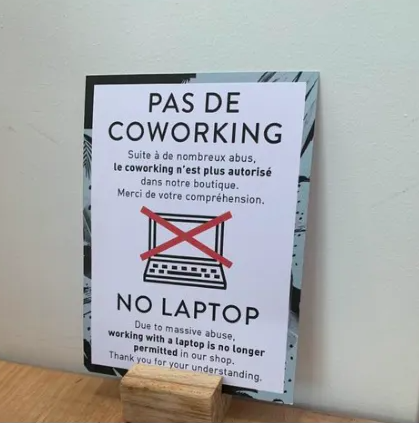
Notably, cafes in Asian countries such as South Korea, Japan, and Singapore have also begun implementing similar restrictions. Common practices include setting clear time limits for stays, restricting Wi-Fi usage duration, or requiring customers to make a new purchase every two hours—thus gently discouraging those who stay for long periods to work or study.
Industry experts point out that if customers have genuine office or study needs, it might be better to consider using co-working spaces or study rooms. These professional venues usually provide environments more suited for extended work and can also avoid disrupting the normal operations of cafes.
Of course, there are also consumers with differing views. Some office workers say that when urgently handling emails or performing simple office tasks, a roadside cafe remains the most convenient option. They believe that an outright, indiscriminate ban on laptop use by owners may seem overly strict and could even affect customers’ overall impression of the cafe.
This debate over the boundaries of public space usage reflects a shift in the operational philosophy of cafe businesses. How to strike a balance between maintaining smooth operations and meeting the diverse needs of customers will be a key challenge for cafe management in the future.
The above content is compiled by CoffeeHunters, a coffee news website.


