







Introduction:The latest May report from the International Coffee Organization reveals global coffee supply and demand dynamics, with production expected to increase by 5.8% year-on-year to 178 million bags, while consumption demand is also growing by 2.2%. This article provides an in-depth analysis of the main factors driving price fluctuations, export performance from major producing regions, and market signals behind inventory changes, helping readers grasp the latest trends and practical insights in the coffee market.
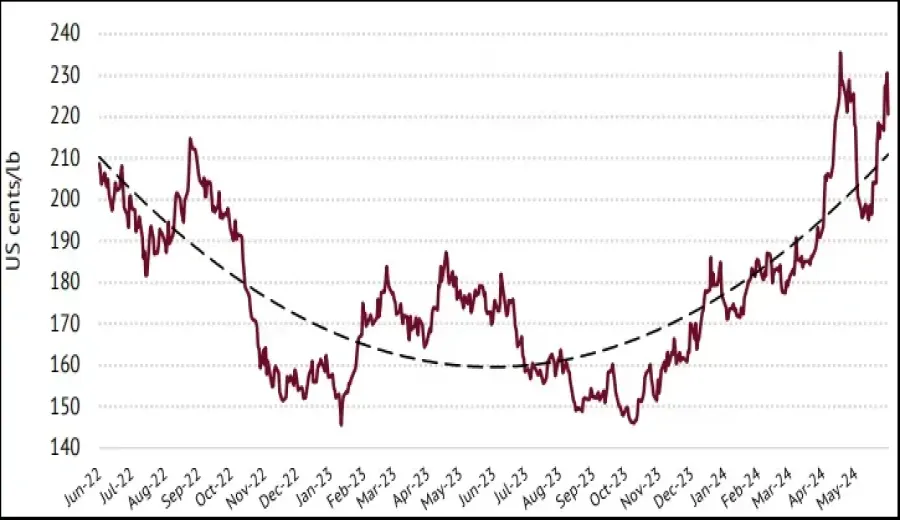
The May market report recently released by the International Coffee Organization (ICO) shows that the average global composite indicator coffee price was 208.38 US cents per pound, a decrease of 3.9% compared to the previous month. This round of price adjustments was influenced by multiple factors, including the improvement of drought conditions in Vietnam, favorable dry weather in Brazil aiding the harvest, but also the uncertainty in Central American supply and the continued depreciation of the Brazilian real, which together influenced market trends.
During May, the composite indicator price fluctuated between 195.13 and 230.61 US cents per pound. Looking back to the end of April, Vietnam, the world’s second-largest coffee producer, experienced widespread drought, causing many coffee farmers to worry about potentially irreversible damage to coffee trees, which temporarily pushed market prices higher.
However, in early May, as rainfall arrived in Vietnam, farmers’ concerns about the drought eased, and with Brazil experiencing mainly dry weather—less precipitation actually benefiting the coffee harvesting process—market prices began to show a downward trend.Nevertheless, by mid-May, prices rose again, primarily due to the still uncertain supply outlook from the two major producing regions of Brazil and Vietnam, coupled with concerns arising from persistent high temperatures and dry weather in Central America. Additionally, the depreciation of the Brazilian real added further pressure.
In terms of inventory, both the US ICE exchange and the European ICEU exchange saw significant increases in coffee stockpiles. The US ICE exchange’s inventory rose sharply by 30.3% to 840,000 bags, while the European ICEU exchange’s inventory also increased by 24.9% to 780,000 bags. This surge in inventory mainly stems from a notable increase in global green coffee bean exports. According to statistics, the total global green bean exports in April reached 10.77 million bags, a 15.3% increase compared to the same period last year.
Looking at the export performance of each major producing region, total coffee exports from South America grew by 44.5% to 5.15 million bags, with Brazil’s performance being particularly outstanding. Its monthly export volume reached 4.24 million bags, a staggering 54.8% increase compared to the same period last year, setting a new historical record for April exports.Coffee exports from Africa also saw significant growth, with the total volume increasing by 39.4% to 1.37 million bags, mainly contributed by Côte d'Ivoire and Ethiopia, whose export volumes increased by 202.5% and 103.6% respectively compared to the same period last year.
In contrast, coffee exports from Asia and Oceania saw a slight decline, with the total volume decreasing marginally by 0.3% to 3.78 million bags, mainly affected by reduced production in Vietnam and Indonesia. Similarly, exports from Mexico and Central America also declined, falling by 12.6% to 1.66 million bags. Among them, exports from Guatemala, Honduras, and Nicaragua dropped sharply by 12.6%, 26.3%, and 22.9% respectively, due to these regions being in their low production season, compounded by adverse weather leading to reduced yields.
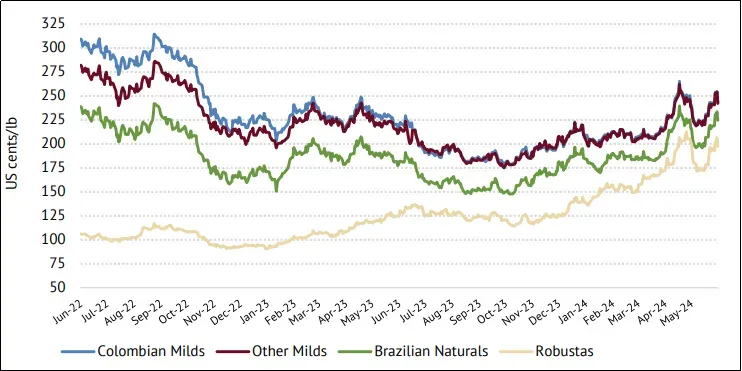
It is worth mentioning that although the overall export volume from the Asia and Pacific region decreased,the export volume of Robusta coffee actually increased against the trend by 13.4%. Due to reduced production in Vietnam and Indonesia, along with the Red Sea crisis putting pressure on Eurasian shipping routes, global market demand for Brazilian Robusta has risen significantly. Data shows that in April 2023, Brazil exported only 120,000 bags of Robusta, but by April this year, exports soared by 448.6% to 680,000 bags.
According to the International Coffee Organization’s forecast, the total global coffee production for the 2023/24 season is expected to increase by 5.8% year-on-year to 178 million bags, with Arabica coffee production projected at 102.2 million bags and Robusta at 75.8 million bags.Looking back at the 2022/23 season, affected by the COVID-19 pandemic, rising living costs and reduced disposable income led to a 2% decline in global coffee demand, which stood at only 173.1 million bags. However, the market has now shown signs of recovery, with global coffee consumption demand expected to resume growth in the 2023/24 season, increasing by 2.2% to 177 million bags.
The above content is compiled by CoffeeHunters, a coffee news website.


