







Introduction:Recently, Manner Coffee has made headlines after three separate incidents of conflicts between staff and customers, sparking widespread public concern about the working conditions of baristas. This article delves into the underlying causes behind these events, examining factors such as brand management, employee treatment, and the impact of semi-automatic coffee machines on service efficiency. We explore the hidden risks of rapid expansion and discuss how to balance quality and staffing under high-pressure operations.
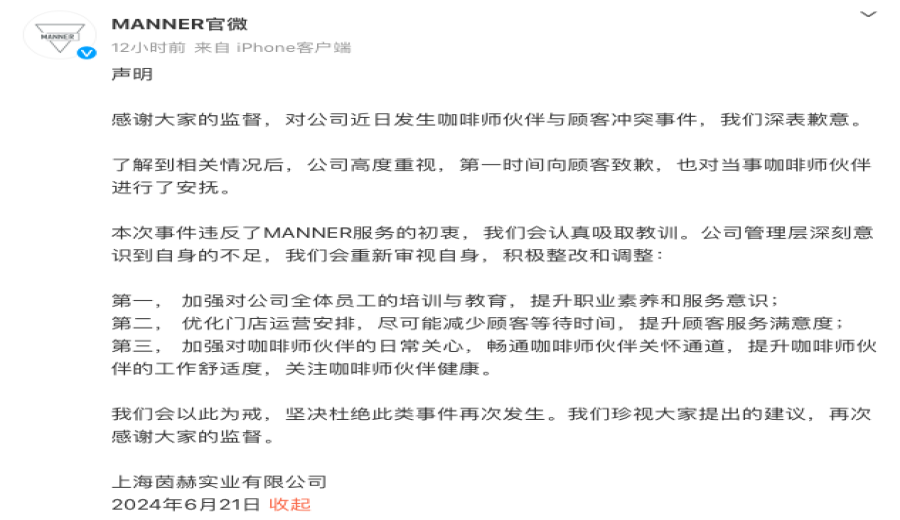
Manner Coffee has become the focus of public discourse following three consecutive incidents of altercations between employees and customers. The brand later issued an apology statement via its official Weibo account, acknowledging that the incidents contradicted its service philosophy and pledging internal improvements. However, the statement failed to provide a clear explanation for the most widely discussed incident—where a customer allegedly entered the service counter and assaulted a staff member—prompting online backlash and accusations that the brand was dodging the core issue.
Although the brand claimed it would re-evaluate its operational methods and improve service quality, netizens remain skeptical. On the Douyin platform, the content from both of Manner’s official accounts has been completely wiped, along with related discussions and messages of support for the staff, further clouding the transparency of the entire situation.
A deeper investigation reveals that these conflicts are not isolated incidents. Reports from multiple media outlets and whistleblowers among former employees have exposed that, amid Manner’s rapid expansion, frontline baristas are subjected to intense work schedules, immense psychological pressure, and an unreasonable pay structure. These accumulated issues eventually boiled over under high-stress conditions.
According to media reports, to secure a 1,000-yuan attendance bonus, many Manner employees opt to work eight-hour shifts on an empty stomach. The overwhelming daily workload is difficult to bear, and over time, it not only affects physical and mental health but also easily leads to workplace emotional issues.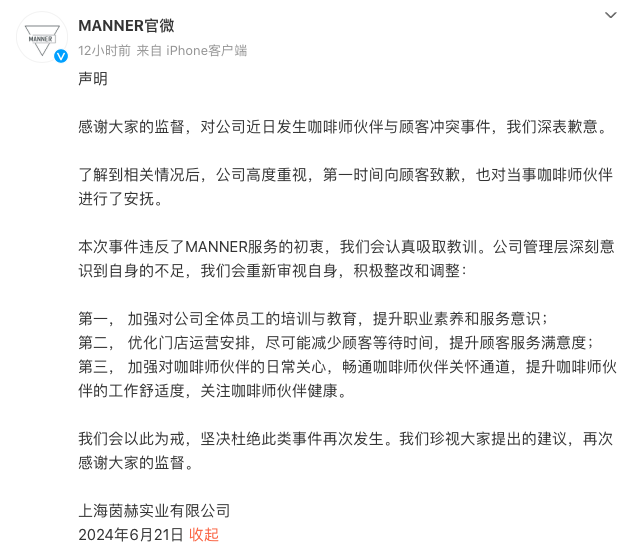
Moreover, the widely advertised “8,000-yuan monthly salary for Manner baristas” seen on job platforms is not easily attainable for newcomers. Several former employees revealed that reaching this pay level requires passing internal promotion assessments, which have an approximate success rate of just 5%. Before promotion, most baristas earn around 5,000 yuan per month, and their working hours and overtime pay are often deducted unfairly, resulting in actual income that is disproportionate to their efforts.
What sets Manner apart from other major chain coffee brands is its insistence on using semi-automatic coffee machines to prepare beverages. Industry insiders note that among global brands with over a thousand stores, Manner is almost the only one still exclusively using semi-automatic machines. While this choice enhances the extraction quality and flavor profile of the coffee, it also places higher demands on the technical skills and proficiency of baristas.
Operating a semi-automatic coffee machine involves a relatively complex process. From grind size and tamp pressure to extraction time and water temperature control, every step influences the final product. Compared to fully automatic machines, semi-automatics produce drinks at a noticeably slower pace. When a store needs to serve 300 to 500 cups a day, baristas end up performing high-precision tasks repeatedly, akin to assembly line workers, which can easily lead to both physical and mental exhaustion.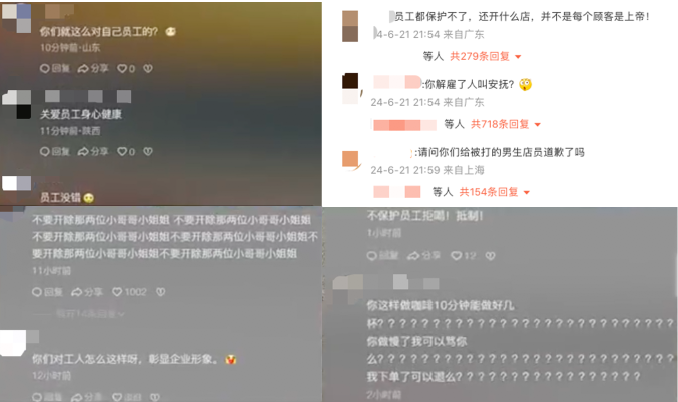
This distinctive equipment choice was once a key highlight that attracted both consumers and investors, as well as a crucial strategy in Manner’s branding as a “specialty coffee” provider. However, as the number of stores continues to grow, staffing shortages have gradually emerged. Although the brand has attempted to alleviate the workload by hiring more part-time staff, these roles are typically limited to taking orders and packaging takeout orders—tasks that do not involve the core beverage preparation. As a result, the actual pressure on baristas remains consistently high.
In today’s coffee market, where efficiency and cost-performance are paramount, Manner strives to simultaneously uphold a “specialty style,” “high cost-performance,” and “low-cost operation.” These multifaceted business objectives ultimately place a heavy burden on frontline employees. When the pressure exceeds their tolerance, it can easily erupt in sudden conflicts.
These incidents serve as a wake-up call not just for Manner, but for the entire coffee industry: striking a balance between rapid expansion and brand positioning—while properly allocating manpower, optimizing workflows, and genuinely respecting and caring for employees—will be critical to the sustainable development of any brand. Only by achieving equilibrium among efficiency, quality, and human-centric values can a brand thrive in an increasingly competitive landscape.
The above content is compiled by CoffeeHunters, a coffee news website.


