







Introduction:The latest report from the United States Department of Agriculture (USDA) indicates that global coffee production is expected to rebound to 176.2 million bags in the 2024/25 season, primarily driven by increased output in Brazil and Indonesia. The supply boost will also push exports up to 123.1 million bags. However, performance varies across regions—while Vietnam maintains production levels, exports are declining due to domestic demand and drought. This article provides an in-depth analysis of the latest trends in major producing regions to help you grasp the dynamics of the global coffee market.
The USDA’s recently released “Coffee: World Markets and Trade” report offers forecasts for the 2024/25 global coffee production and trade outlook. According to the report, with Brazil’s production steadily recovering and Indonesia increasing output, global coffee production is projected to reach 176.2 million bags, an increase of approximately 7.1 million bags compared to the previous year.
As supply rises, global coffee exports are also expected to grow, with the total estimated at 123.1 million bags, an increase of 3.6 million bags year-on-year. Performance across regions varies significantly, with Brazil and Indonesia being the main drivers, while Vietnam faces downward pressure on exports due to rising domestic consumption and weather challenges.
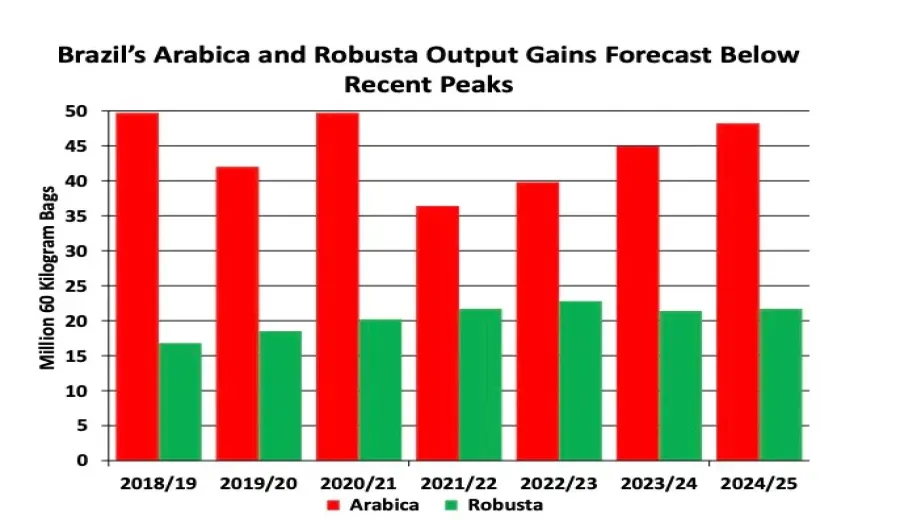
As the world’s largest coffee producer, Brazil’s total coffee output for the 2024/25 season is forecasted to climb to 69.9 million bags, an increase of 3.6 million bags from the previous year. Of this, Arabica production is expected to reach 48.2 million bags, and Robusta 21.7 million bags. Thanks to this production growth, Brazil’s coffee exports are also set to rise to 42.5 million bags.
Although parts of Brazil experienced extreme weather—including high temperatures with little rain or heavy rainfall—in the first half of 2024, the overall impact on production was limited. This is attributed to advanced irrigation techniques adopted in some regions to mitigate drought, as well as years of continuously expanding planted areas, which have provided strong support for stable output.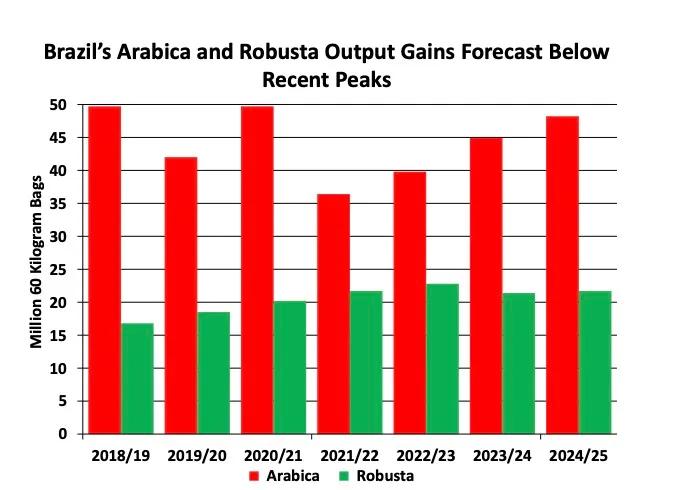
In Colombia, the El Niño phenomenon since 2023 has had a notable impact on coffee-growing regions, extending into the first half of 2024. However, as the influence of this climate pattern gradually weakens, recent months have seen a slight recovery in Colombian coffee production, with the current year’s output estimated at 12.4 million bags.
Notably, the rate of coffee borer beetle infestations is on the rise locally, which may pose a threat to future yields. The 12.4 million bags figure may already be close to the short-term production ceiling. As a result, although Colombian coffee exports have reached 10.8 million bags due to increased supply, returning to the highs of 2011–2013 remains a challenge.
In Central America, overall production performance has been steady. Among the region’s producers, only Mexico saw a slight increase of 30,000 bags to 3.9 million bags, while Nicaragua increased by 300,000 bags to 2.7 million bags. Other major producing countries such as Costa Rica, El Salvador, Guatemala, Honduras, and Panama remained relatively flat. Consequently, the region’s total exports are projected to rise slightly to 13.4 million bags.
Good news comes from Indonesia, where total coffee production is expected to increase by 2.8 million bags to 10.9 million bags. Although some crops in the previous year were affected by heavy rainfall during the growing season—impacting pollination—the southern part of Sumatra and lowland areas of Java were less impacted. With favorable weather, Robusta production has surged by 2.7 million bags to 9.5 million bags, and exports have accordingly risen to 6.5 million bags.
However, the growth in Indonesian Robusta production still falls short of fully compensating for the shortfall left by Vietnam’s reduced output. Vietnam’s coffee production for this year is projected at 29 million bags, unchanged from last year. But due to rising domestic demand and drought conditions, exports will decline by 500,000 bags to 24.4 million bags.
In the first half of this year, multiple major coffee-producing regions in Vietnam continued to suffer from drought, with temperatures generally higher than the annual average. The rainy season arrived late and brought less rainfall than expected. Additionally, Vietnam’s coffee industry faces long-term challenges such as groundwater depletion, reduced forest cover, and competition for land with other crops. To address future risks, the Vietnamese government is actively promoting sustainable coffee production strategies, aiming to gradually improve both environmental conditions and production performance in coffee-growing areas.
The above content is compiled by CoffeeHunters, a coffee news website.


