








Introduction:Luckin Coffee’s lemon series beverages have gained widespread popularity for their refreshing taste, but recently, some consumers reported finding green thread-like foreign objects in their drinks, suspecting them to be lint from cleaning towels. Customer service explained that the objects were fruit pulp fibers, but multiple store employees admitted to having encountered similar situations. This article delves into the incident, explores possible sources of the foreign objects, and provides key points for ensuring beverage quality, helping readers identify the root of the issue.
Luckin Coffee’s lemon series beverages, with their fresh and tangy flavor, have successfully won over a large number of consumers. However, a recent customer complaint has drawn this popular drink into controversy. A customer, while enjoying the beverage, unexpectedly bit into an unchewable green thread-like substance. Initially thinking it was lemon pulp fiber, they continued chewing but found the texture unusually hard. Eventually, when they took it out of their mouth, it turned out to resemble the edging material of a towel.
After discovering the foreign object, the customer immediately contacted Luckin’s customer service to report the issue. The response from customer service was that the green thread-like substance was likely a byproduct formed when fruit pulp fibers dried out, which might slightly affect the drinking experience. However, the customer disagreed with this explanation, pointing out that based on its appearance and texture, the object was clearly different from normal lemon pulp fibers and more similar to some kind of fabric fiber—tough and impossible to easily bite through.

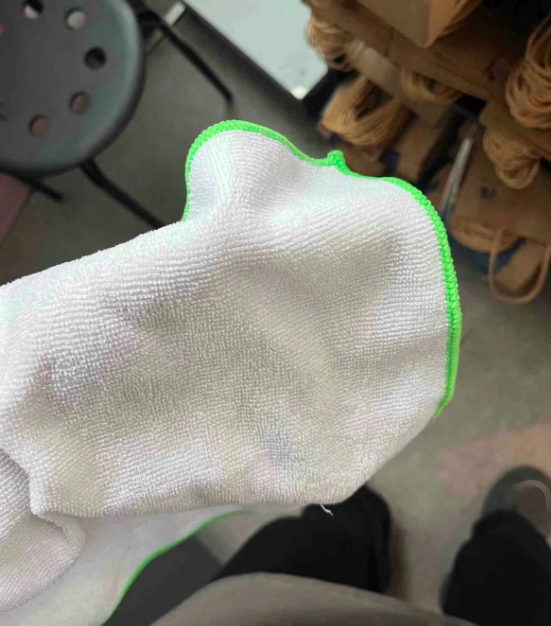
In response to this incident, some Luckin store employees publicly shared photos of the towels used in-store, showing that there were indeed white towels with green edging. According to the employee, the store has clear classifications and regulations for towel usage, with different colors corresponding to different purposes, and strict rules against mixing them up. For example, the green towel shown in the photo is only to be used for non-food-contact items and must never be used to wipe packaging cups or other tools that come into direct contact with beverages, in order to avoid contamination risks.
Luckin has always maintained strict quality control over its beverage preparation processes. The bar area is equipped with surveillance cameras to monitor whether staff operations comply with regulations in real time, so employees must follow standard operating procedures and carefully complete each step when making drinks. However, some employees revealed that the batch of green towels used recently seemed to have quality issues, possibly shedding lint during daily repeated use. If such lint accidentally drifts into a packaging cup, it could lead to foreign object incidents like this one.
However, in the comments section of related discussions, some employees stated that they had also personally experienced similar situations and did not believe it was entirely due to staff operational errors. One employee commented: “I made a drink myself and also tasted this, but I didn’t use a green towel—I just felt like it tasted like a towel!!” Others shared: “I’ve tasted something like this once before, the texture felt like threads,” or “One day when I was making staff drinks, I also found it,” indicating that this issue may not be an isolated incident.
One Luckin store manager even shared her own personal experience. She mentioned that when purchasing a Lemon C Energizing Can at another store, she found a green foreign object and suspected it was due to improper handling by the staff. Later, however, when she was making a Lemon C staff drink at her own store, she encountered the same situation again, which made her realize that being “affected” twice in a row might not be a coincidence. But regarding whether these foreign objects were fabric fibers shed from bar towels or impurities mixed in during the production process of the lemon juice ingredients, the manager admitted she couldn’t give a definitive judgment.
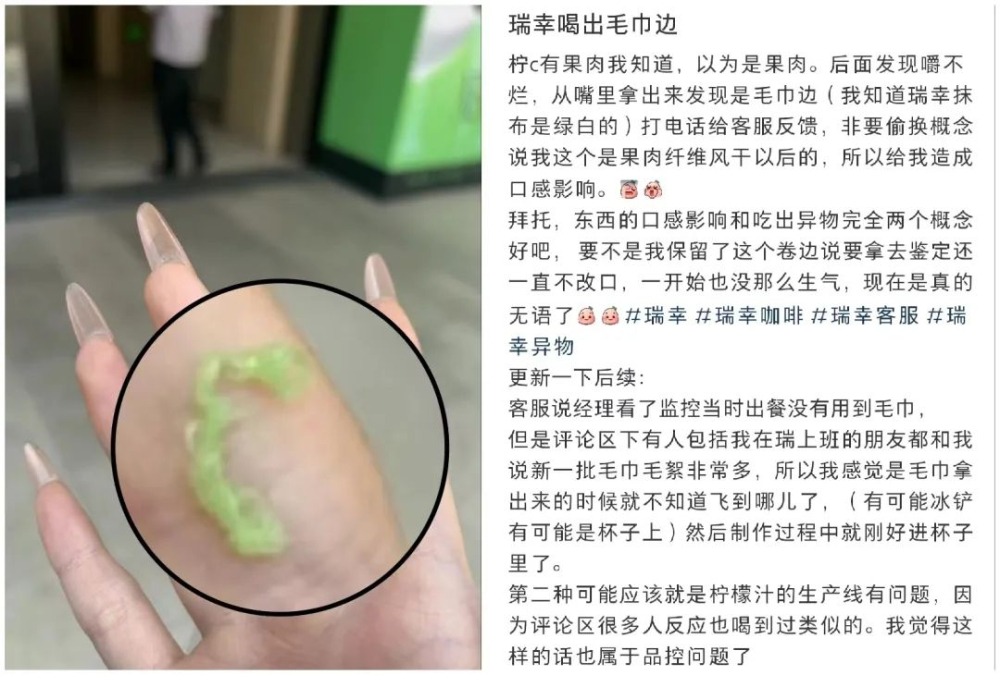
Luckin’s recently launched range of fruit coffee beverages all highlight “real juice” as a key selling point, emphasizing that the drinks contain actual fruit pulp fibers to underscore the product’s authenticity and quality. Based on feedback and images from social media users, the Lemon C series beverages do indeed allow consumers to feel the presence of lemon pulp, adding layers and texture to the drink. However, for those unlucky consumers who encountered the green foreign object, the texture was rough and unchewable, clearly differing from the texture of normal fruit pulp fibers and more resembling fabric fibers—significantly different from what customer service described as “fruit pulp fibers.”
As of now, the customer who posted the incident reported that customer service had contacted the store, and after reviewing the surveillance footage, the store manager did not find any evidence of staff using green towels during the preparation process, thus not accepting the customer’s claim about the “towel edge.” As for the final source of the green foreign object and the outcome of its handling, the customer has not yet received a clear response from customer service, leaving the truth of the incident still to be further clarified.
The above content is compiled by CoffeeHunters, a coffee news website.


