







Introduction:Global chain coffee brands are facing unprecedented challenges. Starbucks' market value plummeted by over a hundred billion yuan overnight, while Luckin’s first-quarter report shifted from profit to loss. As the consumer market becomes more rational, price wars lose effectiveness, and brand collaborations yield diminishing returns—how should chain coffee operators adjust their strategies? This article delves into the latest financial reports to help you understand the direction of industry transformation.
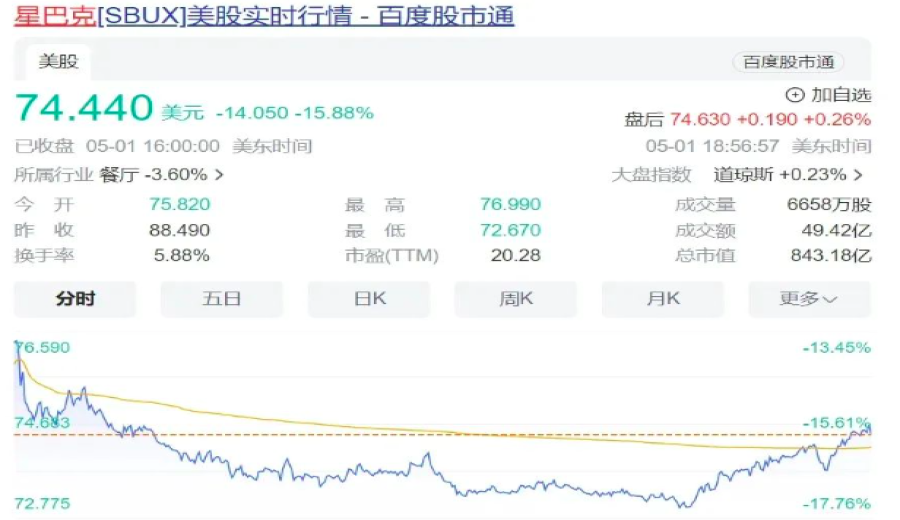
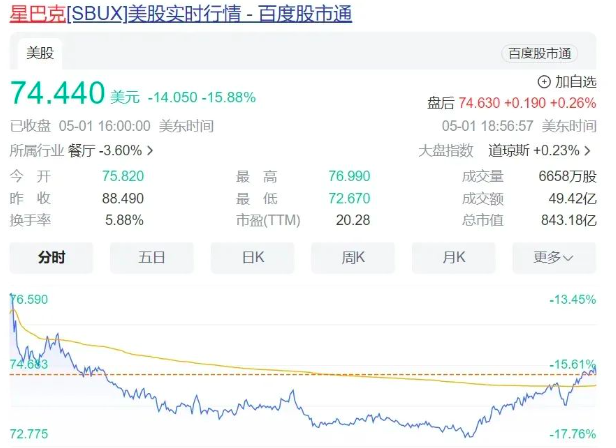
Entering May, the chain coffee market was rocked by shocking news. Starbucks suffered a major setback in the U.S. stock market, with its share price plunging nearly 18% at one point during trading, ultimately closing down 15.88%. Its market value evaporated by as much as $15.915 billion in a single day, equivalent to approximately 1.15 trillion yuan, bringing its total market cap down to $83.318 billion.
This sharp stock fluctuation stemmed from Starbucks’ second fiscal quarter report (January 1 to March 31, 2024), released just before May 1. The data showed that multiple key financial metrics failed to meet Wall Street expectations, particularly notable being a 4% year-on-year decline in same-store sales—the first negative growth since the COVID-19 pandemic in 2020, sharply contrasting with the market’s original expectation of a 1.46% increase.
Starbucks management subsequently lowered its full-year revenue growth forecast to a low single-digit rate during the investor meeting, marking the third adjustment to growth targets this year. Market analysts pointed out that Starbucks is under dual pressure from increasingly conservative consumer spending and fierce competition from rivals.
Similar to Starbucks, Luckin Coffee also released a first-quarter report that drew attention. By the end of this year’s first quarter, Luckin’s total number of stores had rapidly expanded to 18,590, with 2,342 new stores added in the single quarter. Although total revenue reached 6.278 billion yuan, a year-on-year growth rate of 41.5%, it declined 11% quarter-on-quarter, and the quarter recorded a net loss of 71.42 million yuan—sharply contrasting with the profit of 564 million yuan during the same period last year.
A deeper analysis of the market environment reveals a clear global trend of consumption downgrading, with consumers placing greater emphasis on cost-performance. The once red-hot 9.9-yuan price war has exposed the profit structures of chain coffee brands to the public, leading to more cautious and rational purchasing decisions.
As a representative of the premium coffee market, Starbucks has also had to adjust its strategy in response to market changes. Users frequently receive various discount coupons, group-buying promotions continue unabated on e-commerce platforms, and even during the May Day holiday, a limited-time promotional offer of 19.9 yuan per cup was launched. These moves show that even Starbucks, positioned as a premium brand, has substantively joined the price competition arena.
On the other hand, Luckin, as a major driver of the price war, has drawn dissatisfaction from some consumers due to continuously reducing the 9.9-yuan discount and restoring original prices for many products. Despite the continuous increase in store numbers, per-store revenue shows a declining trend, especially with same-store sales at company-operated stores plummeting 20.3% this period.
Notably, whether it’s Starbucks or Luckin, the once-effective strategy of relying on new product launches and IP collaboration marketing is showing diminishing returns. Consumer reactions to brand collaboration events have become lukewarm, with less active participation in each new product release compared to the past. Brands need to rethink how to strike a balance between product innovation and consumer experience.
Although China’s coffee market continues to grow rapidly, shifts in mass consumer attitudes and consumption downgrading under the macroeconomic environment pose substantial challenges to chain coffee brands. Whether Starbucks and Luckin can reverse their downturn through more precise market positioning and operational strategies remains to be seen. Meanwhile, some brands have emerged in the market, offering diverse choices and enriching the coffee market ecosystem.
The above content is compiled by CoffeeHunters, a coffee news website.


