







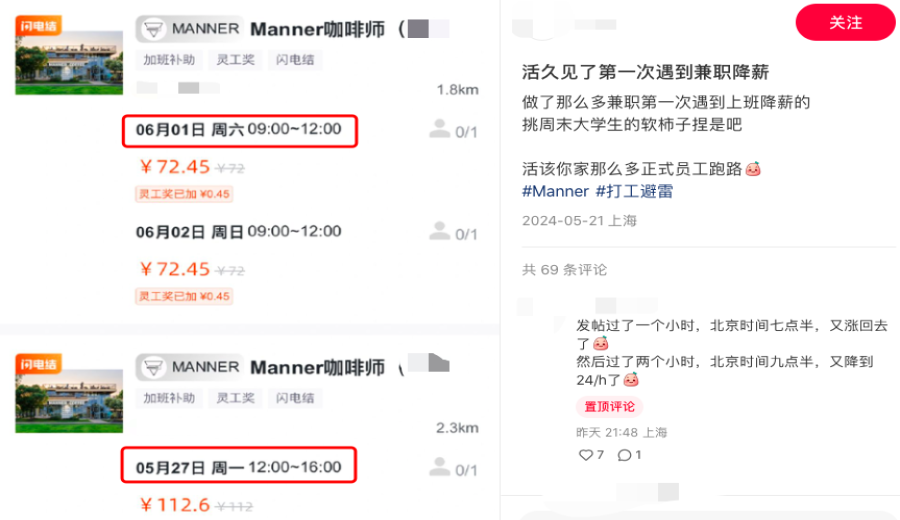
Introduction:Recently, the well-known chain coffee brand Manner was reported to have suddenly reduced the hourly wages of part-time employees, with cuts of up to 6 yuan in some regions, sparking heated discussions among staff and on social media. Hourly wages were cut from 28 yuan to 24 yuan in Shanghai, and from 28 yuan to 22 yuan in Shenzhen. Many part-timers are facing reduced incomes and have also experienced fluctuations where their pay was briefly adjusted upward only to be cut again shortly after. This article details the full story behind this incident and explores its potential impact on the stability of the part-time workforce and store operations.
Recently, the chain coffee brand Manner has made headlines due to adjustments in the hourly wages of part-time employees. Many part-timers were surprised to find that even though their scheduled shifts remained unchanged, their daily earnings had noticeably decreased—some by nearly 40 yuan—when they checked their next month’s schedules. Investigations revealed that this wage adjustment affected multiple regions, with reductions ranging from 1 to 6 yuan per hour. The most significant cuts were seen in Shanghai, where the rate dropped from 28 yuan/hour to 24 yuan, and in Shenzhen, where it fell from 28 yuan to 22 yuan.
According to feedback from several part-time workers, the general range of the hourly wage cuts was between 1 and 6 yuan, with variations across different cities. Some employees mentioned that they had expected higher earnings during the summer sales peak but were instead met with reduced pay, which greatly affected their morale. After the news broke, the brand initially reinstated the original hourly wages, but within less than two hours, most stores saw another round of wage cuts, catching many part-timers off guard.
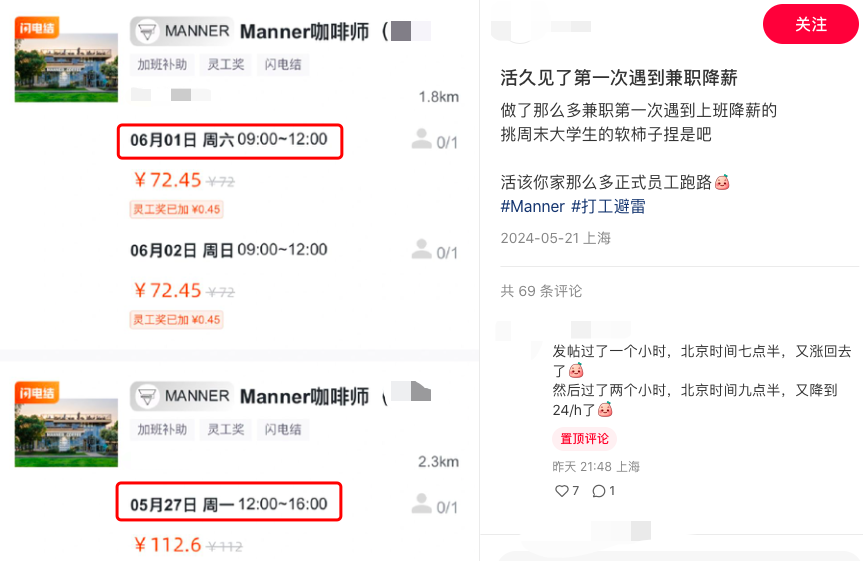
This wage adjustment not only shocked the part-time employees but also triggered intense discussions on social media platforms. Many expressed surprise that the brand would choose to directly reduce salaries without shortening working hours or cutting positions. Some employees described the rapid fluctuation of hourly wages within just a few hours as being like a rollercoaster stock market, likening the experience to going through a nerve-wracking investment journey.
Industry observers note that “pay cuts” have become a sensitive topic in the labor market in recent years. From the financial sector, which was the first to implement large-scale wage adjustments, to the catering and retail industries this year adopting cost-control and efficiency-improvement measures, chain coffee brands such as Starbucks and Luckin have also sought to enhance profitability by optimizing labor costs. Against this backdrop, while Manner’s move is surprising, it also reflects the broader operational pressures faced by the industry.
However, unlike other brands, Manner has historically attracted a large number of students and young part-time workers with relatively competitive hourly wages, making it a top choice for many seeking part-time jobs. This sudden pay cut could not only affect the retention of current employees but may also deter potential job applicants. Especially with the upcoming summer sales peak, some stores are staffed with only one full-time employee, and without sufficient part-time support, customer service quality and store operational efficiency could be directly impacted.
A Manner full-time employee pointed out that as June arrives and various stores enter the summer consumption peak, peak-hour crowds increase. Having an additional part-timer on hand can not only help share the workload but also help maintain service standards. However, with income decreasing, some experienced part-timers may choose to leave, and recruiting and training new staff will also pose challenges.
For many workers, wages are a crucial source of livelihood, and any adjustments directly affect their “financial future,” so their tolerance for wage changes is generally low. Manner’s decision to reduce hourly wages without prior adequate communication has not only caused dissatisfaction among existing employees but has also led many staff members to worry whether full-time workers might face the same fate in the future.

In summary, while Manner’s hourly wage adjustments may help control costs in the short term, their long-term effects on the morale of the part-time team, the stability of store operations, and the brand image remain worthy of ongoing observation. How to balance operational efficiency while taking into account employee welfare and customer experience will be an important challenge the brand must face in the future.
The above content is compiled by CoffeeHunters, a coffee news website.


