







Introduction:The global coffee market has recently undergone dramatic changes. The Vietnamese đồng has continued to depreciate, extreme heat has scorched central coffee-growing regions, and the Red Sea shipping crisis has driven up freight costs. These multiple factors have pushed robusta coffee futures to an all-time high of $4,339 per ton. This article delves into the underlying logic behind Vietnam’s coffee prices rebounding from their lowest point to the $4,000 range, exploring how weather, currency fluctuations, and international developments impact the cost of every cup of coffee—helping readers grasp market trends and future directions.
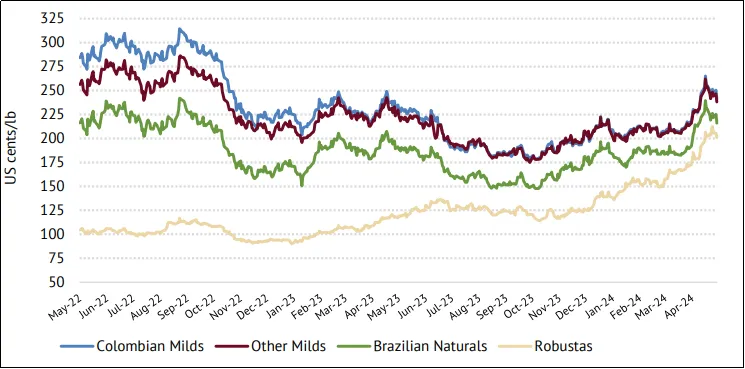
In late April this year, the global coffee futures market experienced intense volatility, with robusta coffee futures prices briefly surging to a historic high of $4,339 per ton, dragging arabica coffee futures upward as well. Entering May, although Brazil and Vietnam subsequently released their April export reports showing increases in both production and exports, and the Intercontinental Exchange (ICE) coffee inventories temporarily eased market anxieties—leading to a cooling of speculative buying sentiment—the upward trend in coffee prices had quietly taken shape.
In fact, coffee is not the only agricultural product affected. Trading prices of tropical crops such as cocoa and sugar have also dropped by nearly 14% during this wave of volatility. The decline in international futures prices quickly trickled down to origin-level purchasing. On May 8, the local purchase price for Vietnamese green coffee beans fell to a low of 90 million Vietnamese đồng per ton (approximately $3,500), but within just a few days, prices in the central highlands quickly rebounded to between 96 million and 100 million đồng per ton (around $3,900 to $4,000). Although it had once dropped by 16% compared to the peak of 120 million đồng per ton (about $4,700) on May 4, as the spot delivery date approaches and global coffee bean output has largely stabilized under the influence of multiple factors, a price rebound has almost become a certainty.
The root cause of this sharp fluctuation in Vietnamese coffee prices lies in the recent heatwaves that have struck Southeast Asia. Vietnam’s central coffee-growing regions have suffered severe droughts and water shortages, leaving coffee trees without adequate irrigation and resulting in reduced yields. The latest report from the Vietnam Meteorological Administration indicates that some provinces in the central region will see rainfall in May, which may help alleviate drought conditions for plants and rivers, though the short-term boost to production remains limited.
Beyond weather factors, Vietnamese coffee also faces competition from other high-profit crops. Fruits like durian and mango have become the “new favorites” among farmers in recent years. According to local Vietnamese media, Vietnam’s durian exports grew significantly in 2023, with exports to China alone reaching more than five times the 2022 volume, exceeding $2 billion in value—prompting many local farmers to switch to cultivating these more lucrative crops. Vietnam’s coffee industry has long lacked investment, with planted areas continuing to shrink, which could affect future yields in the long run. Notably, a similar situation occurred in the global coffee market back in 2012: a surge in coffee prices led many farmers to expand cultivation, but as rust disease subsided and large-scale planting took place, coffee prices plummeted by 70% a few years later.
Vietnamese durian was only approved for entry into the Chinese market in 2022, yet by 2023 it already accounted for 31.8% of China’s durian market share—and continues to grow into 2024.
Meanwhile, the continuous depreciation of the Vietnamese đồng has also become a key factor driving up coffee prices. The USD/VND exchange rate has repeatedly hit new highs in recent days, reaching as much as 24,245. While currency depreciation can lower the relative price of exported goods on the international market and enhance competitiveness, it also raises import costs. As a major agricultural nation, Vietnam is one of the key fertilizer importers in Southeast Asia, which will undoubtedly increase the cultivation costs of coffee and other agricultural products, further intensifying upward pressure on prices.
In addition, turbulence in the shipping market has added further uncertainty to coffee prices. Due to factors such as a short-term backlog of European-bound cargo and the low likelihood of the Red Sea route reopening, shipping companies have implemented another round of fare hikes on European routes. For Vietnamese coffee beans, which are primarily exported to European countries, increased transportation costs may further drive up end-market prices.
Overall, the rebound of Vietnamese coffee prices from their nadir to the $4,000 range is the result of a combination of weather, currency, international dynamics, and market demand. Whether you’re a coffee farmer, trader, or consumer, it’s essential to closely monitor the ongoing developments of these factors in order to respond to potential market shifts.
The above content is compiled by CoffeeHunters, a coffee news website.


