







Introduction:India’s coffee production in the 2024/25 season is expected to remain steady at around 6 million bags, of which approximately 1.4 million bags are Arabica, and over 70% are Robusta. However, insufficient rainfall from March to May and ongoing water shortages have severely impacted fruit-setting rates. Coupled with the strained Red Sea shipping routes and soaring international coffee prices, India’s coffee exports are facing multiple challenges. This article provides an in-depth analysis of regional conditions, price trends, and logistical bottlenecks to help readers grasp the latest developments in the global coffee supply chain.
The U.S. Department of Agriculture’s recent annual report on Indian coffee indicates that the total coffee production for the 2024/25 season (October 2024 to September 2025) is estimated to remain stable at 6 million bags, calculated per 60-kilogram bag. Of this, high-quality Arabica varieties account for about 1.4 million bags, each weighing 69 kilograms, while the remainder is predominantly Robusta, totaling 4.6 million bags, also at 60 kilograms per bag. The overall production shows little change compared to recent years, but the actual environmental and market pressures faced by growing regions should not be underestimated.
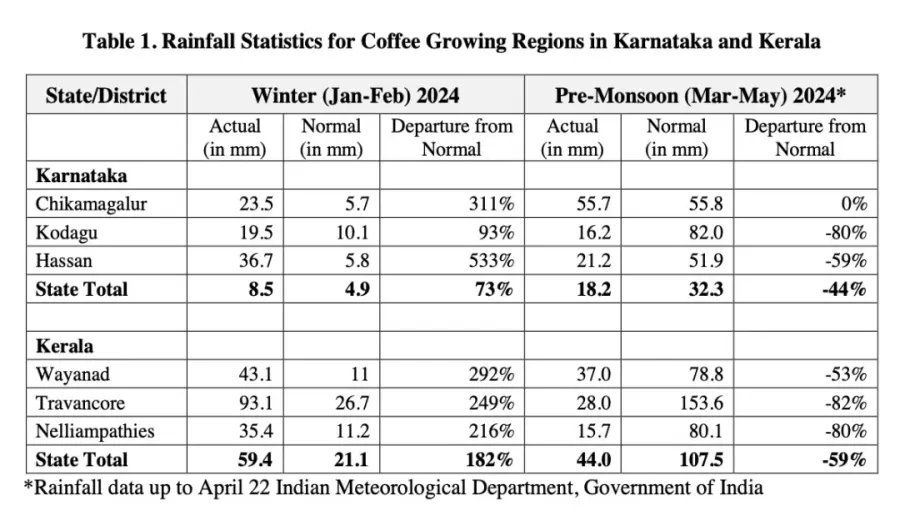
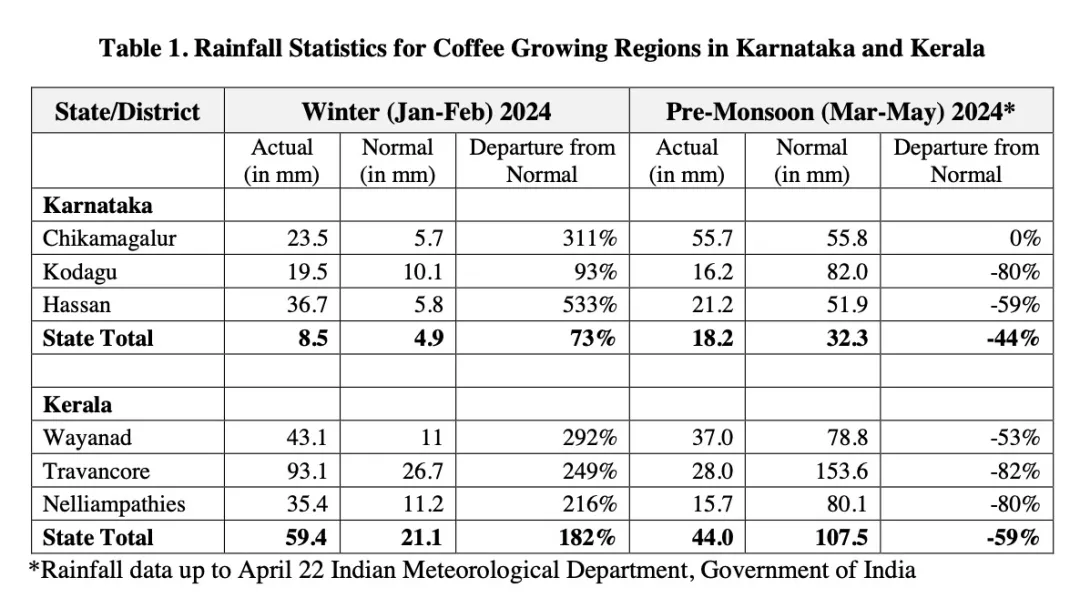
India has experienced abnormal weather this season. While January and February saw heavy rainfall, most coffee-growing regions faced significant rainfall deficits from March to May. Long-term over-extraction of groundwater, along with altered rainfall patterns due to climate change, have pushed India into a severe water crisis—especially in key coffee-growing areas—resulting in a noticeable decline in fruit-setting rates after blooming, directly affecting final yields.
Notably, Robusta, which accounts for over 70% of India’s total coffee output and is the country’s predominant variety, is harvested mainly between December and February each year. Thus, rainfall from March to May plays a critical role in determining its yield. In contrast, Arabica, which has higher environmental requirements, is more susceptible to water shortages. This year, its per-hectare yield is projected to drop by about 3%.
Globally, India is not alone in facing climate challenges. Other major producers such as Brazil, Vietnam, and Indonesia have also seen inventory tightening and downward revisions in yield forecasts due to extreme weather, driving up international coffee prices. In late April, Robusta prices surged rapidly, while Arabica prices also found support—even though they have slightly pulled back recently, the overall level remains well above the five-year average.
Driven by international market trends, domestic coffee prices in India also saw notable increases in April, with Arabica prices rising 13% and Robusta up 15%. Against the backdrop of steadily growing global demand, India’s coffee export volume is expected to remain around 6.3 million bags. However, it is worth noting that domestic demand for instant coffee in India is rising quickly, with consumption in the 2024/25 season projected to grow by 2%, reaching 1.3 million bags.
Although Indian authorities plan to expand coffee cultivation area, with total area expected to increase to about 475,000 hectares in the 2024/25 season, drought and rainfall shortages have led to declining yields per unit area, offsetting some of the benefits of increased acreage. As a result, overall production is unlikely to rise significantly, and production faces bottlenecks.
Beyond climate and yield challenges, Indian coffee exports must also contend with dual pressures from shipping and pricing. Since Europe is the main export market for Indian coffee, the escalating tensions in the Red Sea route have visibly driven up transportation costs. According to traders, due to threats from Yemen’s Houthi militants to expand attacks to the Indian Ocean and Arabian Sea, container freight rates on European routes have sharply increased from the original $2,755/TEU (20-foot standard container), with an expected rise of $600 to $1,000. The overall range may now fall between $2,900 and $5,000/TEU, and prices could climb further during the August peak season.
The rise in freight costs places a heavy burden on exporters. Coupled with the fact that international coffee prices are already at a ten-year high—with Arabica prices up 45% and Robusta up 66% compared to October 2023—not only are these prices higher than India’s internal benchmark prices, but they have also led many international buyers to postpone further purchases. With the dual impact of high prices and uncertainty, export performance in the coming months remains uncertain.
For coffee consumers, understanding the supply situation in major producing regions like India can help gauge market price trends and guide product selection. Professional advice suggests that when choosing everyday blends, one might consider a mix of Robusta and Arabica, balancing flavor complexity while effectively managing budget and cost.
The above content is compiled by CoffeeHunters, a coffee news website.


