







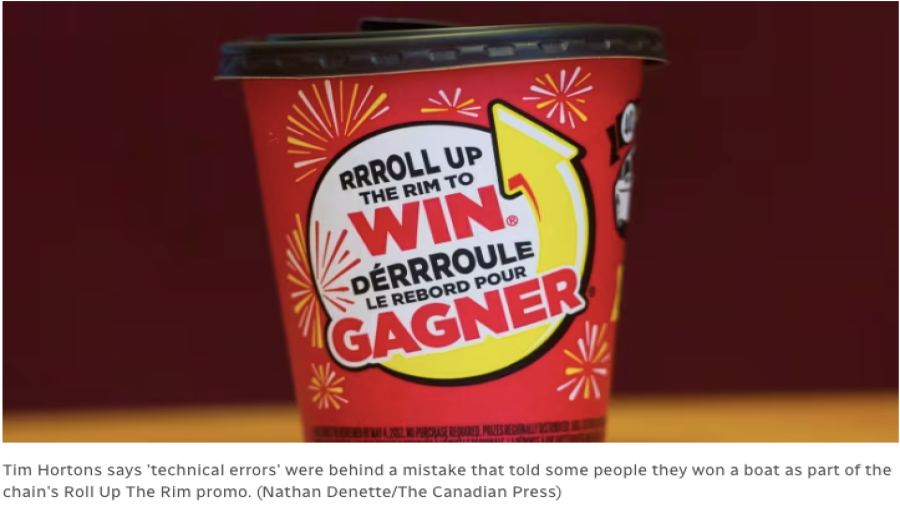
Introduction:When the well-known Canadian coffee chain Tim Hortons launched its “Roll up to Win” promotional lottery, a system error caused nearly 500,000 subscribers to receive notifications claiming they had won major prizes. The company later clarified that it was a technical glitch. This incident not only sparked widespread dissatisfaction among consumers but also led to a class-action lawsuit seeking up to $10,000 CAD per person. This article delves into the sequence of events, the legal issues involved, and the implications for marketing and customer relations in the coffee industry.
Recently, while running its annual “Roll up to Win” promotional lottery, the renowned Canadian coffee brand Tim Hortons experienced a technical malfunction that resulted in approximately 500,000 subscribers mistakenly receiving “winning” notifications. Many customers believed they had won high-value prizes such as luxury yachts and trailers. However, Tim Hortons subsequently sent correction emails stating that these notifications were sent in error and advised recipients not to take them seriously.
Although the error was quickly corrected, it still led to considerable backlash, with some consumers even deciding to pursue legal action. On April 19, the law firm LPC Avocats from Montreal officially filed a class-action lawsuit in the Quebec Superior Court, accusing Tim Hortons of violating the Consumer Protection Act. The suit demands $10,000 CAD in punitive damages for each customer who received the erroneous winning email, with the final amount to be determined by the judge.
In the early stages of the incident, many users gathered in groups on social media platforms such as Facebook to discuss the matter. Over 2,000 people shared their joy at having “won,” particularly when it came to the top prize of the campaign—a yacht worth over $68,000 CAD (approximately more than NT$5 million) along with its trailer. Many users stated that they were thrilled upon receiving the notification and had already begun planning how to use their “prizes,” only to later be informed that it was all due to a system error.
In response to the incident, a spokesperson for Tim Hortons explained that the winning notifications were the result of a “human error.” The intention had been to send participants a summary of their engagement with the campaign, but a technical error led to some users receiving incorrect information. The company emphasized that it had promptly sent out correction emails once the issue was discovered, urged the public not to be misled, and stated that it would defend its position in court, arguing that the lawsuit lacked sufficient legal grounds.
Legal experts have also provided in-depth analysis of the incident. Gilles LeVasseur, a professor of law and business at the University of Ottawa, pointed out that although the contest rules typically include liability disclaimers—which may make it more difficult for plaintiffs to win—the consumers could still claim punitive damages under the Consumer Protection Act. He further explained that, practically speaking, since consumers did not suffer any actual financial loss, even if the case were to succeed, the court might award only around $500 CAD (approximately NT$13,000) per plaintiff in symbolic compensation to facilitate a quick settlement, though the settlement amounts in such cases are usually not high.
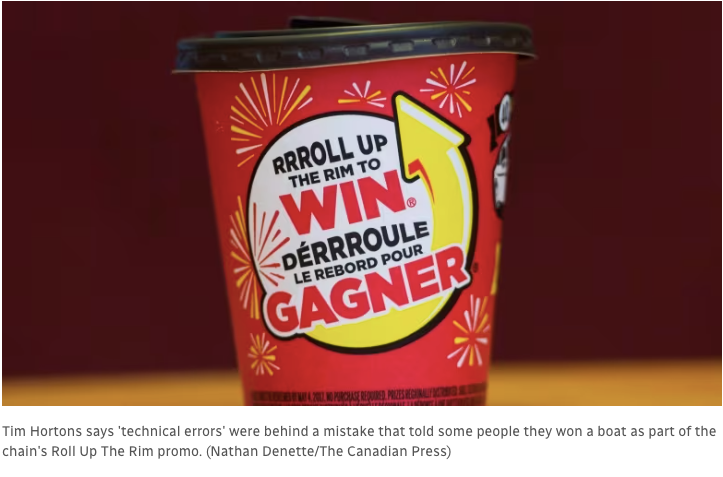
Beyond the legal debate, this incident has also significantly impacted Tim Hortons’ brand image and consumer trust. Experts noted that brands should exercise extra caution when conducting promotional campaigns, especially ensuring multiple reviews and tests before sending out information, in order to avoid large-scale misinformation due to technical or human errors. For coffee businesses, establishing long-term trust with customers through honest and accurate marketing strategies is an important challenge for future operations.
In summary, Tim Hortons’ accidental distribution of winning emails is not just a simple marketing mistake, but also highlights the importance of risk management and customer communication in large-scale digital promotions. For consumers, it also serves as a reminder to stay rational when faced with unexpected “good news” and to wait for official clarifications.
The above content is compiled by CoffeeHunters, a coffee news website.


