







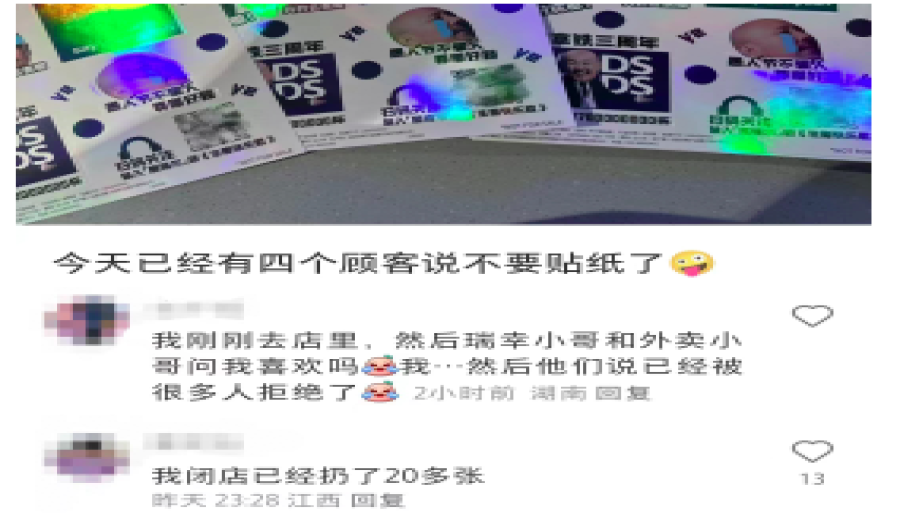
Introduction:Luckin Coffee’s birthday collaboration with singer Tengger for the Coconut Latte has sparked heated discussion, especially as the accompanying real-person meme sticker set received polarized reactions. Some customers rushed to buy due to its fun factor, while others found it hard to use and opted out. This article analyzes the highlights and controversies of this co-branding strategy, and explores how coffee merchandise can balance buzzworthiness with practicality.
Recently, Luckin Coffee launched a collaboration with singer Tengger to celebrate its classic drink, the Coconut Latte. Not only did stores loop the “Coconut Happiness Song,” but they also gave out real-person meme stickers of Tengger, quickly drawing fans’ attention. However, the stickers unexpectedly met with a cold response at some locations—many customers took their coffee but left the stickers behind at the pickup area. It’s reported that some stores accumulated up to 20 unclaimed stickers in a single day.
Once the campaign launched, fans even made repeat purchases of the collaborative set just to collect these unique stickers, showing high enthusiasm. However, many consumers also expressed concerns, bluntly saying things like “too embarrassing” or “don’t know where to put it,” revealing a clear divide in public opinion about this co-branded merchandise.
As a well-known singer, Tengger’s classic works are deeply rooted in the public’s memory. In recent years, he has shown a humorous and approachable side through online covers and film appearances, successfully attracting the attention of younger audiences. Luckin’s choice to collaborate with him was based not only on his professional singing talent but also on his fan base spanning multiple age groups, which can generate considerable buzz.
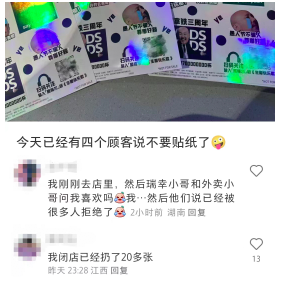
Bolstered by star power, some consumers went out of their way to get these quirky meme stickers—even visiting multiple stores. Netizens noted that stickers sold out quickly at certain outlets, indicating strong market demand. However, this “buying the case but returning the pearl” behavior also highlights how the appeal of merchandise itself can sometimes even surpass that of the drink.
Compared to past collaborations with IPs like “Tom and Jerry” or “Line Friends,” whose sticker designs were typically cute and aesthetically pleasing—suitable for decorating notebooks or phone cases, combining utility with beauty—this time’s Tengger stickers, though funny and entertaining, were seen as too realistic and stylistically bold, making them hard for some consumers to accept.
Some customers who usually collect beautifully designed stickers mentioned that they would previously place orders because of the intricate design and decorative value, but this time they were puzzled, asking “where should I put this?” or “I feel awkward even holding it.” One consumer even said outright: “Too embarrassing, don’t really want it,” and another commented, “So ugly, wherever I put it, it’s just annoying to look at.”
This reaction shows that even if a collaboration campaign successfully grabs attention, merchandise lacking in practicality or aesthetic resonance may still face consumer resistance. Compared to past successful cases, merchandise that combines fun with functional design often enjoys more lasting popularity.
Therefore, this Tengger collaboration demonstrates Luckin’s innovative attempt at cross-industry cooperation, successfully generating buzz. On the other hand, it also reminds brands that when planning merchandise, they need to more carefully consider the preferences and usage scenarios of their target audience to maximize campaign effectiveness and truly achieve brand-effect synergy.
The above content is compiled by CoffeeHunters, a coffee news website.


