








Introduction:The luxury brand Gucci recently collaborated with local coffee brand Grid Coffee to launch a "Single-Origin Salty Mocha," but was accused by an independent coffee shop owner in Beijing of copying her signature salty mocha, which she developed in 2020. The incident has sparked industry discussions on the sources of inspiration for creative coffee beverages, the definition of originality, and the boundaries of market borrowing. This article delves into the full story of the incident, analyzes the differences between the two recipes, explores the challenges of protecting creativity in coffee beverages without patent protection, and offers practical advice to help coffee professionals balance inspiration with originality certification.
In recent years, luxury brands have frequently crossed over into the coffee market. Gucci has recently partnered with Blue Bottle Coffee, %Arabica, and Grid Coffee to create limited-time pop-up coffee shops in Beijing, Shanghai, Chengdu, and Shenzhen. Among them, the "Single-Origin Salty Mocha" and "Single-Origin Salty Chocolat" launched at Gucci’s Beijing location in collaboration with local specialty coffee brand Grid Coffee have attracted considerable attention for their focus on single-origin coffee beans and cocoa ingredients. However, this "salty mocha" has quickly become embroiled in an originality controversy.
An independent coffee shop owner in Beijing claimed on social media that the "salty mocha" in Gucci’s collaborative beverage is highly similar to her signature product, which she began developing in 2020, adjusted with ice cream base in 2022, and officially launched. She stated that she had already introduced this salty mocha based on ice cream milk as early as 2022 under the name "salty mocha" and had even shared the recipe free of charge with other specialty coffee shops. She never expected it to be "borrowed" and repackaged as a classic by an international brand.
After the incident came to light, online public opinion quickly divided into two camps. Supporters of originality argued that, based on the timeline, the shop owner’s product clearly predates Gucci’s, and that the brand should respect the original creator’s efforts and not promote its distinctive beverage as its own classic product. However, some netizens pointed out that Gucci’s version of the "salty mocha" emphasizes single-origin ingredients, while the shop owner’s version highlights ice cream milk as its selling point, and that there may be fundamental differences in the development logic and recipe details, which should be considered different products.
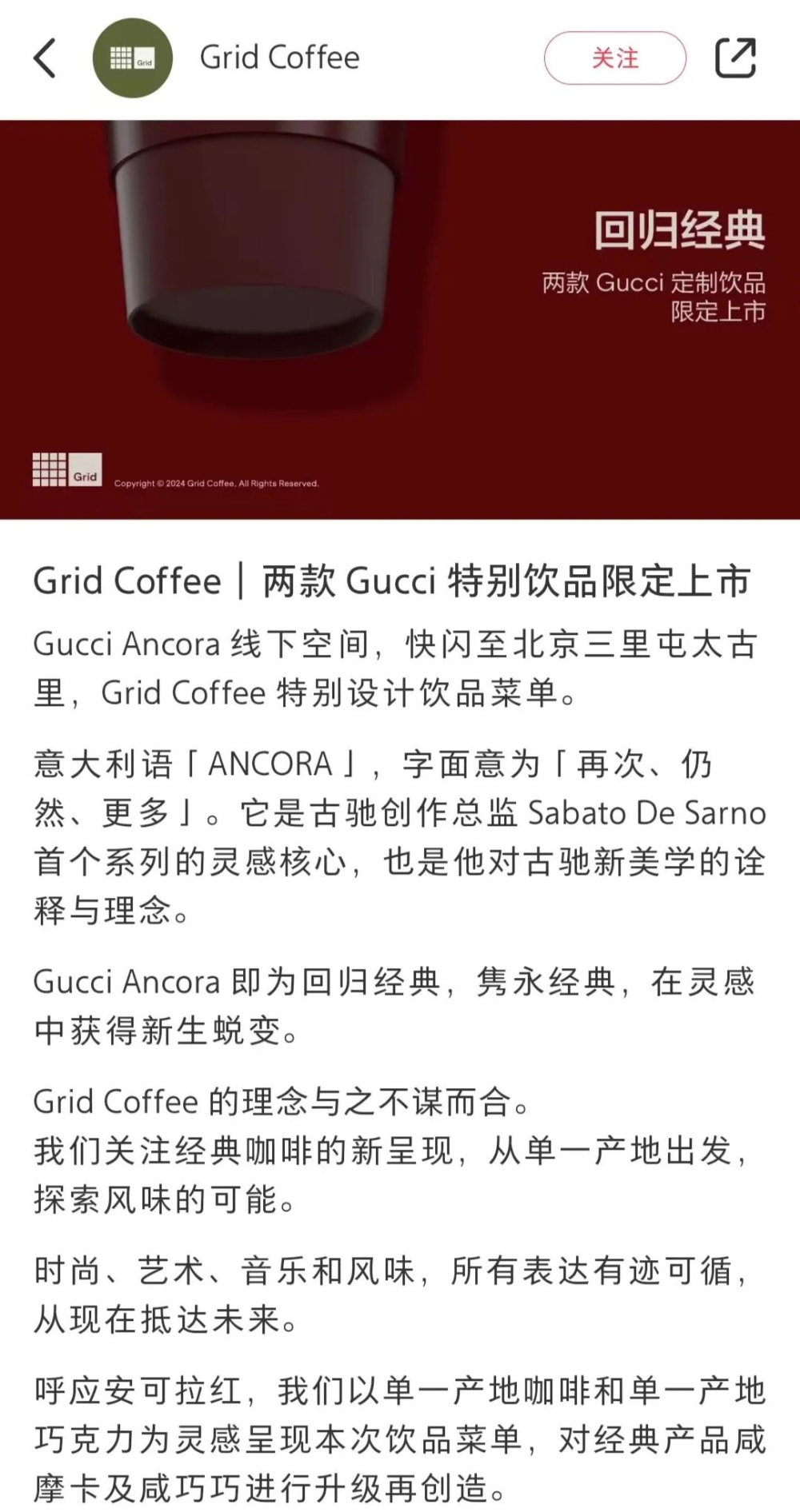
From a legal perspective, since coffee beverages generally cannot be patented, the industry widely believes that this controversy is more appropriately defined as a "creative collision" rather than clear product plagiarism. Many industry insiders pointed out that the inspiration for creative coffee beverages often stems from years of repeated experimentation and adjustments within the industry. Flavor combinations such as sweet and salty have long been circulating among baristas both domestically and internationally, and Starbucks even launched a sea salt mocha in 2017, showing that the concept of a "salty mocha" is not new.
This incident has also drawn public attention to the common phenomenon of "inspiration borrowing" in the marketing of creative coffee beverages. Observers noted that when a certain type of beverage trend emerges, multiple brands or shops often launch similar products, making it difficult for the original creator to prove their "first-to-market" status. In response, many industry professionals suggest that in addition to focusing on the flavor and quality of the product itself, coffee professionals can also strengthen market recognition and the connection to originality of their products through detailed recipe records, proof of launch timing, and brand story packaging.
For consumers, although the debate over "who is the original" may influence brand perception, the ultimate decision still hinges on the actual taste and experience. For creators, this incident serves as a reminder of the ongoing challenge in the coffee industry—how to balance open exchange with self-protection in a culture of shared inspiration.
The above content is compiled by CoffeeHunters, a coffee news website.


