







Introduction:Amid market price competition and rumors of store closures, Wu Xiaomei, founder of the specialty coffee chain Seesaw, has responded publicly for the first time regarding its strategic adjustments. This article delves into the rationale behind its closure of “Three-Nos” stores, highlights its layout strategy in core business districts across East China, and reveals the key strategies through which the brand has achieveda year-on-year same-store sales growth of 22%despite the industry-wide price war.
Over the past month, the specialty coffee chain Seesaw has become the focus of the industry due to consecutive store closures in multiple locations. From Beijing, Shanghai, and Hangzhou, to Chongqing and Wuhan, news of closures has continued to unfold, leading to widespread speculation among consumers and industry insiders about the brand’s operational status.
In response to this wave of store closures, Wu Xiaomei, Seesaw’s founder, recently issued an official statement. She admitted that the brand is undergoing strategic adjustments, closing some “Three-Nos” stores that do not align with its regional focus strategy, brand positioning, or store model. These outlets were either located outside of the brand’s core strategic focus in East China, failed to embody Seesaw’s specialty characteristics, or did not meet long-term profitability expectations.
Notably, despite these store closures, Seesaw’s performance over the past three years has remained impressive.With same-store sales growth reaching 22%,it demonstrates strong operational capability even while consolidating its existing market share. In the current environment where low-price drinks dominate the market and competition is fierce, whether Seesaw can hold its ground by adhering to its specialty route and focusing on core business districts in East China has become a focal point of industry attention.
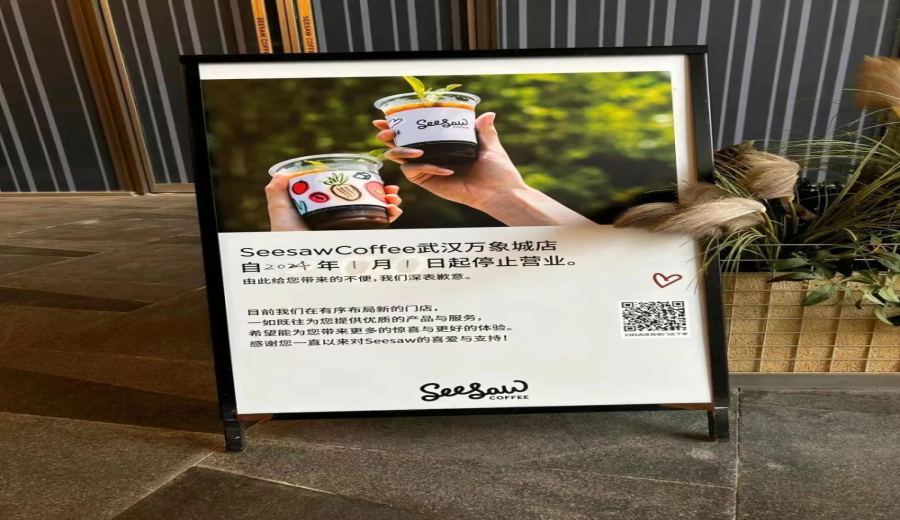
Since mid-December last year, Seesaw Coffee has been caught up in a swirl of “store closure” rumors, drawing high-level attention from both within and beyond the industry. Initially, the closures were concentrated in select stores in Beijing, Shanghai, and Hangzhou, but soon spread to other cities. For example, the Chongqing Vientiane store ceased operations on December 27, and Wuhan stores shut down completely on January 1.
According to information from Dianping, as of now, at least 15 Seesaw stores in major cities such as Shanghai, Beijing, Shenzhen, Hangzhou, Chongqing, and Wuhan have closed. Some reports even suggest that the actual number of closed stores may be higher. Combining data from the brand’s community channels (as of December 29, the official community still had 103 groups) and data from Zhaomen Catering (135 nationwide stores in early December), this adjustment constitutes a large-scale store closure.
Regarding the reasons for the closures, reporters from Jiemian News contacted property management teams at related malls, including Beijing Oriental Plaza, Shanghai World Financial Center, and Hangzhou Binjiang Longfor Paradise Walk. Property staff indicated that the affected stores mostly closed gradually between July and December, often due to lease expirations or simply being “notified to temporarily suspend operations for a few days.”
The successive closures in multiple locations have led consumers to speculate on Seesaw’s future prospects, with concerns that the brand may be in decline. On the evening of January 3, 2024, Wu Xiaomei responded to Jiemian News, elaborating on the background of the brand’s strategic adjustments and its future direction.
She stated that during the three-year plan from 2021 to 2023, Seesaw had achieved its phased strategic goals, completing its national presence in first-tier and new first-tier cities with over 100 stores. Entering the new three-year plan, the brand hopes to make adjustments by focusing on core markets. Therefore, it has closed some “Three-Nos” stores that do not fit the regional focus strategy, brand positioning, or store model, while continuing to implement refined management and improve front-, middle-, and back-end systems to lay a more solid foundation for future expansion.
For the next three-year plan, Wu Xiaomei revealed that Seesaw will focus on first-tier and new first-tier cities in East China, further increasing store density in core business districts to enhance the brand’s market share and influence in the region. In addition, she emphasized that the brand achieved strong performance growth in the previous phase,with same-store sales growing by 22%,demonstrating stable operational strength.
Faced with the industry trend of price wars and market penetration into lower-tier cities, Seesaw has chosen a differentiated path. The founder stated in an interview with Forbes China in 2023: “Our competitors are educating the market in lower-tier cities, but for Seesaw, expanding into those markets is not efficient. Our logic remains to build ‘specialty.’”
Beyond physical stores, Seesaw has also found growth in delivery and retail. For example, it has listed its own coffee beans and freeze-dried coffee powder on Tmall flagship stores, expanding its online sales channels. Wu Xiaomei said Seesaw’s coffee bean business continues to grow, ranking first in both specified purchases and average order value during Singles’ Day, showcasing its competitiveness in the retail market.
Looking back at the past year, low pricing has become the mainstream trend among chain coffee brands, with consumer expectations for the price of a cup of coffee having dropped to a more affordable range. Even Starbucks has introduced various discount coupons. While in-store foot traffic has increased, average order value has noticeably declined. In such a market environment, specialty coffee—due to its relatively higher pricing—faces greater pressure.
Compared to Seesaw, other brands also labeled as “specialty coffee,” such as Manner and M Stand, have accelerated their store expansion. Manner announced justFocusing on the core business districts of East China, through refined management and retail business supplementation, may uncover new growth momentum in the fiercely competitive market.
The above content is compiled by CoffeeHunters, a coffee news website.


