








Introduction:The global coffee production and sales landscape in the 2022/23 season underwent significant changes, with markedly varied harvests across producing regions and the market facing multiple supply-demand challenges. Based on the latest report from the International Coffee Organization (ICO), this article delves into the reasons behind production shifts in major regions, the factors contributing to the decline in consumer markets, as well as potential climate risks for the 2023/24 season, helping readers grasp the latest trends in the global coffee market.
The ICO’s latest monthly report shows that global coffee production in the 2022/23 season rose only slightly by 0.1%, reaching 168.2 million bags. Although the overall figure appears stable, performance varied greatly by region. The Americas saw growth driven by a strong recovery in Brazil, while Asia, Africa, and Oceania experienced generally declining output due to extreme weather, creating a stark contrast.
Breaking it down, total coffee production in Asia and Oceania fell by 4.7% to just 49.84 million bags; Africa fared even worse, with a sharp decline of 7.2%, producing only 17.9 million bags. Major producing countries such as Vietnam, Côte d'Ivoire, and Uganda suffered varying degrees of loss due to abnormal weather. In contrast, South America, bolstered by Brazil’s consecutive two-year production increases of 8.4%, saw an overall regional output rise of 4.8%.
Analyzing by bean type, the total coffee supply in the Americas reached 100.5 million bags, with Arabica production increasing by 1.8% to 94 million bags, while Robusta production decreased by 2% to 74.2 million bags. Looking ahead to the 2023/24 season, global coffee production is expected to rebound, with total output projected to rise to 178 million bags, an increase of 5.8%. Among them, Arabica is expected to reach 102.2 million bags, and Robusta up to 75.8 million bags.
It is worth noting that the aftereffects of the severe frost Brazil experienced in 2021 are gradually fading, providing a positive boost to production in the Americas. However, the alternating occurrence of La Niña and El Niño phenomena from 2022 through 2023 has become the biggest uncertainty factor affecting future output. Take Vietnam, for example, which is about to face the dual challenges of high temperatures and drought, potentially further impacting the stability of Robusta supply.
Turning to the global coffee consumption market, the 2022/23 season saw an unexpected decline, with total consumption dropping by 2% to just 173.1 million bags. Previous expectations were that as the impact of the pandemic gradually faded, consumption would gradually recover and maintain modest growth. However, soaring living costs, shrinking disposable income, along with significant reductions in coffee exchange inventories and EU-region stockpiles, all negatively impacted consumption performance.
Data shows that the combined coffee inventories of the EU and U.S. intercontinental exchanges decreased by 4.8 million bags, falling from the original 14.5 million bags to 9.8 million bags. Additionally, the EU’s recently implemented deforestation-related regulations are also expected to further suppress import and inventory levels. Amid the interplay of multiple factors, the global market in the 2023/24 season is projected to experience a slight oversupply of around 1 million bags.
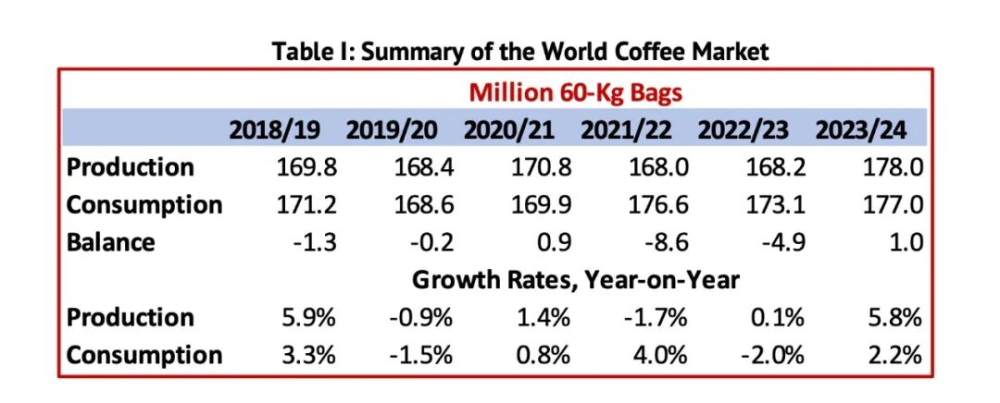
Overall, the 2022/23 global coffee market exhibited the dual characteristics of “widely varying regional performances and abnormally declining consumption.” Over the coming year, weather changes and policy adjustments will continue to influence the supply-demand balance. For coffee importers, roasters, and consumers alike, understanding these key trends will help better navigate market fluctuations.
The above content is compiled by CoffeeHunters, a coffee news website.


