








Introduction:The use of dry ice in coffee creativity is sparking a new trend, from smoking cocktails to frozen grinding. These techniques not only enhance the visual experience but also influence flavor release. This article delves into the science behind combining dry ice with coffee, including the physical mechanisms behind smoke effects, the impact of frozen grinding on particle distribution, and practical tips for using it as an ice substitute in pour over brewing. It helps readers understand the practical value behind these creative practices.
When dry ice meets hot tea, the instant burst of white mist and sizzling sound adds dramatic tension to coffee creations. This fusion of visual and olfactory presentation has become increasingly common in the specialty coffee scene in recent years — from Earl Grey tea fusion specials developed by Hong Kong competition champions to the application of frozen grinding technology. Dry ice is reshaping the coffee experience in diverse forms.
Observing popular smoking coffees on the market, their basic structure often consists of a coffee base mixed with juice, paired with a tea beverage infused with dry ice as the source of smoke. The key operation lies in controlling the amount of dry ice used relative to the tea — typically, 50–100 grams of dry ice is recommended per 500 ml of tea. Excessive amounts can lead to over-cooling, which affects taste. Sommeliers often remind us that if the smoke dissipates midway through drinking, a small amount of dry ice can be added to maintain the visual effect, but care should be taken to avoid direct contact with the liquid to prevent excessive boiling.
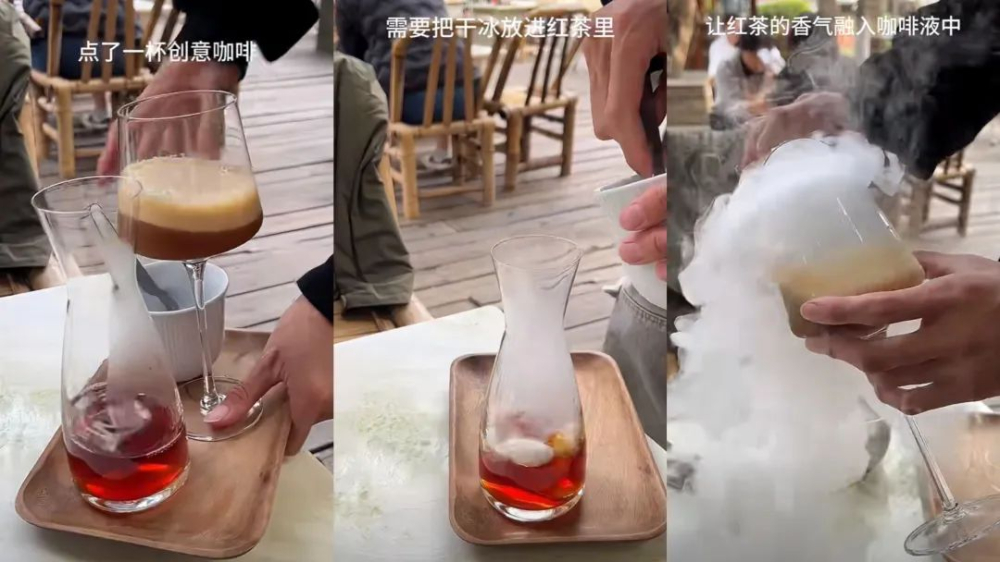
One of the pioneers of this technique is Dwan Chan, two-time consecutive winner of the Hong Kong Barista Championship. His creation, Amber Coffee Brewery, uses the carbon dioxide released by dry ice to concentrate the bergamot aroma unique to Earl Grey tea within the coffee liquid. Scientifically speaking, dry ice (solid carbon dioxide) sublimates directly at -78.5°C when it comes into contact with liquid, producing a mist that is essentially a mixture of water vapor and carbon dioxide. This process accelerates the volatilization of aromatic compounds in the tea leaves.
Beyond its performative aspects, dry ice plays a more critical role in coffee processing. Frozen grinding techniques are divided into two main types: dry ice freezing (-79°C) and liquid nitrogen freezing (-196°C). The former is commonly found in commercial equipment, while the latter is mostly used in competition-level processing. Coffee beans treated at extremely low temperatures have cell wall structures that become fragile due to thermal expansion and contraction, resulting in a 15%–20% increase in the proportion of ultra-fine particles during grinding. This helps release more aromatic compounds, particularly enhancing the expression of acidity and sweetness.
In practical operation, it’s important to preheat the grinder to room temperature when grinding frozen beans to avoid condensation affecting the uniformity of the grind. Industry data shows that coffee grounds produced via liquid nitrogen freezing have about 25% more surface area, allowing hot water to come into contact with more flavor compounds during extraction. However, this also requires shortening the brewing time to within 1 minute and 30 seconds to prevent over-extraction.
An alternative technique developed by pour over enthusiasts involves using dry ice instead of traditional ice cubes for cooling. When hot coffee is poured into a server containing dry ice, the mist formed by carbon dioxide gas not only creates a dramatic effect but also maintains the liquid’s temperature between 8–12°C for 8–10 minutes — the ideal drinking temperature range for iced coffee. Notes: each addition of dry ice should not exceed 30 grams, and low-temperature-resistant glass containers should be used to avoid cracking caused by sudden temperature changes.
Although some of these innovative applications carry performative elements, their core all revolves around flavor science. From the aroma diffusion promoted by dry ice, to the extraction efficiency optimized by frozen grinding, to the protective effect of physical cooling on taste, they demonstrate that modern coffee technology is moving toward precision and multi-sensory experiences. Consumers are advised to first understand the underlying principles before adjusting parameters according to their actual equipment conditions.
The above content is compiled by CoffeeHunters, a coffee news website.


