








Introduction:During the pour over process, the blooming expansion and the noticeable indentation that forms in the center of the coffee bed after brewing are often mistaken as indicators of quality. This type of coffee bed morphology, known as a "deep pit," is actually influenced by multiple factors such as bean variety, roast level, and pouring technique. This article will delve into the mechanisms behind the formation of deep pits, explore their true relationship with coffee flavor expression, and provide practical advice on optimizing coffee bed uniformity.
Many beginners in the world of pour over coffee are often curious about the blooming expansion of coffee grounds during the immersion phase, as well as the deep indentation that appears in the center of the coffee bed after brewing. Some even mistakenly believe these phenomena are key indicators of a delicious cup. However, practical experience tells us that achieving a deep pit is not easy, and its presence doesn’t necessarily correlate directly with the final flavor outcome.
So, how exactly is this fascinating "deep pit" coffee bed formed? Can it serve as a standard for evaluating the quality of coffee brewing? Let’s take a closer look from multiple perspectives.

Beginners often fixate on what they call the "deep pit" phenomenon—they believe that coffee without a noticeable indentation or blooming expansion must be lacking in taste. But once they actually start practicing, most find that these visual effects are not easily achieved.
Next, we’ll explore the causes of deep pits and whether they truly reflect the quality of a cup of coffee.
Basic Characteristics of a Deep Pit
The so-called "deep pit" coffee bed typically exhibits a significant depression in the central area of the coffee layer, while the surrounding coffee walls remain relatively even and thick. This state of the coffee bed is not only something beginners aspire to but also favored by many professional baristas. A veteran coffee professional recalls that during early brewing practice, every time a senior successfully brewed a coffee bed with a deep pit, they would specifically invite him to observe—essentially carrying a certain demonstrative significance.
Precisely because of this visual impact, the deep pit has become a goal pursued by many newcomers. But in reality, forming such a neat deep pit does not necessarily require advanced skills—just mastering a few key elements can make it achievable.

Conditions for Deep Pit Formation
1. Using Dark Roasted Coffee Beans
Dark roasting is one of the most common factors contributing to the formation of a deep pit. Compared to light roasted beans, using dark roasted coffee beans significantly increases the likelihood of achieving a deep pit.
The main principle behind this phenomenon relates to changes in the density of the coffee beans. The darker the roast, the more porous the internal structure of the coffee beans becomes, resulting in lower overall density and increased volume. In other words, two coffee beans with similar physical characteristics before roasting will exhibit completely different trends in volume and density after undergoing different levels of roasting.
Light roasted beans, due to shorter heating times, have a compact structure and higher density; whereas dark roasted beans, due to extended roasting times, develop more internal pores and expand in volume, resulting in a fluffier texture. This structural difference causes dark roasted beans to absorb water and expand more noticeably during brewing, and the ground coffee particles are also lighter in weight.
In contrast, light roasted beans are heavier and tend to accumulate at the bottom of the filter; whereas dark roasted beans tend to suspend in the water and gradually spread outward during the pouring process, rather than continuously sinking and accumulating. This physical behavior ultimately leads to a reduction in coffee grounds in the central area, creating a noticeable indentation—a deep pit—while the surrounding coffee walls remain thick and stable.
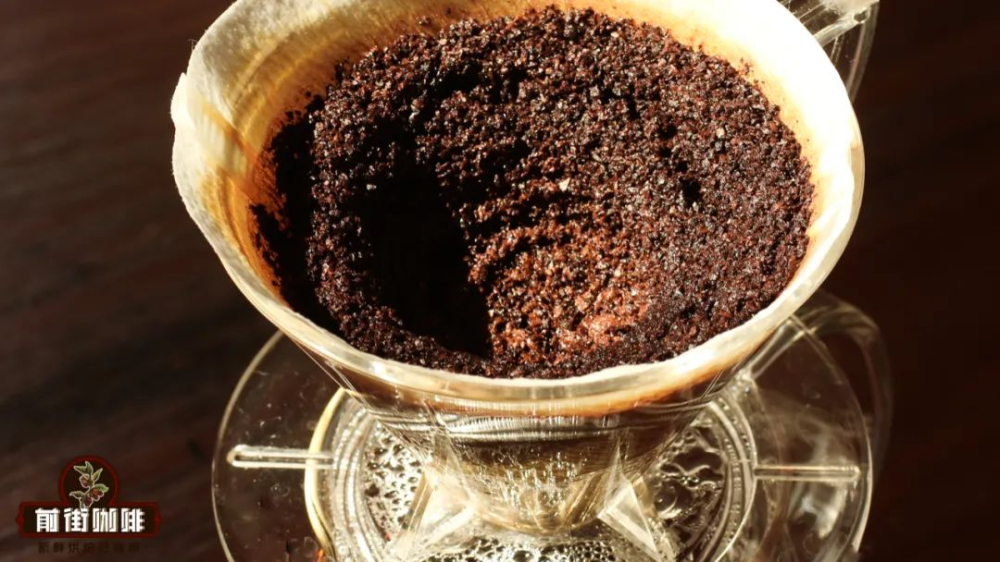
2. Appropriately Increasing Coffee Grounds Quantity
Besides the choice of bean type, the total amount of coffee grounds used is also an important variable affecting the shape of the coffee bed. If the amount of coffee grounds is too small, there naturally won’t be enough “building material” to support the formation of a deep pit, making it difficult to construct the desired indentation.
By reasonably increasing the amount of coffee grounds, you can provide a more substantial material base for the coffee bed, thereby increasing the likelihood of forming a noticeable deep pit.
3. Pouring Technique Focused on the Center
Beyond material conditions such as ingredients and coffee grounds quantity, the technical aspect of pouring technique is equally crucial. If the pouring path is random, the water stream may directly wash against the inner wall of the filter, dislodging coffee grounds attached to the cup wall. These displaced particles may then fill in the center of the coffee bed, ultimately leading to a flattening of the bed rather than the formation of an ideal deep pit.
Therefore, to create a deep pit shape, it’s recommended to focus the pouring on the central area of the filter—where the coffee layer is most densely packed. By maintaining continuous and stable pouring in the center, the upper layer of the central coffee area can be effectively broken apart, thereby forming a noticeable indentation and neat coffee walls.

4. Freshness of the Coffee Beans
The freshness of the coffee beans also affects the formation of a deep pit. Fresher beans contain more abundant carbon dioxide, which reacts more vigorously upon contact with hot water, helping to form a deeper indentation in the coffee bed.
This also means that even beans that haven’t fully completed their degassing period can still exhibit a noticeable deep pit, as long as the roast level is sufficiently dark.
From this, it can be seen that the formation of a deep pit does not entirely equate to superior coffee flavor performance. Its shape and depth more often reflect technical details and material conditions during the brewing process, rather than being directly tied to the final taste of the coffee.
Summary and Practical Advice
The indentation morphology of the coffee bed, whether it forms a deep pit or not, mainly reflects the uniformity of pouring and the level of technical control during the brewing process. Improper pouring, such as water streams directly hitting the filter wall, can lead to undesirable shapes like a "flat pit" or "layer break." In such cases, more attention should be given to adjusting the pouring technique rather than simply pursuing the visual effect of a deep pit.
Understanding the multiple factors behind deep pit formation helps us scientifically adjust parameters and techniques during pour over practice, thereby improving overall brewing consistency and flavor performance.

The above content is compiled by CoffeeHunters, a coffee news website.


