








Introduction:Specialty coffee enthusiasts often spot the 'COE' label on coffee packaging but may not fully understand its significance. This article delves into the COE (Cup of Excellence) competition, analyzing its origins, scoring criteria, and competition process in detail. It highlights the key differences from SCA scoring and clarifies the distinction between auction lots and national winner lots—helping you select high-quality coffee beans with confidence.
If you’re a specialty coffee lover, you’ve likely seen the term ‘COE’ on coffee bean packaging. But do you know what it stands for? Why are COE-labeled beans often more expensive? This article will give you a comprehensive understanding of COE—from its historical background and founding organization to the differences with the SCA cupping score system, and even the competition process of Ethiopia’s COE. We’ll break it all down step by step. We’ll also explain the difference between auction lots and national winner lots, as well as the distinction between commonly available 'same batch' beans and true auction lots—so you can make more informed coffee bean purchases.
The full name of COE is 'Cup of Excellence'.This competition was first held in Brazil in 1999 by the non-profit organization 'Alliance for Coffee Excellence' (ACE) and has since become one of the most authoritative global competitions for specialty green coffee beans. Any country can apply to host a COE competition, and the ‘competitors’ are the coffee beans from across that nation. The standout beans from the competition are auctioned off after the event, bringing prestige and substantial auction revenue to their originating farms.

The economic returns from these auctions not only motivate coffee farmers to continue growing high-quality beans but also allow consumers to enjoy premium-quality coffee. In a way, the COE competition truly embodies the principle that 'hard work pays off.'
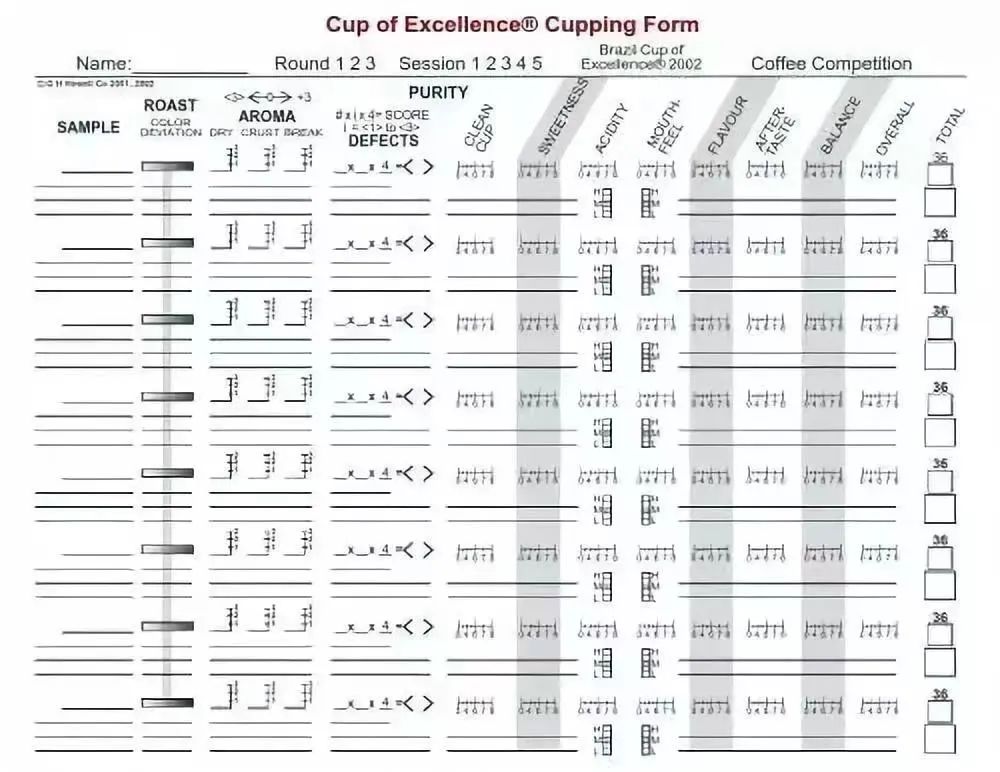
Next, let’s take a look at the COE cupping score system.It differs somewhat from the SCA scoring system and is actually derived from it.For detailed information on SCA scoring categories, you can refer to relevant resources. For COE cupping, four cups of each sample are prepared, and the scoring sheet is as follows:

The scoring frameworks of the two are broadly similar, but the differences mainly lie in some details. In COE’s scoring categories, dry and wet aromas are no longer included in the total score, and the cleanliness criteria are stricter. The body category is replaced with 'mouthfeel,' which evaluates not just the level of body but also smoothness and astringency, aiming for a more comprehensive assessment across multiple dimensions.
Flavor evaluation refers to the updated flavor wheel, enabling judges to provide more precise and specific descriptions (e.g., additional blank fields for custom entries). Additionally, COE has eliminated the 'uniformity' scoring category.
The COE competition format varies slightly by country. Here, we’ll use the 2020 Ethiopia COE as an example. The entire competition is divided into three stages: the pre-selection phase, the national jury phase, and the international jury phase.
Pre-selection Phase: The judges in this stage are all domestic professional evaluators from the host country, typically numbering between 12 and 18. They rigorously examine the competing coffee samples, including factors such as roast level and cupping procedures. Only beans that score85 points or abovequalify to advance to the next round.
National Jury Phase: This stage is also handled by domestic professional judges from the host country. Their main task is to conduct a second round of screening for the beans that passed the pre-selection phase. Beans that make it through this round proceed to the final international jury phase.
International Jury Phase: The judging panel in this stage consists of international cuppers. All competing coffee samples are assigned a random code, and the correspondence between the code and the actual bean is known only to the moderators. The judging panel conducts blind tastings based on these codes.
Ultimately, beans that score87 points or aboveare designated asCOE auction lots. The remaining beans, while not meeting the auction criteria, mostly score above 85 points as well. These beans fall under the category ofNational Winners.
Whether COE auction lots or national winner lots, they must ultimately be acquired through the auction process—this is the part that coffee farmers value the most. Therefore, when purchasing coffee beans, you might occasionally see the COE label on packaging; these could be the 'competitors' that won awards in the competition. However, it’s important to note that some beans may only be 'same batch' COE beans, not true auction lots.
The above content is compiled by CoffeeHunters, a coffee news website.


