







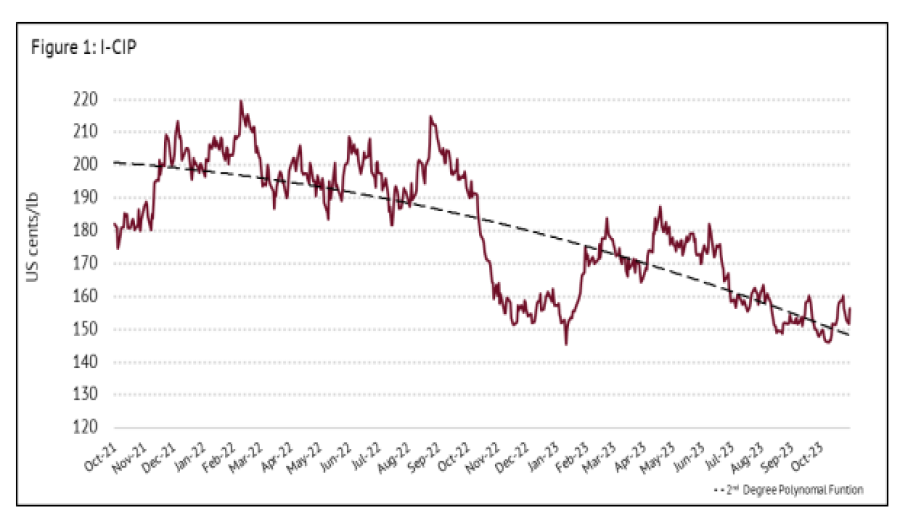
Introduction:The latest October report from the International Coffee Organization (ICO) shows that global composite coffee prices have slightly declined, but the prices of most Arabica varieties have risen, while Robusta has moved in the opposite direction. Notably, global green coffee bean exports have seen a significant year-on-year decline, particularly in Asia and Oceania, where the drop exceeded 30%. This article takes you deep into the dynamics of the October green coffee market, the export performance of various producing regions, and the reasons behind the changes in global coffee production and sales for the 2022/23 season.
According to the ICO’s monthly market report published in October 2023, the global composite coffee indicator price averaged 151.94 US cents per pound, a slight decrease of 0.8% from September. Although the overall price trend has eased somewhat, performance among sub-categories varied: Robusta spot prices dropped markedly by 4.1% to 118.83 US cents per pound, while the prices of most Arabica varieties showed an upward trend, with Brazilian Natural coffee experiencing the most significant increase—rising 0.9% in a single month to 155.52 US cents per pound.
Beyond fluctuations in spot prices, there have also been significant changes in inventory levels across major global coffee futures exchanges. As of the reporting period, coffee inventories at the ICE exchange in the United States decreased to 440,000 bags, a year-on-year decline of 10.7%; inventories at the ICEU exchange in Europe also fell sharply to 670,000 bags, down 7.9%, reflecting mounting supply-side pressures in the market.
Looking further at green coffee bean export performance, the total global export volume in September 2023 was only 7.8 million bags, a full 11.6% less than the 8.83 million bags exported in the same period of 2022. Among them, aside from Colombian Washed coffee, which saw a counter-trend increase of 6.7%, other major categories—including Washed coffee, Brazilian Natural, and Robusta—all experienced declines, with export volumes falling by 13.1%, 13.4%, and 13.8% respectively.
By region, the export performance of major global coffee-producing areas was also less than ideal. South America as a whole exported 4.74 million bags, a year-on-year decrease of 3.4%; Africa saw a 1.9% decline in exports; Central America and Mexico combined saw a reduction of 9.2%; and Asia and Oceania saw an even steeper contraction of 35.7%, making it the worst-performing region globally.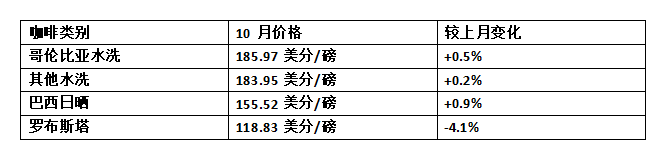
Looking back at the entire 2022/23 coffee year, the total global green coffee bean exports dropped from 117 million bags in the 2021/22 season to 110 million bags, a decrease of 5.5%. Among sub-categories, the total exports of Arabica coffee saw a significant contraction, falling from 74.63 million bags in the previous year to 67.05 million bags, a year-on-year decline of 10.1%; in contrast, Robusta coffee demonstrated resilience, with exports rising from 42.66 million bags to 43.76 million bags, an increase of 2.6%.
The industry generally believes this trend is related to global economic uncertainty. Faced with price volatility and declining purchasing power, consumer markets are more inclined to choose the relatively cheaper Robusta coffee as a substitute for Arabica. In addition, the reduced global production of Arabica is also one of the key factors driving this consumption shift.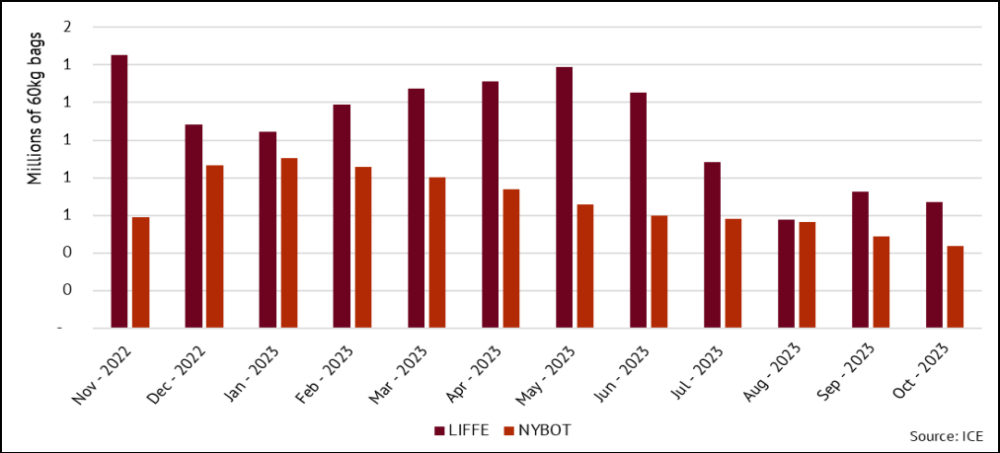
The ICO also revised its data on global coffee production and consumption for the 2021/22 season and provided the latest forecasts for the 2022/23 season. It is estimated that global coffee production in 2022/23 will increase by 1.7% compared to the previous year, reaching 171.3 million bags. Although 2022/23 is a low-production year in Brazil’s coffee cycle, increased output in other producing regions such as Africa helped boost global supply. In comparison, the 2021/22 season saw high fertilizer prices and adverse weather conditions offsetting the production advantages of Brazil—the main producing country—during its high-cycle year, ultimately leading to a decline in global output.
In summary, the global coffee market in October 2023 exhibited the dual characteristics of price divergence and export decline. Arabica variety prices generally rose, but export volumes continued to shrink; Robusta, though slightly lower in price, became the market’s preferred safe haven due to its price advantage and stable supply. Whether the global coffee market can stabilize in the future still depends on further changes in climate conditions, economic environments, and consumption trends in major producing regions.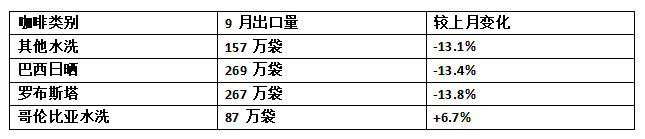
The above content is compiled by CoffeeHunters, a coffee news website.


