







Introduction:The rules for the 2024 World Barista Championship (WBC) have recently been officially announced. Although the overall changes are relatively limited, clearer guidelines have been introduced regarding judge conflict of interest disclosures, milk selection standards, and the texture evaluation of espresso. This article breaks down these key adjustments in detail to help readers grasp the new direction of the competition. Whether you’re a competing barista or a passionate spectator, you’ll quickly understand the critical changes in the competition’s judging logic.
The Specialty Coffee Association (SCA) has recently released the latest rules and regulations for the 2024 World Barista Championship (WBC). While the overall modifications are relatively mild, several important adjustments have been made, focusing primarily on the management of judge conflicts of interest, milk usage guidelines, and the sensory scoring details of espresso. For competing baristas, judges, and coffee enthusiasts around the world, these tweaks could directly impact performance and scoring outcomes.
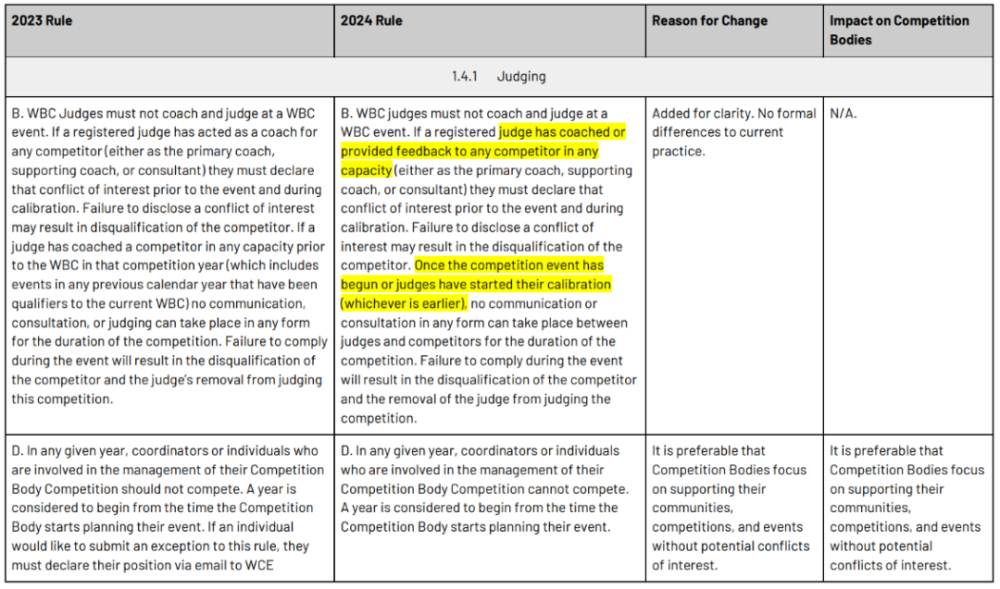
Regarding judges and conflicts of interest, the 2024 rules further clarify that WBC judges may not also serve as competition coaches. If a registered judge has provided guidance or feedback to a competitor in any form — including as head coach, assistant coach, or advisor — they must proactively declare this conflict of interest during the pre-competition and calibration phases. Failure to disclose may result in the disqualification of the competitor. It is important to note that once the competition officially begins or judges enter the calibration process, no form of communication between judges and any competing barista is permitted. Violation of this rule during the event may not only lead to the competitor’s disqualification but also the revocation of the judge’s accreditation.
This revision also introduces stricter regulations on the coffee beans used in the competition: no additives of any kind may be present in the coffee used during the competition. This includes, but is not limited to, flavorings, colorants, spices, aromatic substances, liquid additives, or powders, ensuring fairness and allowing the intrinsic flavors of the coffee to shine through.
In terms of milk selection, the 2024 WBC rules provide clearer guidance to help competitors make more informed choices when selecting milk:
First, the competition allows the use of all legally available, unflavored milk on the market, whether animal-based (such as fresh milk, cream) or plant-based (such as soy milk, oat milk, almond milk, etc.). Second, competitors may mix different brands of commercially available milk or use powdered milk prepared according to package instructions, as long as all materials used contain no additional additives. Additionally, if a competitor wishes to remove certain components from commercially available milk (e.g., through techniques like freeze distillation), as long as no extra ingredients or additives are introduced during the process, it is compliant with the rules.
As for the scoring criteria of espresso, the 2024 WBC has made a key adjustment in sensory evaluation: the tactile experience after the coffee leaves the mouth — such as astringency or smoothness — will be separated from the previous “aftertaste” scoring category and evaluated independently under the “texture” scoring item. This change enables judges to more accurately capture the body and finer details of the coffee in the mouth, while also requiring competitors to take a more holistic approach when adjusting grind, extraction, and milk foam texture to consider the overall mouthfeel.
Overall, although the adjustments to the 2024 WBC rules are not drastic, they bring more rigorous detail management to the operation of the competition, competitor preparation, and judging execution. Understanding these changes can help competitors adjust their strategies in advance and allow spectators to gain deeper insight into the professional scoring logic behind the event. Whether you’re a professional barista, competition enthusiast, or industry stakeholder, mastering these new rules will bring you closer to the pulse of the international WBC stage.
The above content is compiled by CoffeeHunters, a coffee news website.


