







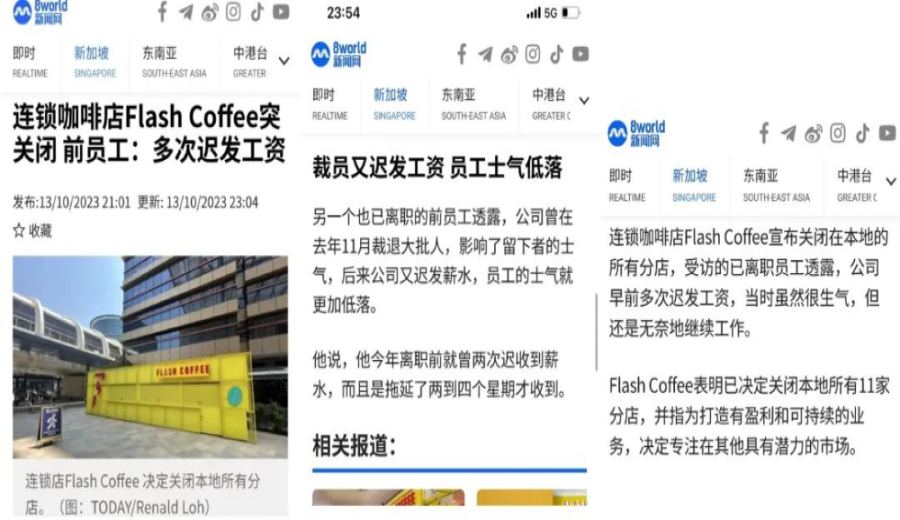
Introduction:Flash Coffee, a homegrown Singaporean coffee brand that had previously secured US$50 million in funding, recently announced the closure of its 11 local outlets and entered provisional liquidation, drawing significant market attention. Aside from issues such as unpaid wages and unfulfilled employee benefits, the brand’s high-cost expansion strategy also became unsustainable amid tightened cash flow. This article details the full sequence of events, the brand’s operational model, and its potential impact on both the local and regional markets.
In recent years, competition in the global coffee market has intensified, with many chain brands facing operational pressures and even widespread store closures. Amid this trend, Flash Coffee, a Singaporean brand once favored by international capital, was not spared. The brand recently announced the sudden closure of all 11 of its Singapore outlets, along with reports of delayed staff salaries, unpaid Central Provident Fund contributions, and unused leave not being honored, sparking labor disputes.
Founded in Singapore, Flash Coffee positioned itself as a digitally operated, fast-service coffee brand focused on takeout and convenient consumption, at one point seen as the “Southeast Asian counterpart” to Luckin Coffee. Earlier this year, the brand announced the completion of a US$50 million Series B funding round led by White Star Capital, with follow-on investments from Delivery Hero and Geschwister Oetker. The funds were originally intended to enhance profitability and accelerate expansion across the Asia-Pacific region.
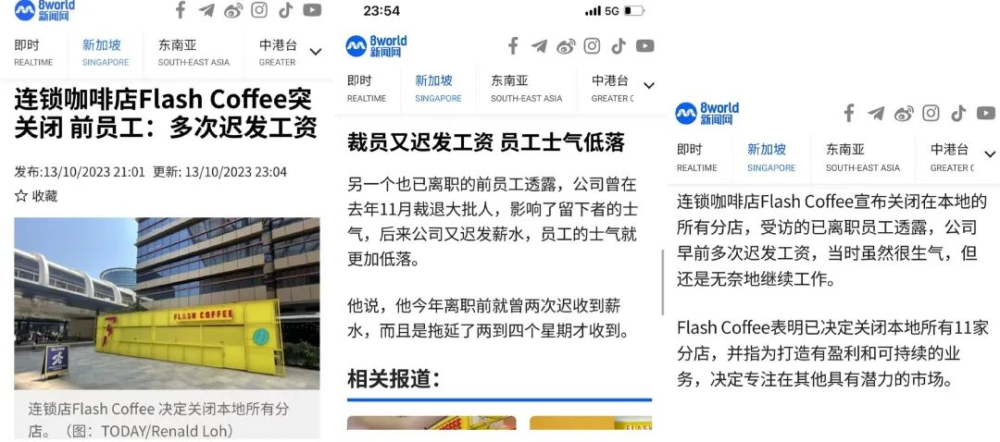
However, in less than half a year, the situation took a sharp turn for the worse. Singapore-based employees posted strike notices on social platforms, citing repeated salary delays and announcing the indefinite closure of all outlets island-wide, while calling for better working conditions for baristas. In an official response, the brand stated that the closure of its Singapore outlets was to “focus on other promising markets,” but this still raised questions about its financial health.
The Singapore National Trades Union Congress subsequently confirmed that Flash Coffee employees had widely experienced issues with unpaid wages, CPF contributions, and leave entitlements.Provisional liquidation processThe service was terminated with immediate effect, and it was revealed that the brand would be withdrawing from the Singapore market, though it pledged to retain its Hong Kong operations.
Notably, although Flash Coffee once positioned itself as the “Luckin Coffee of Southeast Asia,” in actual operation it did not establish a solid localized supply chain or differentiated product strategy like Luckin. The brand primarily relied on delivery platform subsidies and frequent promotions to attract customers, yet failed to build significant advantages in product development, customer loyalty, or cost control.
Furthermore, according to data from the Accounting and Corporate Regulatory Authority (ACRA) of Singapore, Flash Coffee’s current status has been listed as“creditors’ voluntary liquidation”, indicating that its cash flow has become severely strained, forcing it to undergo asset liquidation through legal procedures.
Although the brand had previously claimed that its 92 outlets in Indonesia were all profitable, the abrupt withdrawal from the Singapore market still raised questions about the overall soundness of its financial structure and regional expansion strategy. Especially in a context of tightening financing environments and more conservative consumer spending, an operational model overly reliant on money-burning expansion is difficult to sustain in the long run.
In summary, the complete shutdown of Flash Coffee’s operations in Singapore not only reflects the operational challenges faced by a single brand, but also highlights that in the highly competitive coffee market, even with capital backing, a brand that fails to establish a robust financial model and differentiated competitiveness may still face sudden market elimination.
The above content is compiled by CoffeeHunters, a coffee news website.


